
It is the fourth tasting panel for the same product. Eleven samples sit in identical glasses down the middle of the table, numbered in marker on masking tape. Six people are in the room. The founder, the brand lead, someone from operations, someone from finance who was invited late, and two people from the development side. Everyone tastes. Everyone nods. Somebody says sample seven is "closer." Somebody else says sample four has "more of that thing we talked about." A third person says they liked round two better, which is awkward, because round two no longer exists.
Nobody in that room can say which sample is rightEvery great beverage starts with a Gold Standard product. Most brands skip this step, and skipping it has a price that shows up later, in money, in calendar time, and in a finished drink that nobody quite loves. Here is the thesis in one sentence: a Gold Standard is the written, agreed definition of the product you are trying to make, set before formulation begins, that every later decision gets measured against.
. Not because the palates are bad. Because nobody ever wrote down what right means.
We are going to give the whole thing away in this article. By the end you will have a template you can open a blank document and write this week, whether or not you ever speak to us. That is deliberate. The concept is more useful to the industry shared than hoarded, and it sits at the center of , so we would rather explain it properly than gesture at it.
the way we design, develop, and deliver beverages
One thing to be clear about before we start. Without a Gold Standard you do not get a slow project. You get an expensive one. Those are different problems, and the second one is worse.
The failure mode has a name, and it is not "bad formulation." It is undefined target. Let us take that apart.

Why Most Beverage Projects Stall Before They Start
Almost every stalled beverage project we have ever seen shares one origin story: the team started formulating before agreeing what the product was supposed to be. Not what it was supposed to be called, or how it was supposed to be positioned. What it was supposed to be. What it tastes like, what it costs, what it does, and how anyone would know when it had arrived.
That sounds like an obvious thing to skip past. It rarely feels like a mistake in the moment. Formulating feels like progress. Writing a definition feels like a meeting. So the team goes to the bench, samples start arriving, and the project acquires momentum in a direction nobody has actually specified. The stall does not announce itself at the start. It shows up around round four, and by then it looks like a flavor problem rather than what it is, which is a definition problem wearing a flavor problem's clothes.
There are four ways this typically plays out. Most projects that go wrong go wrong in at least two of them at once.
- Taste by committee. With no written target, the tiebreaker becomes whoever is most senior, most certain, or most persistent. Sometimes that person is right. Often the group avoids the conflict entirely and everyone compromises toward the middle, sanding off the interesting edges one round at a time. Beverages designed by consensus tend to taste like consensus.
- The endless tasting panel. A panel cannot approve a sample without a standard to approve it against, and no standard was ever set. So the panel does the only thing available to it: it reacts. Rounds four, five, and six are not refinement. They are drift with a meeting invite attached.
- The reformulation loop. Every additional round has a real cost: ingredient spend, bench hours, pilot time, lab work, and weeks on the calendar. Budget burns steadily while the product does not improve. It just changes. Change and improvement look identical when there is nothing to measure against, which is precisely why the loop is so hard to notice from inside it. If you want the honest version of what those extra rounds do to a schedule, we wrote about how long beverage development actually takes, and the rework loop is the single biggest variable in that answer. On the money side, the early-budget realities in our founder's roadmap for starting a beverage company cover what that spend looks like before revenue exists to absorb it.
- Scope creep by stealth. The brief was a sparkling citrus refresher. Around round five somebody suggests an adaptogen, because a competitor launched one and the idea is genuinely interesting. Nobody formally decides to add it. It simply appears in the next sample set. Now the pH has moved, the label claim has changed, the regulatory pathway is different, and the cost per unit has climbed. No single person made that decision. The project made it by default.
Every one of these failures traces back to a single missing document. That document is the Gold Standard.
Here is the through line worth noticing. In every scenario above, the team has plenty of information. They have samples, opinions, market data, competitor benchmarks, and often a very clear brand vision. What they do not have is a shared, written, agreed answer to a small set of specific questions. All that information cannot resolve into a decision because there is no reference point to resolve it against.
We want to be careful about tone here, because this is common and it is not shameful. The teams this happens to are not careless. Some of the sharpest brand people and most technically gifted developers we have worked alongside have lived exactly this loop. It happens to global brands with full innovation departments and it happens to founders working nights. The problem is not talent and it is not effort. The problem is process, specifically the absence of one document at the front of the process.
That last one deserves a second look, because stealth scope creep is the failure that most often gets misdiagnosed. Teams experiencing it usually believe they have a formulation challenge. What they have is a product that is now three products in a trench coat, none of which anyone has committed to.
What a Gold Standard Product Actually Is
The Gold Standard is the benchmark product definition established at the very start of development. It is the agreed target that every subsequent formulation, manufacturing, and commercial decision is measured against.
That is the whole definition. It is deliberately unglamorous.
In our own framework, the Gold Standard is the sensory benchmark every future iteration is measured against, and it is the defining output of the Design stage. It is the north star for the project: a clear articulation of the sensory experience, the commercial position, the functional promise, and the operational reality that the finished product has to satisfy. When a project loses its way in month three, and when there is honest disagreement about whether the newest sample is an improvement or just a change, the Gold Standard is what settles it.
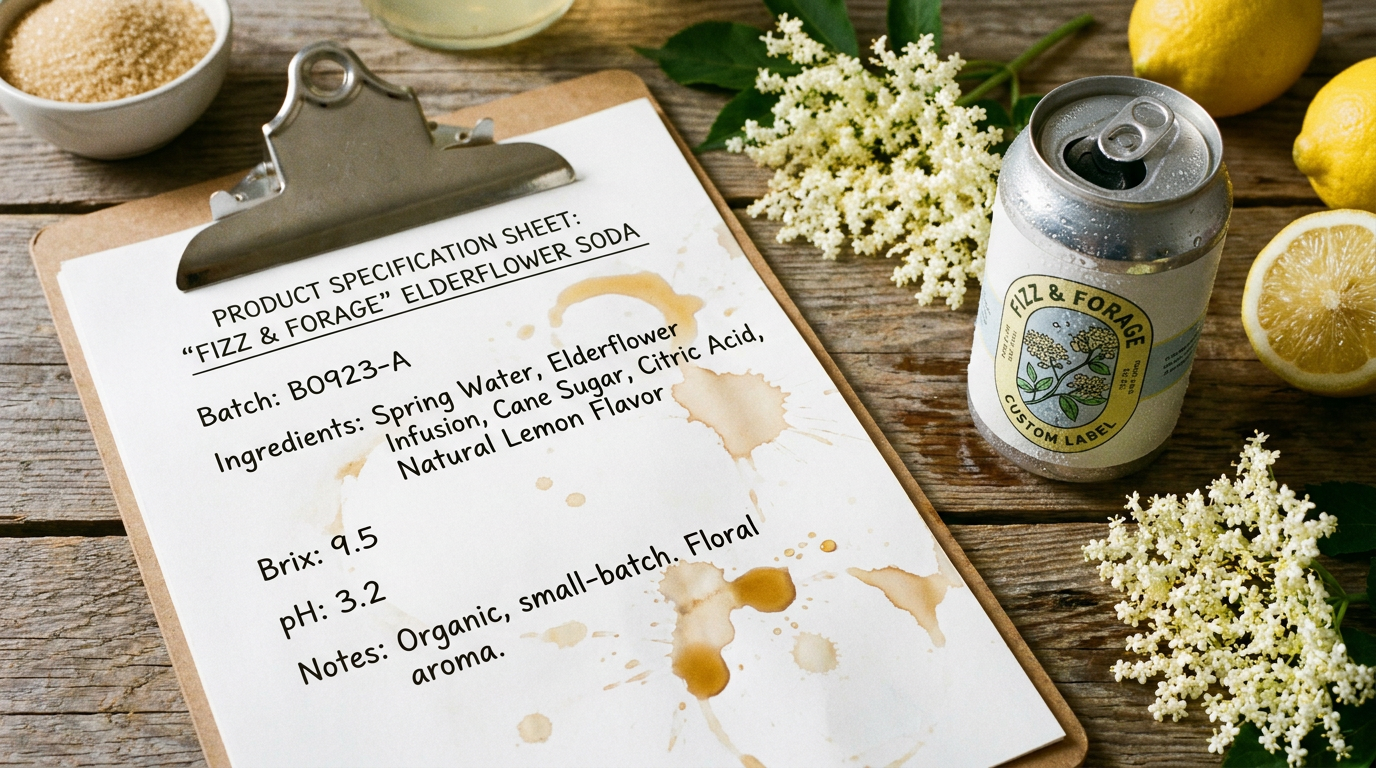
It is a written artifact, not a feeling.A complete Gold Standard answers six questions:
This is the part teams resist, and it is the part that matters most. If the standard lives only in a conversation, a founder's palate memory, or a shared understanding that everybody nods along to, it does not exist. Shared understanding is not a real thing until it is written down, because six people can nod at the same sentence while picturing six different drinks. A Gold Standard has to be a document that someone can physically point at during a disagreement. That is not bureaucracy. That is the entire function.
- What exactly are we making?
- What must it taste like?
- What must it cost?
- What must it deliver functionally?
- Where will it be sold?
- How will we know when we have hit it?
The distinction has a practical test attached to it. Hand your document to a food scientist who has never met you. If they can tell you whether a given sample passes or fails, it is a Gold Standard. If they can only tell you whether the sample seems nice, it is a mood board.
It is equally useful to be precise about what a Gold Standard is not. It is not a recipe. It is not a formulation. It is not a mood board, a brand positioning deck, a consumer insight summary, or a wish list of everything the product could eventually become. A recipe tells you what to do. A Gold Standard tells you what you are aiming at and how you will know you arrived. Those are different documents doing different jobs, and confusing them is why so many teams believe they already have a Gold Standard when what they actually have is a beautiful deck about a feeling.
That sixth question is the one most often left out, and it is the one that turns the document from a description into a tool. A target without an acceptance test is an aspiration.
A Gold Standard also applies at any scale and in any format. It works the same way for a canned RTD heading to national retail, a dairy-based beverage with protein stability challenges, a non-alcoholic spirit, a cannabis-infused drink with a hard compliance ceiling, or a single signature cocktail going onto a bar menu in forty locations. Any base, any format. The had to hold a defined flavor profile across an oat milk base, live carbonation, and a real shelf life, which is exactly the kind of project where a vague target quietly becomes an unmanufacturable one. The Design stage is where we set that target with the client before any of the technical work begins, and it is formally part of how The definition is simple. The contents are specific. Here is what actually goes in one.
our beverage development servicesRTD cold brew shandy we formulated
are structured.
The Anatomy of a Gold Standard: Five Components
A Gold Standard is not a paragraph of intent. It is five defined blocks, and a document missing any one of them will fail in a predictable way.
1. The Sensory Target
This is the flavor profile, aroma, mouthfeel, body, color, carbonation level, sweetness intensity, acidity, finish, and serving temperature. Written in language precise enough that two people who have never met could taste the same sample and agree on whether it complies.
Words like "refreshing," "premium," "crisp," and "clean" are not sensory targets. They are adjectives that make everyone in the room feel aligned while meaning something different to each of them. A sensory target reads more like this, purely as an illustration of the required format: bright citrus forward with a short finish, low residual sweetness, medium carbonation at roughly 2.6 volumes, moderate acidity, no perceptible bitterness on the back palate, served at 38F. Numbers where numbers exist. Specific descriptors where they do not.
This is a real analytical discipline, not an invented formality. Descriptive analysis with trained panels is standard practice in professional product development, and the Institute of Food Technologists' overview of is a good primer on how structured sensory work differs from casual tasting. The peer-reviewed literature on makes the same point from the academic side. Trained panels exist precisely because untrained opinion does not replicate.
sensory evaluation in new product developmentthe state of sensory science
2. The Functional Target
The critical discipline here is that dose gets defined at the target, not discovered later. Dose drives two things simultaneously: cost and claim. A botanical at a token level is a cost you carry and a claim you cannot make. The same botanical at an efficacious level may triple the ingredient cost and change the flavor profile enough to break the sensory target you wrote in component one. Deciding this early is what keeps those two components honest with each other.
What the product does, and what is in it to do that. Actives and dose per serving, caffeine content, protein grams, electrolyte profile, botanical or adaptogenic inclusions, vitamin levels, calorie ceiling, and sugar ceiling.
What can go in, and at what level, is also constrained by the . Any sugar or calorie ceiling should be written with the in view, because rounding rules and serving size definitions shape what a number on the front of the pack is allowed to say.
Nutrition Facts label requirementsFDA's Generally Recognized as Safe framework
3. The Commercial Target
Reconciling these two upfront is uncomfortable, because it sometimes means admitting the drink you want cannot be sold at the price you want. Far better to have that conversation in week one, on paper, than in month five, in a panic.
The rule here is blunt: if the sensory target and the commercial target were never reconciled, one of them is going to lose. It is almost always the sensory one, and it almost always loses late, under deadline, when the only available moves are subtractive. A product that reaches its cost target by having its best ingredient swapped out in month five is a product that has been quietly redesigned by a spreadsheet.
Landed cost per unit, target retail price, required gross margin, pack format and count, and channel pricing expectations. Written as numbers, before formulation.
4. The Technical Constraints
pH, water activity, shelf life requirement in days or months, process compatibility (hot fill, cold fill, tunnel pasteurization, retort, HPP), pack format and material, and the regulatory pathway for the category.

pH is the clearest worked example of why these belong in the target rather than in a later test. Under the FDA's , products in that category must have a finished equilibrium pH of 4.6 or below. That single number determines process requirements, filing obligations, and what a co-packer can legally run. A formulation that lands just above the threshold is not slightly off target. It is in a different regulatory world.
acidified foods regulation, 21 CFR Part 114
Shelf life deserves the same treatment. Teams routinely write shelf life as something to be measured after the formula is finished, which gets the causality backwards. Shelf life is a design input. A twelve-month ambient requirement rules out ingredients, processes, and pack formats that a ninety-day refrigerated requirement permits easily. Deciding it after the fact means discovering it as a failure rather than designing to it as a constraint. If the product is alcoholic, the regulatory pathway also runs through , which shape the pack before the liquid is final.
TTB labeling laws and regulations
5. The "What This Is Not" Boundary
Having five components written down is not the point in itself. The point is what it changes about how decisions get made.
Boundaries can be revised, of course. The point is that revising a written exclusion is a decision somebody has to make on purpose, which is exactly the property scope creep depends on avoiding.
This reads like a strange thing to spend time on. It is the single most effective anti-scope-creep mechanism available, because it converts a vague "that doesn't feel like us" into a documented basis to say no. When someone proposes the adaptogen in round five, the boundary is what lets the team decline without it becoming a personality conflict. The document says no. Nobody in the room has to.
Write down, explicitly, what the product will not be. Not a meal replacement. Not a zero-sugar product. Not carrying a functional energy claim. Not sold into club channel. Not launching in a glass format. Not containing dairy.
The most skipped component, and the most valuable one.
Why It Works: Turning Opinion Into Evidence
A Gold Standard is only paperwork if you never use it. Used properly, it changes the physics of how a development project makes decisions, and it does so in five specific ways.
It converts subjective opinion into objective specification. "I don't love it" becomes "sample three reads sweeter than target and the finish is running longer than spec." One of those statements can be acted on at the bench tomorrow morning. The other is a mood with a seat at the table. This is not about dismissing instinct, which is genuinely valuable and often the reason a product is worth making at all. It is about giving instinct somewhere to land. A skilled palate that says "too sweet" is providing real information. The spec is what turns that information into a formulation instruction.
It makes decisions evidence-based rather than political. This one is quietly the most valuable thing a Gold Standard does inside a large organization. Without a written target, the tiebreaker in any disagreement defaults to seniority, volume, or proximity to the budget. With one, the spec is the tiebreaker. That changes the character of the meeting completely. People stop advocating for their preference and start assessing against a shared target, which is a much easier room to be in and a much faster one to get out of.
It gives the manufacturer something to hit. No co-packer can deliver "premium and refreshing." They can absolutely deliver a defined Brix, a specified pH, a target viscosity, a fill temperature, and a carbonation level. The Gold Standard is what makes a production run reviewable, because it converts the product into a set of measurable attributes that either were or were not achieved. Without it, a scale-up debrief is a discussion about vibes with a lot of money riding on it.
It gives the R&D team a pass or fail test. Every bench iteration can be scored against the target rather than debated. That is the mechanism by which rounds converge instead of drift. A team working to a spec knows what "done" looks like, which means it can also recognize when it is done, a milestone that is surprisingly hard to reach without a definition of it.
It protects the product during trade-offs. Cost pressure always arrives. Supply issues always arrive. Somebody's preferred ingredient always goes on allocation. When it happens, the Gold Standard tells you which attributes are load-bearing and which are negotiable, because you decided that in week one when nobody was under pressure. Teams without a standard make those calls under duress and tend to protect whichever attribute the loudest stakeholder cares about, which is not the same as protecting the product.
There is one more thing that makes the difference between a Gold Standard that works and one that gathers dust: it has to be written with the client, not handed to them. This is the practical reason we describe ourselves as collaborators rather than as a consultant firm, and the distinction is not a semantic one. A specification delivered as a recommendation is something the team can quietly disagree with. A specification the team co-authored and signed is something it is accountable to. We have written at more length about , and the Gold Standard is the clearest proof point for it. The document only holds because both sides built it.
why the difference between a consultant and a collaborator matters
"Menu Collective has an unparalleled ability to take a brief and a conceptual desired customer experience and apply their mixology wizardry to create a truly magical cocktail program."
Keith Jacobsen, Brand Manager, Roastery and Reserve at Starbucks
That describes the exact translation work a Gold Standard formalizes: taking a brief and an intended customer experience and turning it into something buildable and repeatable. The So that is what a Gold Standard prevents. Now consider what happens when there is not one at all.
full bar development program for the Starbucks Reserve Roastery
is a large-scale version of the same discipline that applies to a single SKU.
What Happens Without One: Four Expensive Outcomes
These four scenarios are archetypes, not case studies. Every one of them is common enough that most people who have worked in beverage development for a few years will recognize at least two.
Delicious but unmanufacturable. The bench sample is genuinely excellent. Everybody is thrilled. Then it goes toward production and the problems surface in sequence: the fresh ingredient at the heart of the flavor will not survive pasteurization, or the emulsion separates at week three, or the process the formula requires is one the chosen co-packer does not run. Nobody checked, because no technical constraint was ever written down to check against. The product was designed in an environment with no constraints and now has to survive one that is nothing but constraints.
Manufacturable but over cost. This one scales beautifully. It is stable, compliant, and it tastes good. It also lands at a cost per unit that makes the intended retail price impossible and the required margin a fantasy. Now the team reformulates backwards from margin, which is the worst possible direction to work in. Every change is subtractive and every decision is made under time pressure. The product gets worse in small increments until it either clears the cost target or the project quietly dies. Cost-driven reformulation is survivable, but only if there is a benchmark defining what has to be preserved. That is doubly true where sugar reduction and functional actives are involved, which is where most of today's cost and formulation pressure originates, as we covered in .
the functional beverage trends that are actually sticking in 2026
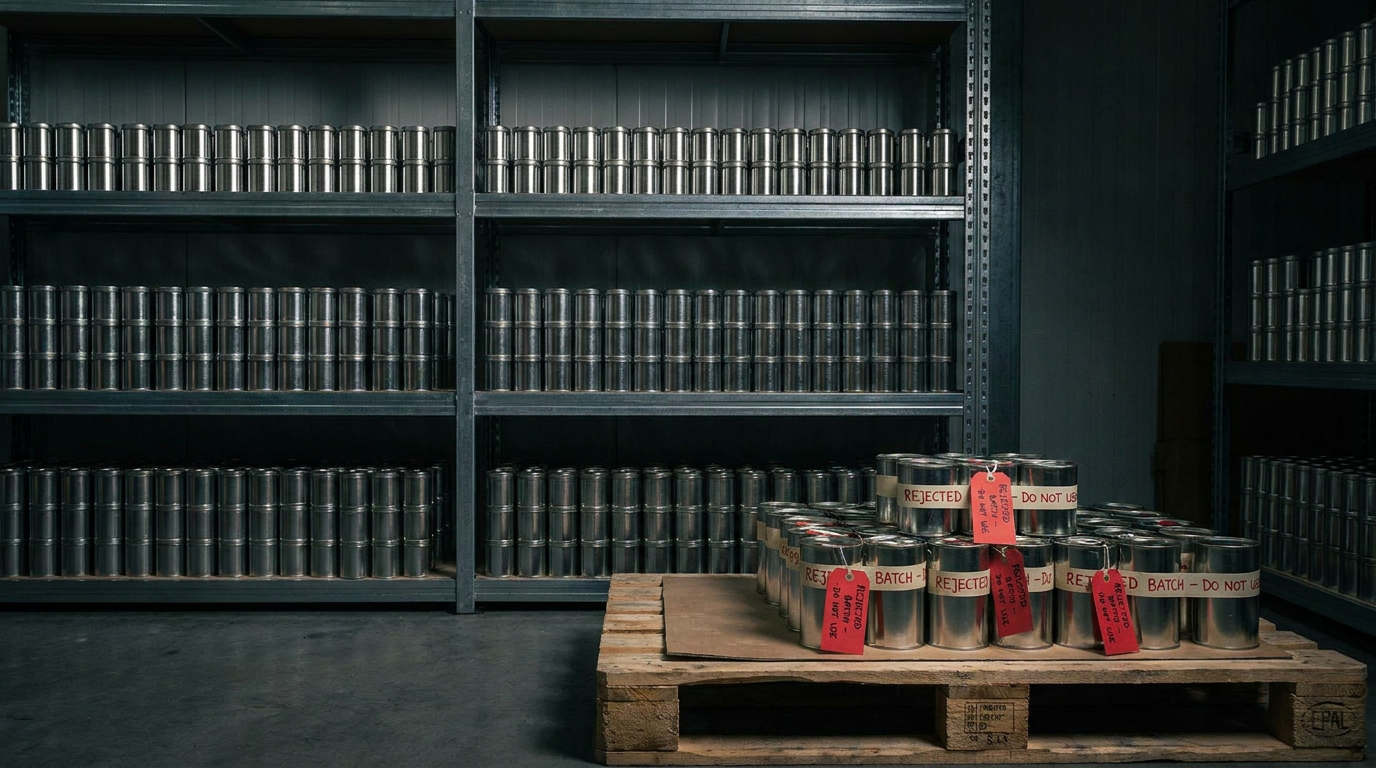
Approved but undifferentiated. Everybody signed off. Nobody is happy. The product cleared every gate because at each gate somebody compromised a little, and the accumulated compromises produced something that offends no one and excites no one. This is the direct output of taste by committee, and it is the most dangerous outcome of the four, because unlike the others it does not fail visibly. It launches. It just does not sell, and the postmortem struggles to identify what went wrong, because nothing did. Nothing went wrong in particular. The product was averaged into existence.
Finished but unlaunchable. The formulation is locked and then reality arrives from an unexpected direction. The claim on the front of the can turns out not to be supportable with the dose in the formula. Or the pack format does not fit the retailer's planogram. Or the shelf life is shorter than the distribution cycle requires, so the product cannot physically reach the shelf with enough life left on it. Each of these is a definition that existed in somebody's head and never made it onto paper where it could have constrained the work. Format and channel realities in particular have a way of ambushing projects late, which is part of why we wrote Which brings us to the useful part. Here is how to write one yourself.
our guide to winning in RTD in 2026
Here is the common thread, and it is worth sitting with. None of these are formulation failures. Every single one is a definition failure, discovered late, at the point in the process where fixing it costs the most. The bench work in all four scenarios may have been excellent. Excellent execution against an undefined target still produces the wrong product, just more efficiently.
around those constraints rather than around flavor trends.
How to Write Your Own Gold Standard: A Practical Template
Open a blank document. This takes a focused half day with the right people in the room, and it is the highest-return half day in the entire development process. Eight steps.
Step 1: Write the one-sentence product definition
Before anything else, one sentence covering what it is, who it is for, and the occasion.
Something with the shape of: a lightly sparkling citrus refresher for afternoon energy without caffeine jitters, sold chilled at grab-and-go.If the team cannot agree on this sentence, stop. Do not proceed to step two, do not book bench time, and do not order ingredients. A team that cannot agree on one sentence has a fundamental disagreement about the product, and every downstream decision will inherit it. Discovering that on day one is a gift. Discovering it in round six is a crisis.
Not marketing copy. A functional description.
Step 2: Fill in the sensory target
Copy this field list into your document and complete every line:
- Appearance and color
- Aroma
- First taste
- Mid-palate
- Finish
- Mouthfeel and body
- Sweetness level
- Acidity
- Carbonation level
- Serve temperature
The most effective move in this step is to anchor the whole thing to a physical reference point the entire team can taste. A competitor product, an existing SKU in your portfolio, an early bench sample, or even a blend of two things. Then write your target as deltas from that reference: brighter on the front, less residual sweetness, shorter finish, same carbonation. A shared reference beats adjectives every single time, because everyone calibrates to the same liquid instead of to their own private definition of "bright."
Complete every field even where you are uncertain. A field marked "undecided, resolve by week two" is infinitely more useful than a field left blank, because blanks get filled in silently by whoever happens to be at the bench.
Step 3: Set the functional target
Actives and exact dose per serving. Calorie ceiling. Sugar ceiling. Protein or electrolyte targets. Caffeine content. And critically, the claim you intend to make on pack.
Here is the caution that saves projects: write the claim you want before you formulate, then check that it is supportable. Not after. The sequence matters enormously. Teams that formulate first and check claims later routinely discover that the number they need on the front of the pack requires a dose that changes the taste, the cost, or the regulatory pathway. Checking the claim first means the formulation is built to satisfy it. Checking it last means the claim gets downgraded to whatever the formula happens to support, which is how a product intended to be functional ends up being merely flavored. Ground this against the while you write it.
FDA's Nutrition Facts label guidance
Step 4: Set the commercial target
Target retail price. Required gross margin. Maximum landed cost per unit. Pack format and count. Primary channel.
Then add one discipline step that most teams skip: pick the two attributes you will never trade away, and write them down now, while nobody is under pressure. Maybe it is the real fruit content and the absence of artificial sweeteners. Maybe it is the carbonation level and the cost per unit. It does not matter what they are. What matters is that you decided them calmly, in advance, because the moment you need that decision you will be making it in a room where someone is worried about a deadline. Pre-commitment is the entire value.
Step 5: Define the technical constraints
Required shelf life in days or months. Target pH range. Process (hot fill, cold fill, HPP, tunnel pasteurization, retort). Pack material and format. Regulatory pathway for the category, including the where relevant and if there is alcohol involved.
TTB labeling requirementsacidified foods rules under 21 CFR Part 114
One rule worth stating plainly: if the co-packer is already chosen, their capability list is part of your spec. Copy it in. There is no value in a target that requires a process your manufacturing partner does not run, and there is enormous value in knowing that before the bench work rather than after it.
Step 6: Write the "what this is not" boundary
This is your scope creep firewall. It costs ten minutes to write and it will save weeks.
Not a meal replacement. Not zero-sugar. Not making an energy claim. Not launching in glass. Not sold in club channel. Not containing dairy. Not exceeding a two-week production lead time.
At least five explicit exclusions. Push for more if the team is enjoying it, because they usually start to.
Step 7: Define the acceptance test
Be specific. Something with the shape of: three named approvers, blind tasting against the reference sample, scored on the ten sensory fields from step two, pass requires all fields within tolerance and unanimous approval on the top two protected attributes, target is three rounds with a hard ceiling of five.
How will you know you hit it? Name who approves, on what criteria, in how many rounds, and what a pass actually looks like.
A Gold Standard without an acceptance test is a wish. The test is what makes the document enforceable, and structured approval beats instinctive approval reliably. The IFT's perspective on is a useful read on why methodical evaluation outperforms the room's gut feel, particularly as products get more complex.
next-generation sensory science
Step 8: Get it signed
Everyone with veto power signs the document before formulation begins. Founder, brand lead, finance, operations, technical. Actual signatures, or at minimum an explicit written approval that exists somewhere retrievable.
If someone will not sign, that is not an obstacle. That is the document doing its job. You have surfaced a real disagreement in week one, when resolving it costs a conversation, instead of in round six, when resolving it costs a reformulation. Every unsigned Gold Standard is a future argument that has been located early.
On length: one to three pages is right. If your Gold Standard runs to twenty pages, you have written a strategy deck, and strategy decks do not settle disagreements at a tasting table. The document has to be short enough that everyone in the room has actually read it and can find the relevant line in under thirty seconds. Brevity is a functional requirement, not a stylistic preference.
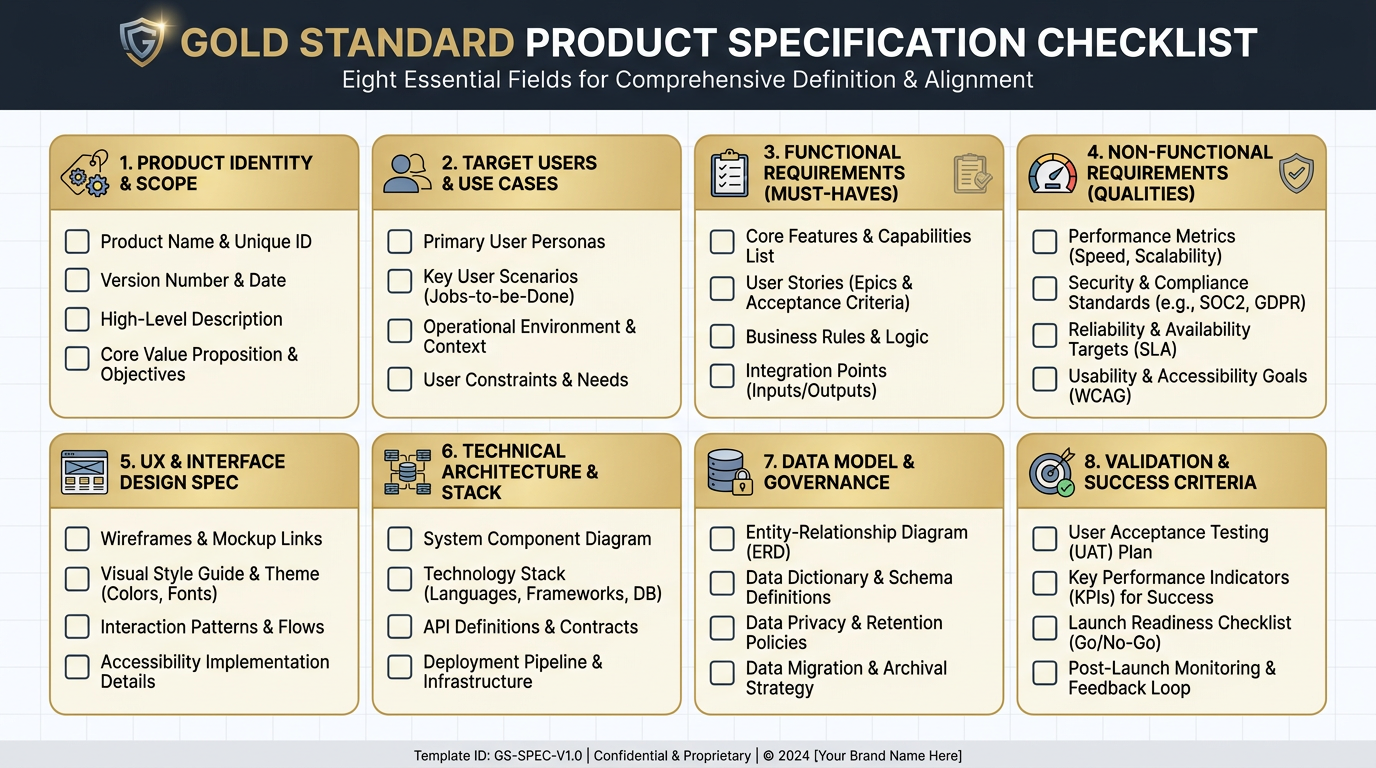
That is the whole template. Use it, adapt it, put your own logo on it. If you would rather not write it alone, or you want people in the room who have seen how these targets behave under manufacturing pressure, Now let us zoom back out to where this document sits in the wider process.
we are happy to build it alongside you
. But the template works perfectly well without us, which is rather the point.
Where the Gold Standard Sits Inside Design, Develop, Deliver
We organize beverage development into three stages: Design, Develop, and Deliver. The Gold Standard is not a step within that framework. It is the hinge the whole thing turns on. sets out the full framework, but here is specifically how the Gold Standard moves through it.
The Menu Collective way
Design. The Gold Standard is the primary output of this stage. Design starts by selecting the right beverage experts for the specific project, because a cannabis-infused functional drink and a signature cocktail program for a global chain need genuinely different rooms of people. Then we define the Gold Standard product together, alongside the client, using discovery sessions, category research, format and channel selection, and an honest assessment of operational feasibility. The important reframe here is that Design is not sketching. Design is deciding. The deliverable is not inspiration. It is a signed target.
Develop. In this stage the Gold Standard becomes the thing every piece of technical work is measured against. Bench formulation runs against it. Sensory panels score against it. Stability testing validates against it. Ingredient sourcing, regulatory review, pilot production, and manufacturing scale-up all reference back to the same document. It functions as a pass or fail test at every gate, which is what allows rounds to converge. This is also the practical reason a clear target compresses a timeline rather than extending it. The time cost of development is dominated by rework, and rework is dominated by ambiguity, which is the honest answer underneath .
how long beverage development actually takes
Deliver. Because the commercial target and the channel were defined at the very start rather than reverse-engineered at the end, the Gold Standard shapes the sales, marketing, and distribution story. The pricing works because it was a constraint, not a hope. The pack fits the channel because the channel was named in week one. The claim on the front is supportable because it was written before the formula, not after. Teams that skip the Gold Standard usually discover their go-to-market constraints during go-to-market, which is the most expensive possible moment to learn them.
The sequencing insight underneath all of this is simple. The Gold Standard is cheap to write and expensive to skip. It costs a focused half day and a few pages. Skipping it costs reformulation rounds, pilot runs, delayed launches, and occasionally a product that cannot go to market at all. It is the lowest-cost, highest-return document in the entire process, and it is the one most likely to be skipped, precisely because writing it does not feel like progress in the way that tasting samples does.
It is also genuinely co-authored, and that is not a courtesy. You are in every room, for every decision. A Gold Standard written for a client is a recommendation they can drift away from. A Gold Standard written with a client is a commitment they helped construct, which is exactly why it holds up in month four when the cost pressure lands and somebody suggests changing the thing that makes the product worth drinking.
Worth noting that this scales in both directions. A global brand running a multi-market program needs a Gold Standard because there are forty stakeholders and no other way to keep them aligned across time zones. A first-time founder needs one because there is nobody else to catch the mistake, and the budget has no room for a reformulation loop. The document is the same shape at both ends. It just has fewer signatures at one of them. Our covers what that looks like from a standing start.
founder's honest roadmap for starting a beverage company
When a defined target holds all the way through, it shows up in the finished range. The went from a backyard recipe to a six-flavor bottled platform, which is the kind of multi-SKU consistency that only works when everyone involved agreed what the core product experience was before the variants started multiplying. Six flavors that belong to the same family require a definition of what the family is.
Fuego Rojo non-alcoholic michelada platform

The Gold Standard Product Is the Fastest Route to a Finished Drink
Great beverages are not the product of a great idea alone. Plenty of great ideas die in round six. They are the product of a team that agreed what great meant before they started.
Use the template. Copy it into your own document, share it with your team, change the fields that do not fit your category, and write your Gold Standard product without us. It works either way, and we would rather the industry made better drinks than that we kept a useful idea to ourselves.
The document does one job, and it does it by answering six questions in writing before anyone touches a bench: what exactly are we making, what must it taste like, what must it cost, what must it deliver functionally, where will it be sold, and how will we know when we have hit it. Answer those six with real specificity, add the exclusions and the acceptance test, get it signed, and you have converted the most chaotic phase of product development into a set of decisions with a reference point.
A Gold Standard does not slow a project down. It is the only thing that lets a project move quickly without moving backwards. Speed in beverage development is not a function of how fast you formulate. It is a function of how rarely you have to undo what you formulated, and that is entirely determined by whether the target was clear before the work started.
Let's Talk
If you are staring at a project that has drifted, or you are early enough to get the definition right the first time, we would like to hear about it. Start with a free consult: a straightforward conversation about the product you are trying to build and what your Gold Standard should contain. We build with you, not for you, and you are in every room for every decision.
when you are ready, or take a look at first if you want to understand the scope before you reach out.
our beverage development servicesTalk to us