
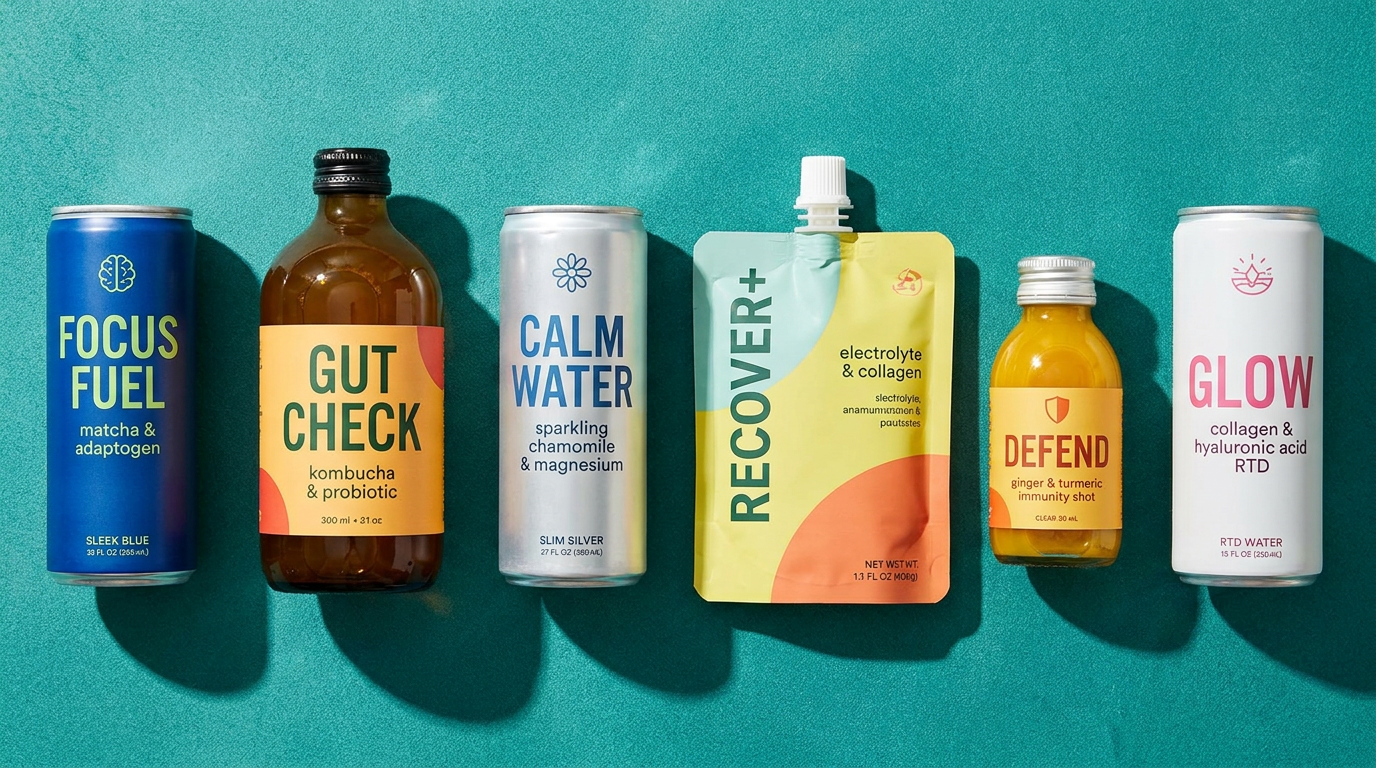
The functional beverage market is no longer emerging, it's here, and it's accelerating. In 2026, the trends that are actually sticking share one thing in common: they work commercially, not just conceptually. From gut health sodas to adaptogen RTDs, here are the six functional beverage trends that are moving off shelves and into scale.
A functional beverage, by definition, is a drink formulated to deliver a specific health or physiological benefit beyond basic hydration or nutrition. Think probiotics for gut health, adaptogens for stress resilience, electrolytes stacked with nootropics for cognitive hydration, or botanical blends designed to replicate the complexity of spirits without a drop of alcohol. The category spans an enormous range — and so does the commercial opportunity.
According to , the US functional beverage sector is projected to grow from $164 billion to $239 billion by 2031, at a 7.9% CAGR. That's not a niche market on a hopeful trajectory, that's a structural shift in how consumers think about what they drink. Every sip, for a growing majority of shoppers, is expected to do somethingAt Menu Collective, we've spent 45+ years working with brands across the full spectrum of this industry, from developing the full bar program for the Starbucks Reserve Roastery Chicago to formulating complex cannabis-infused RTDs for bold CPG start-ups. What we've learned over those decades is that consumer trends and commercial reality are not always the same thing. Plenty of ingredients go viral on social media and disappear from shelves within eighteen months. The trends we're highlighting here have passed a more demanding filter: they are scalable, regulatorily navigable, and genuinely moving product.
BeverageDaily's 2026 trend overview
.
This is not a surface-level listicle. This is a commercially grounded trend report from practitioners who formulate for a living. Explore
Menu Collective's beverage development services
Here are the six functional beverage trends that are actually sticking in 2026, each examined for ingredient reality, format opportunity, and commercial viability.
if you want to understand the lens through which we evaluate every single one of these opportunities.
Gut Health Becomes the New Energy: Probiotics, Prebiotics & Postbiotics in RTD
If there's one functional beverage trend that has decisively crossed the chasm from wellness niche to mainstream consumer expectation, it's gut health. In 2026, the gut is no longer just a digestive organ in the popular imagination, it's the body's second brain, the seat of the immune system, and the governing system behind mood, energy, and long-term wellbeing. And consumers have gotten remarkably specific about how they want to support it.
According to , 59% of global consumers are actively seeking out functional ingredients like probiotics and prebiotics, not just for digestive health, but for the broader mental and physical health benefits that an optimized gut microbiome supports. That's a majority. That's a mainstream market, not a wellness subculture.
Food Navigator USA
To understand why this trend has the commercial legs it does, it helps to understand the three distinct pillars of gut-health functionality in beverages:
- Probiotics — live beneficial microorganisms, most commonly from the Lactobacillus and Bifidobacterium families. These are the organisms found in kombucha, kefir-inspired drinks, and fermented tea formats. They directly colonize the gut microbiome.
- Prebiotics — the dietary fibers that feed and support probiotic organisms. Inulin, chicory root fiber, and green banana flour are the most commercially common. They don't require live cultures, which makes them significantly more shelf-stable and formulation-friendly.
- Postbiotics — the metabolites and bioactive compounds produced by fermentation. This is the frontier of the category. Postbiotics like short-chain fatty acids and butyrate are gaining serious attention because they deliver gut-health benefits without the viability challenges of live cultures.
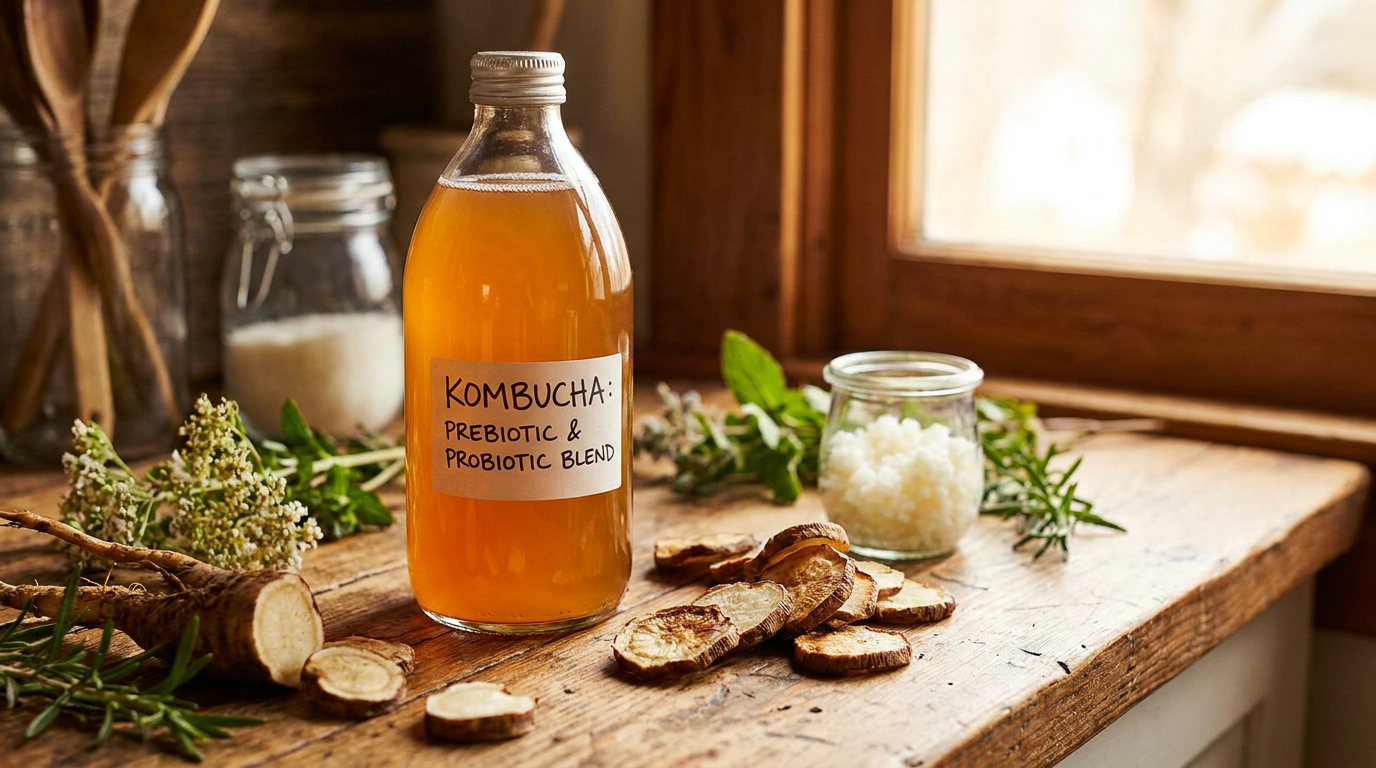
The commercial proof points for this trend are impossible to ignore. In March 2025, PepsiCo announced its $1.95 billion acquisition of Poppi, a prebiotic soda brand that had built its entire identity around apple cider vinegar and prebiotic fiber. The deal was completed in May 2025. In the same month, Coca-Cola launched Simply Pop, its own prebiotic soda entry, delivering 6 grams of fiber per can. When the two largest beverage companies on earth are placing nearly $2 billion bets on prebiotic sodas, the functional beverage trends for 2026 have been written in bold. As Kombucha, meanwhile, continues its quiet evolution beyond the original glass-bottle health-food-store format. Shelf-stable kombucha, achieved through precision pH control and pasteurization of non-probiotic versions, or through careful probiotic strain selection, is unlocking mass retail distribution. Synbiotic blends, combining prebiotic fiber with probiotic cultures in a single beverage, are the format that savvy formulators are betting on for the next wave of category growth.
Food Navigator notes
, these moves signal that the prebiotic soda format has achieved the scale validation that most emerging functional categories never reach.
From a formulation standpoint, the central challenge with probiotics in ambient RTD formats is viability. Live cultures are inherently vulnerable to heat, light, pH variation, and extended shelf life. At
The gut addresses the body's internal ecosystem — but the next trend targets the nervous system directly, and it's where some of the most exciting formulation work in functional beverages is happening right now.
The gut health functional beverage trend isn't a wave — it's a permanent reorientation of the category. Brands that formulate with ingredient credibility, efficacious dosing, and shelf-stability built into the design from day one will own this space. Those who treat it as a marketing claim will be swept out with the tide.
The prebiotic fiber route — using inulin and chicory root — offers perhaps the clearest commercial path for brands entering this space. The formulation challenge here is mouthfeel: inulin can create a slightly thick or syrupy texture at higher doses, which requires careful balancing against carbonation levels, sweetener systems, and flavor profiles. These are solvable problems — but they require formulation expertise, not just ingredient sourcing.
, we navigate this by evaluating stabilized or freeze-dried probiotic strains, which offer significantly improved survival rates through manufacturing and distribution. For brands seeking the cleanest regulatory pathway and most robust shelf stability, postbiotics present an increasingly compelling alternative — they deliver measurable gut-health bioactivity without the strain-viability concerns that have historically complicated probiotic RTD scaling.
Adaptogens & Functional Mushrooms Move from Niche to Shelf-Ready
A few years ago, the word "adaptogen" was the exclusive vocabulary of herbalists, biohackers, and the Instagram wellness community. Today, it's on the side of cans at Whole Foods, Target, and emerging DTC subscription boxes alike. The global adaptogens market was valued at , growing at a 7.2% CAGR. This is no longer a fringe market — it is a commercially mature, rapidly expanding category with legitimate ingredient science behind it.
$10.89 billion in 2024 and is projected to reach $16.32 billion by 2030
What makes adaptogens distinctive as a functional ingredient class is their mechanism of action: they work by modulating the body's stress response systems, particularly the hypothalamic-pituitary-adrenal (HPA) axis. Unlike stimulants, they don't spike and crash. Unlike sedatives, they don't impair. At their best, they create a more resilient physiological baseline — which is exactly the kind of functional benefit that resonates with a consumer base exhausted by the volatility of modern life.
For beverage formulators, the three most commercially proven adaptogens in 2026 are:
Ashwagandha (KSM-66 / Sensoril): This is the most clinically studied adaptogen on the market. Standardized extract forms — specifically KSM-66 (root extract, 5% withanolides) and Sensoril (whole-plant extract) — have robust human clinical trial data supporting stress reduction, cortisol modulation, and improved sleep quality. The minimum effective dose in published research is 300–600mg per serving. This is a critical detail: many functional beverages use ashwagandha at doses of 50–100mg for label appeal rather than efficacy. Informed consumers are increasingly aware of this gap — and it matters enormously for brand credibility.
Lion's Mane: The cognitive mushroom. Hericium erinaceus has gained significant consumer recognition for its association with focus, mental clarity, and neuroprotective benefits, linked to its ability to stimulate nerve growth factor (NGF) production. It's the adaptogenic ingredient of choice for productivity-oriented, high-performance consumers — a segment with genuine purchasing power and brand loyalty. From a formulation perspective, lion's mane has a distinct earthiness that requires thoughtful flavor pairing; cacao, vanilla, and warming chai profiles work particularly well to mask its character without overwhelming the base.
Reishi: Known as the "relaxation mushroom" in traditional Chinese medicine, Ganoderma lucidum is finding its commercial home in evening drinks, stress-support blends, and sleep-optimization RTDs. Its bitter, woody flavor profile is the primary formulation challenge — it pairs best with dark cacao, warming spices, or honey-based sweetener systems. The triterpenoid compounds responsible for reishi's adaptogenic effects require extraction methods that preserve their bioactivity, making standardized extracts far preferable to crude mushroom powders.
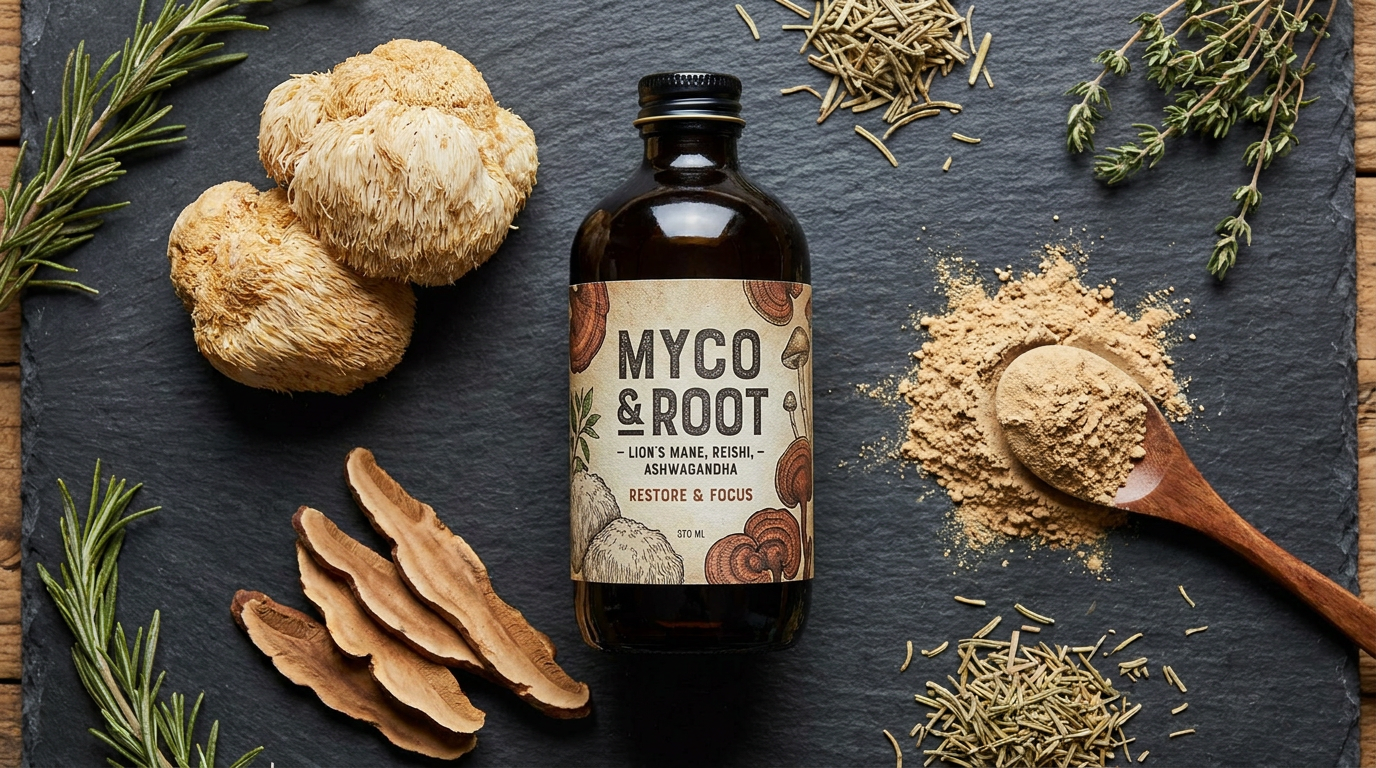
Beyond the core adaptogens, the broader functional mushroom category is expanding rapidly. Chaga is gaining traction as an antioxidant powerhouse. Cordyceps is being positioned for energy and athletic endurance — a natural ally in sports nutrition beverages. identifies the mushroom-adaptogen category as one of the highest-growth ingredient segments in functional nutrition this year, driven by both wellness consumer demand and improving supply chain infrastructure.
ToNutra's 2026 superfood and functional mushroom trend analysis
"The best adaptogens for beverage formulation in 2026 are ashwagandha (KSM-66 or Sensoril at 300–600mg), lion's mane for cognitive focus, and reishi for relaxation. Each requires specific formulation expertise around flavor masking, solubility, and standardized extract sourcing."
— Menu Collective Formulation Perspective
While adaptogens address the mind-body connection, the next trend is disrupting the most crowded shelf in the store — the energy drink aisle — with a very different kind of fuel.
At Menu Collective, the adaptogen and functional mushroom category is one where our formulation expertise creates the clearest commercial differentiation for clients. The gap between an adaptogen product that works — genuinely, efficaciously, at a dose that matches the science — and one that merely mentions lion's mane on the label is enormous. Bridging that gap is precisely what we do.
For brands navigating this space, the regulatory dimension is equally critical. Label claims for adaptogenic ingredients must be framed carefully under FDA guidelines — structure/function claims are permissible, but disease claims are not. Wild-sourced mushroom powders can be inconsistent in active compound content, creating both efficacy and compliance risks. Standardized extracts with documented active compound percentages are the only viable foundation for credible, defensible label claims.
Solubility and stability are the two formulation challenges that determine whether an adaptogen RTD scales or fails. Most mushroom powders and adaptogen extracts are not inherently water-soluble, which creates homogeneity issues in liquid formats — separation, sedimentation, and inconsistent dosing per serving. Nano-emulsion technology and solubilized standardized extracts are the solutions gaining traction at scale. Bioavailability is equally important: a product that delivers the claimed dose but doesn't absorb it effectively is a product that doesn't work, regardless of what the label says.
Clean Energy Reformulation: Moving Beyond Synthetic Stimulants
Walk the energy drink aisle in any major US retailer in 2026 and you'll find two very distinct product philosophies standing side by side. On one side: the legacy formula — synthetic caffeine, taurine, artificial sweeteners, neon colors, and aggressively masculine branding that has dominated the category for two decades. On the other: a rapidly growing cohort of clean-label energy beverages built on botanical caffeine sources, natural sweeteners, and functional stacking designed to deliver sustained focus rather than a spike-and-crash cortisol hit.
The conventional energy formula is not disappearing. But it is losing ground among the consumer segments that matter most to brand builders — health-conscious Millennials, Gen Z, and the performance-optimization community who read labels and make purchasing decisions based on what they find there. According to , clean label and transparency are now primary purchase drivers across functional categories — and the energy segment is no exception.
BeverageDaily's analysis of 2026 functional beverage trends
The natural energy ingredient stack that is proving commercially viable in 2026 looks like this:
- Green Tea Extract: The workhorse of clean-label energy. Natural caffeine delivered alongside L-theanine — an amino acid that modulates the stimulatory effect of caffeine, producing what neuroscientists describe as "alert calm" rather than jittery hyperactivity. The L-theanine/caffeine combination has been studied extensively in clinical settings and consistently demonstrates improved sustained attention, reaction time, and reduced anxiety compared to caffeine alone. For formulators, green tea extract is well-established in supply chains, available in standardized caffeine percentages, and relatively flavor-neutral at functional doses.
- Yerba Mate: A caffeinated botanical with a loyal, passionate consumer base — particularly in Latin America and among North American outdoor and adventure sports communities. Yerba mate delivers naturally occurring theobromine alongside caffeine, adding a mild mood-enhancement and smooth energy dimension that synthetic caffeine cannot replicate. Its distinctive grassy, slightly bitter flavor is a formulation challenge in some formats but an authentic selling point in others.
- Guayusa: An emerging Amazonian tea leaf (Ilex guayusa) that is gaining serious RTD traction as a clean-energy ingredient. Naturally caffeinated, high in antioxidants, and with a smoother, slightly sweeter flavor profile than traditional yerba mate, guayusa appeals to the same consumer seeking botanical provenance in their energy source. Supply chains are still developing — this is worth flagging for brands planning high-volume production, as sourcing consistency and pricing can be variable.
- L-Theanine (Standalone): Increasingly used as a calming counterbalance in nootropic-energy hybrids — products that pair botanical caffeine with L-theanine at a 2:1 ratio for what the category is calling "smart energy." These products occupy a positioning space between traditional energy drinks and cognitive-support beverages, appealing to the growing cohort of consumers who want functional enhancement without the cortisol spike.
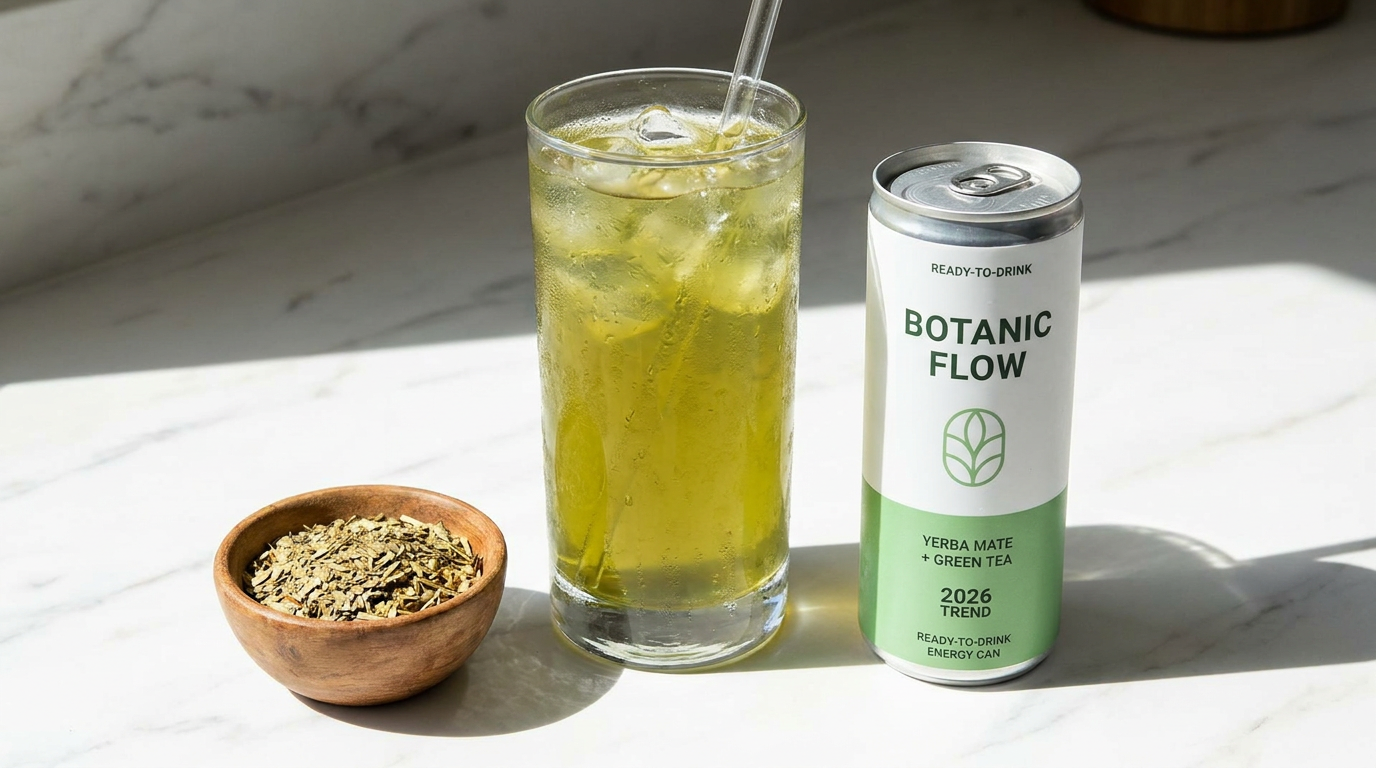
On the sweetener side, the clean-energy reformulation trend is equally clear. Monk fruit and stevia have become the clean-label defaults, replacing high-fructose corn syrup and aspartame in reformulated and new-to-market energy beverages. Allulose is gaining notable traction as a third option — it provides a mouthfeel and sweetness profile closer to sugar than either monk fruit or stevia, without the digestive discomfort that high doses of sugar alcohols can produce. For brands formulating full-sugar-equivalent sensory profiles in a clean-label framework, allulose is the ingredient to watch.
specifically highlights format diversification as a critical dimension of the clean energy trend. Full-size 16oz cans are no longer the only viable format. Single-serve 2oz shots — the format pioneered by 5-hour Energy — are being reimagined with clean-label credentials. 8oz RTDs are emerging as the portion-control, daily-ritual format that health-conscious consumers prefer. And powder sachets — dissolve-in-water formats that consumers can customize by dose and dilution — are gaining traction for portability and packaging sustainability.
Food Processing's analysis of the six key trends shaping functional beverage evolution in 2026
At Menu Collective, our
RTD cold brew shandy formulation work
The clean energy reformulation trend is fundamentally about replacing what doesn't belong with what works better. That philosophy — extracting the unnecessary and replacing it with the purposeful — is also what's driving the next major trend reshaping the entire beverage landscape: the sober-curious movement.
demonstrates the complexity of building clean-label energy beverages that work at scale. Natural caffeine sources introduce color variation, flavor complexity, and pH sensitivities that synthetic ingredients don't. Achieving a product that is shelf-stable, visually consistent, organoleptically excellent, and commercially scalable — at a cost structure that works in retail — requires formulation expertise that goes well beyond ingredient selection.
Non-Alcoholic Spirits & the Sober-Curious RTD Revolution
Let's dispense with any suggestion that this is a passing trend. The sober-curious movement is not a generational moment or a wellness micro-trend that will fade when the next cultural preoccupation arrives. It is a structural, multi-generational shift in how consumers relate to alcohol — and the beverage category it has created is growing at a pace that commands serious commercial attention.
Is the non-alcoholic spirits market growing? Yes — significantly. The global non-alcoholic spirits market was valued at , growing at a 9.5% CAGR. In the United States specifically, the market is expanding even faster — at a 10.4% CAGR according to , reaching $161.9 million by 2030. These are not aspirational projections — they are the result of real consumer behavior change already in motion.
BeverageDaily's US-specific growth analysis$445.8 million in 2024 and is projected to reach $771.9 million by 2030
The demand driver is straightforward: Gen Z drinks less alcohol than any previous generation in recorded consumer research history. Millennials are actively moderating, motivated by a combination of health consciousness, mental wellness awareness, and a cultural shift away from the social norming of heavy drinking that defined previous generations. The social occasion — the dinner party, the celebration, the bar experience — hasn't disappeared. But the expectation that alcohol is the default beverage for those occasions is quietly, decisively eroding.
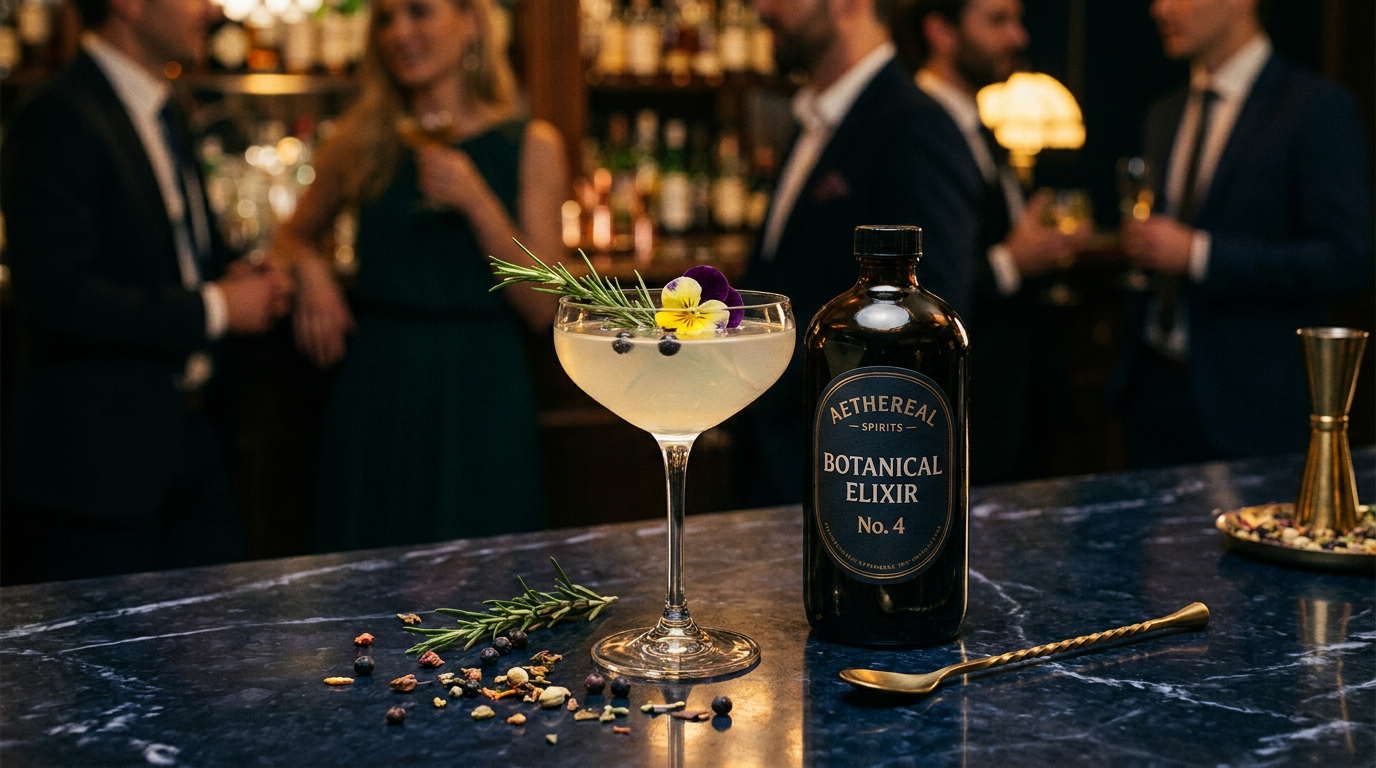
The most innovative products in this space in 2026 are going further — layering NA spirit botanicals with functional ingredients to create dual-benefit propositions that neither alcoholic beverages nor traditional NA options can match. Adaptogens in an NA gin-style RTD. Nootropics in a sparkling botanical aperitivo. Electrolytes in a canned NA cocktail designed for post-workout social occasions. These multi-benefit formulations speak simultaneously to the occasion (social, celebratory) and the lifestyle (health-forward, functional).
The ingredient story behind NA spirits is genuinely fascinating from a formulation perspective. Without ethanol as the structural backbone of sensory complexity — the warmth, the "bite," the palate weight, the aromatic integration — NA spirit formulators must reconstruct those sensory experiences using botanical extracts. Gentian root delivers bitterness. Juniper provides the aromatic backbone of gin-style expressions. Cardamom, citrus peel, and angelica root add complexity layers. Carbonation serves a dual role — providing mouthfeel weight and enhancing aromatic volatility. The formulation challenge is achieving a sensory profile that is genuinely compelling in its own right, not merely a pale imitation of its alcoholic equivalent.
The format opportunity within this trend is significant. Non-alcoholic canned cocktails — NA RTDs — are the breakout format of the category, delivering the social occasion credential of an alcoholic beverage in a functional, health-forward, genuinely sophisticated package. These are not compromised products for people who "can't" drink. They are premium beverages that happen not to contain ethanol — and the best of them are formulated with as much care and complexity as their alcoholic counterparts.
At Menu Collective, our experience formulating complex functional beverages — including our work on
cannabis THC/CBD drink formulation
Non-alcoholic doesn't mean non-functional — and the next trend is proof that hydration itself has been completely reimagined as a delivery vehicle for performance and wellness.
One critical commercial note for brands entering this category: this is unequivocally a premium positioning play. Premium on-premise placement — in bars, restaurants, and hotels — is the proving ground for NA RTDs before retail listing. Pricing should reflect that premium positioning. This is not a value category, and brands that enter it at value price points are misreading both the consumer and the commercial opportunity.
— has given us deep expertise in navigating the regulatory and formulation complexity of beverages where every ingredient must be both purposeful and compliant. NA spirits with functional add-ons present similar layered compliance considerations, and they reward the kind of rigorous formulation discipline that we bring to every project.
Multi-Functional Hydration: Electrolytes Are Just the Beginning
There was a time — not long ago — when "enhanced water" meant water with some sodium and potassium added, perhaps a touch of color, and a sports-performance positioning borrowed entirely from the athlete image on the label. That era is over. Multi-functional hydration in 2026 has evolved into one of the most sophisticated and commercially dynamic segments in the entire beverage landscape, and the innovation happening in this category is moving faster than at any point in its history.
The foundation remains the electrolyte complex — sodium, potassium, and magnesium — because the physiology hasn't changed. Cellular hydration requires electrolytes, and athletes, active consumers, and increasingly everyday wellness consumers understand this. Coconut water as a natural electrolyte source continues to gain clean-label appeal, offering a recognizable, ingredient-story-ready alternative to synthetic mineral blends. But the electrolyte base in 2026 is increasingly the starting point rather than the destination for functional drink formulation.
The multi-functional hydration stack that is generating the most commercial momentum this year layers additional functional benefits on top of the electrolyte core:
- Nootropic hydration: L-theanine, lion's mane extract, and alpha-GPC are being incorporated into hydration products to create a "hydrate your body, fuel your mind" positioning. The cognitive hydration subcategory speaks directly to knowledge workers, students, and the broader productivity-optimization consumer segment — a group that consumes functional beverages as daily rituals rather than occasional treats.
- Collagen hydration: Skin-health hydration is one of the fastest-growing sub-categories in functional beverages. Collagen peptides at efficacious doses (2,500–5,000mg per serving) paired with electrolytes create a beauty-from-within proposition that bridges the sports nutrition and personal care consumer mindsets. Women in the 25–45 demographic are the primary consumer here, and their willingness to pay premium pricing for clinically credible collagen products is well-documented.
- Immunity hydration: Vitamin C, zinc, elderberry extract — the immunity support stack is migrating from the supplement aisle into hydration beverages, creating products that serve the everyday wellness ritual rather than the acute illness response. The positioning is preventive rather than reactive, which aligns with where the broader health consumer's mindset has moved.
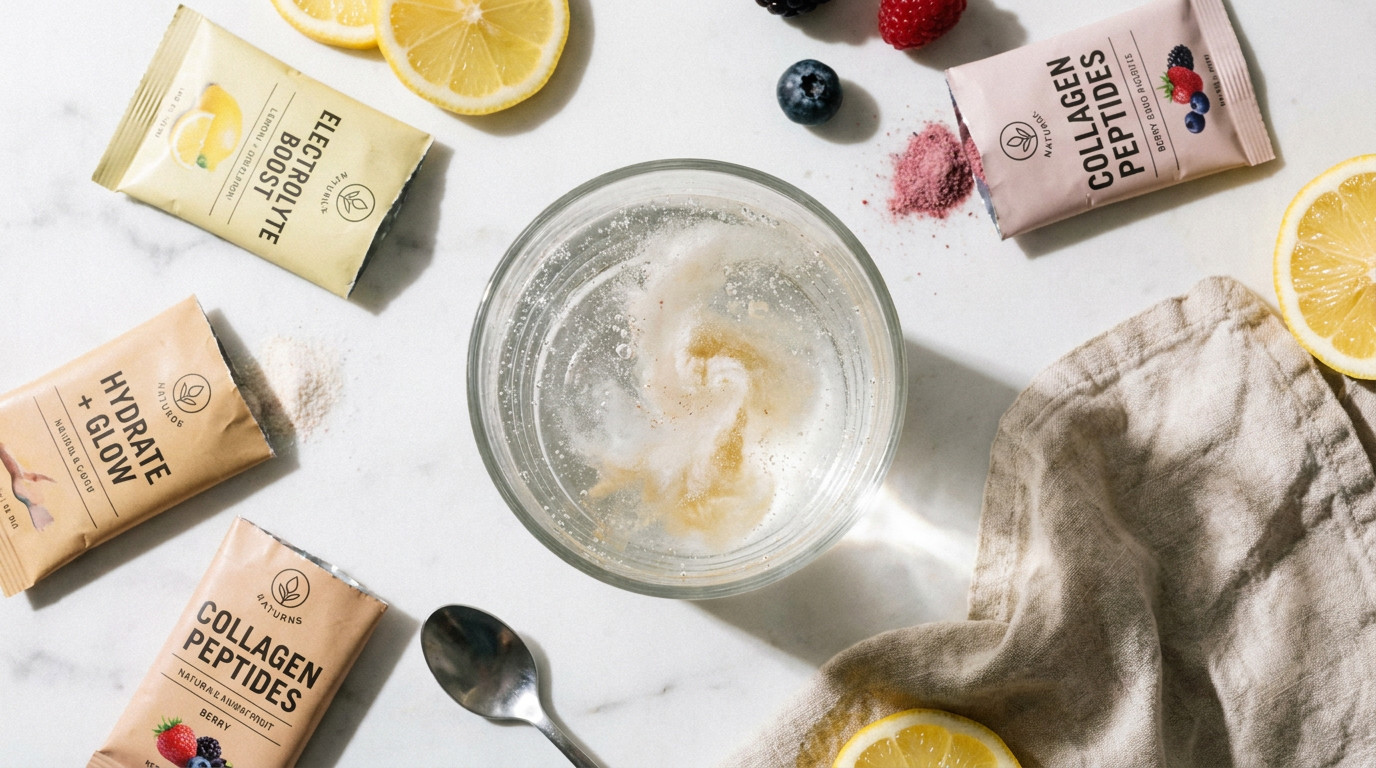
Format innovation is equally important in this category. Single-serve powder sachets — dissolve-in-water formats — are disrupting the RTD model for hydration in ways that are both commercially significant and environmentally compelling. The format eliminates the water weight in shipping (dramatically reducing carbon footprint and freight cost), allows consumers to customize concentration, and creates a daily-ritual product experience that builds habitual repurchase. The success of products like Liquid I.V. and LMNT in the powdered electrolyte format has proven both the consumer appetite and the retail viability of this approach.
According to , the multi-functional hydration and nootropic layering trend is one of the highest-growth areas in functional drink formulation this year, driven by consumers who want their hydration to work as hard as they do. This is not a niche preference — it reflects a fundamental shift in how the health-conscious consumer relates to every beverage choice they make.
Sensapure's 2026 functional beverage trend analysis
The regulatory dimension of multi-functional hydration is where formulation expertise becomes a genuine competitive differentiator. Multi-claim beverages — products making simultaneous structure/function claims for hydration, cognitive support, skin health, and immunity — require meticulous regulatory navigation. Health claims in the US vary by ingredient type and dosage under FDA guidelines. Claims that are substantiated at one dosage level may not be at another. At Menu Collective, our
functional beverage development work
Stacking functional ingredients is only viable if the label can honestly support the claim — which is why the sixth trend reshaping the industry is less about what's in the can and more about what's written on it.
integrates regulatory compliance from the earliest stages of concept development — not as an afterthought, but as a foundation.
Clean Label & Radical Ingredient Transparency: The New Non-Negotiable
Every trend we've discussed in this report — gut health, adaptogens, clean energy, non-alcoholic spirits, multi-functional hydration — shares a common vulnerability. Each of them can be undermined, commercially and reputationally, by the same force: a label that overpromises what the product doesn't actually deliver.
In 2026, clean label is no longer a competitive differentiator. It is a baseline expectation, particularly among Gen Z consumers and health-conscious Millennials who have grown up reading ingredient lists with the same fluency that previous generations read nutritional facts. These consumers know what inulin is. They know the difference between KSM-66 ashwagandha and a generic ashwagandha powder. They know that a "proprietary blend" with an undisclosed dose of lion's mane is hiding something — and they've learned to be skeptical of it.
poses the question directly: are functional beverages actually healthy? The answer, Forbes concludes, depends entirely on whether the formulation behind the claim is credible. This is the functional credibility gap — the widening distance between what a product claims and what the science supports at the dose included.
Forbes' 2026 analysis of the functional beverage boom
What clean label means in the functional beverage category in 2026 is specific:
- No artificial colors, flavors, or preservatives. This is the minimum threshold. Consumers expect it, retailers increasingly require it, and there are excellent natural alternatives for every application.
- Natural sweeteners replacing legacy sugar systems. Monk fruit, stevia, and allulose are the clean-label default. High-fructose corn syrup and aspartame are not merely unfashionable — they are actively damaging to brand trust among the target consumer for functional beverages.
- Short, recognizable ingredient lists. Consumer research consistently shows that label length correlates inversely with purchase intent among health-conscious shoppers. Consumers count ingredients. Complexity without purpose raises red flags.
- Clinically backed dosage transparency. This is the frontier. Brands that display their active ingredient doses — ashwagandha at 600mg KSM-66, lion's mane at 500mg standardized extract, L-theanine at 200mg — are building a new standard of label honesty that is commanding both premium pricing and consumer loyalty.
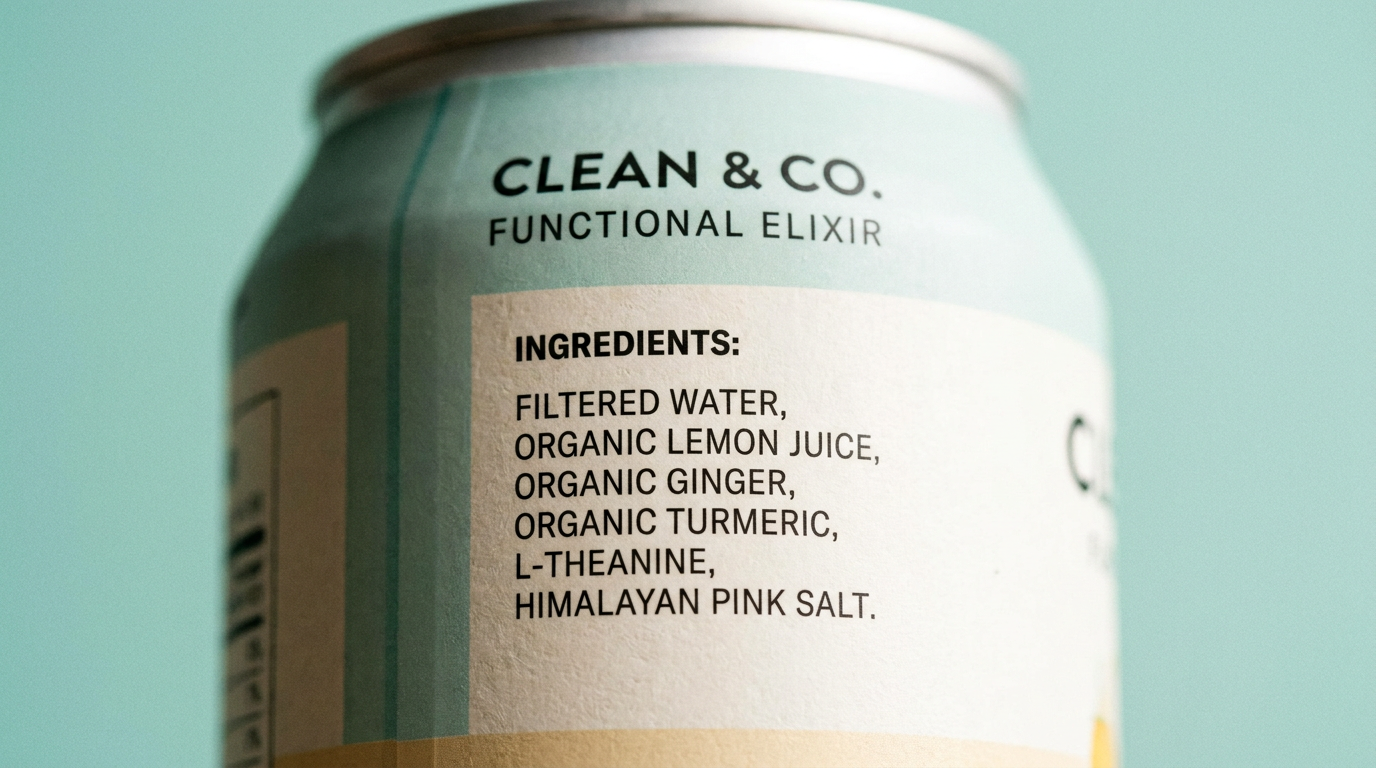
The transparency opportunity is significant for brands with the formulation rigor to back it up. Ingredient sourcing stories — KSM-66 ashwagandha from certified Indian root extracts, organic lion's mane from US-grown mycelium, Fair Trade cacao from traceable Peruvian farms — are not just marketing narratives. They are the substance of consumer trust in a category where skepticism is rising. According to , clean label and personalization are among the most powerful commercial drivers shaping the functional category this year, with sourcing transparency emerging as a key lever for premium pricing.
BeverageDaily's 2026 functional beverage trend analysis
The regulatory environment is moving in the same direction. The FTC and FDA are increasing scrutiny on unsubstantiated health claims in functional beverages, with particular focus on products that make structure/function claims without the dosage evidence to support them. Brands that invest in transparency now — building formulations around efficacious, documented doses of clinically studied ingredients — are not just doing the right thing commercially. They are positioning themselves ahead of a regulatory tightening that is already underway.
"How do you formulate a functional beverage? You define your Gold Standard — the ideal expression of your concept — then develop a scalable, compliant formulation that delivers efficacious ingredient doses in a stable, shelf-ready format. At Menu Collective, our Design, Develop, Deliver process covers everything from ingredient selection and dosage validation to regulatory compliance and manufacturing readiness."
— Menu Collective
This is the ultimate commercial insight of the clean label trend: transparency is not a cost. It is a moat. The brands that formulate with honesty, dose with integrity, and communicate with specificity are the brands that build the consumer trust that sustains long-term commercial success in a category where claims are increasingly scrutinized and skepticism is increasingly sophisticated. Explore to understand how we build that foundation with every brand we work with.
Menu Collective's Design, Develop, Deliver process
These six trends don't exist in isolation. They intersect, reinforce, and amplify each other. The brands that win in 2026 will be those that formulate across multiple trends simultaneously — with commercial rigor, ingredient credibility, and regulatory discipline at every step.
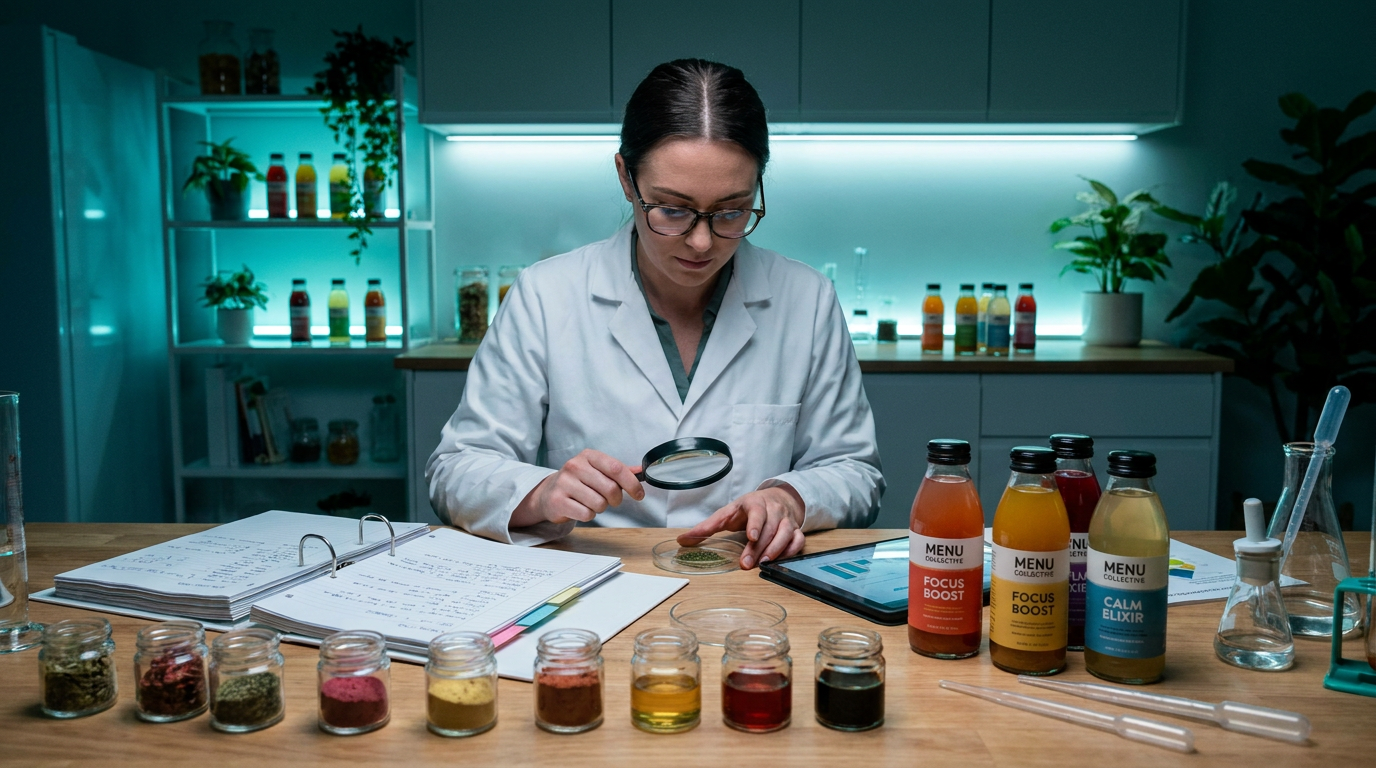
Bringing It Together: What the 2026 Functional Beverage Market Really Means
The six trends we've covered in this report — gut health with probiotics and prebiotics, adaptogens and functional mushrooms, clean energy reformulation, non-alcoholic spirits, multi-functional hydration, and clean label transparency — are not separate storylines. They are expressions of a single, powerful macro shift that is reshaping the entire beverage industry.
Consumers in 2026 expect their beverages to work
Here are the questions we hear most often from brand managers, CPG operators, and innovation teams — answered directly.
At Menu Collective, we've been watching these trends develop not from the sidelines but from the formulation bench. We've been here through the kombucha wave, through the first energy drink reformulation cycle, through the early NA spirits experiments, and through the current explosion in adaptogen RTDs. What we know — from 45+ years in this industry — is that the brands that endure are the ones built on formulation integrity. The concept gets you to the shelf. The formulation keeps you there.
. Not metaphorically — not in the aspirational, lifestyle-signal sense that drove the first wave of wellness beverages — but physiologically, measurably, and honestly. The bar for what "functional" means has been raised by a consumer base that is more educated, more skeptical, and more discerning than any that has come before them. The ingredient lists they read, the dosages they research, and the sourcing stories they care about are the real product brief for brands operating in this space.
Frequently Asked Questions
What is a functional beverage?
A functional beverage is a drink formulated to deliver a specific health or physiological benefit beyond basic hydration or nutrition. This includes beverages with added probiotics, adaptogens, electrolytes, vitamins, nootropics, or plant-based compounds designed to support gut health, energy, cognition, immunity, or relaxation. The defining characteristic is that the drink's formulation is built around a specific, intended physiological outcome — not simply around taste or refreshment.
What are the top functional beverage trends in 2026?
The six functional beverage trends with the most commercial momentum in 2026 are: (1) gut health beverages with probiotics, prebiotics, and postbiotics, (2) adaptogen and functional mushroom RTDs — particularly ashwagandha, lion's mane, and reishi, (3) clean energy reformulation using botanical caffeine sources like green tea extract and yerba mate, (4) non-alcoholic spirits and premium NA RTDs driven by the sober-curious movement, (5) multi-functional hydration beverages stacking electrolytes with nootropics, collagen, or immunity support, and (6) clean-label ingredient transparency as a baseline consumer expectation and commercial differentiator.
How do you formulate a functional beverage?
Formulating a functional beverage begins with defining your Gold Standard product — the ideal expression of your concept at its best. From there, it's a process of developing a scalable, regulatory-compliant formulation that delivers efficacious ingredient doses in a shelf-stable, commercially viable format. At Menu Collective, our Design, Develop, Deliver process covers ingredient selection, dosage validation, sensory development, stability testing, regulatory compliance review, and manufacturing readiness — treating every project as a collaboration with the brand rather than a transaction.
What are the best adaptogens to use in drinks?
The three most commercially proven adaptogens for beverage formulation in 2026 are ashwagandha — specifically KSM-66 or Sensoril standardized extracts at 300–600mg per serving — lion's mane for cognitive focus, and reishi for relaxation and sleep support. Each presents unique formulation challenges around flavor masking and solubility that require experienced formulation expertise to resolve at scale.
Is the non-alcoholic spirits market growing?
Yes — significantly. The
, growing at a 9.5% CAGR. In the US specifically, growth is even faster at 10.4% CAGR. The sober-curious movement and Gen Z's moderation behavior are the primary demand drivers, creating a premium category opportunity that rewards sophisticated formulation and confident premium positioning.
Ready to Bring Your Functional Beverage Concept to Life?
With 45+ years of expertise across every beverage format, base, and functional category imaginable, we bring a rare combination of creative vision and commercial discipline to every project. We've built bar programs for Starbucks, developed cannabis-infused RTDs, formulated prebiotic innovations, and navigated the regulatory complexity of multi-claim functional beverages. We don't consult from a distance — we build alongside you, from the first ideation conversation to the day your product ships to retail.
If you're building a functional beverage brand — whether you're a bold CPG start-up with a concept and a conviction, or an established brand looking to reformulate, innovate, and scale into the trends shaping this market — Menu Collective is the partner that has seen it all and formulated it all.
Our proven Design → Develop → Deliver process ensures that every project we touch is grounded in formulation reality, regulatory integrity, and commercial scalability from day one. Because a great concept that doesn't scale isn't a product — it's a prototype.
Let's Talk →
Ready to see what we've built for others? Explore Our Case Studies →