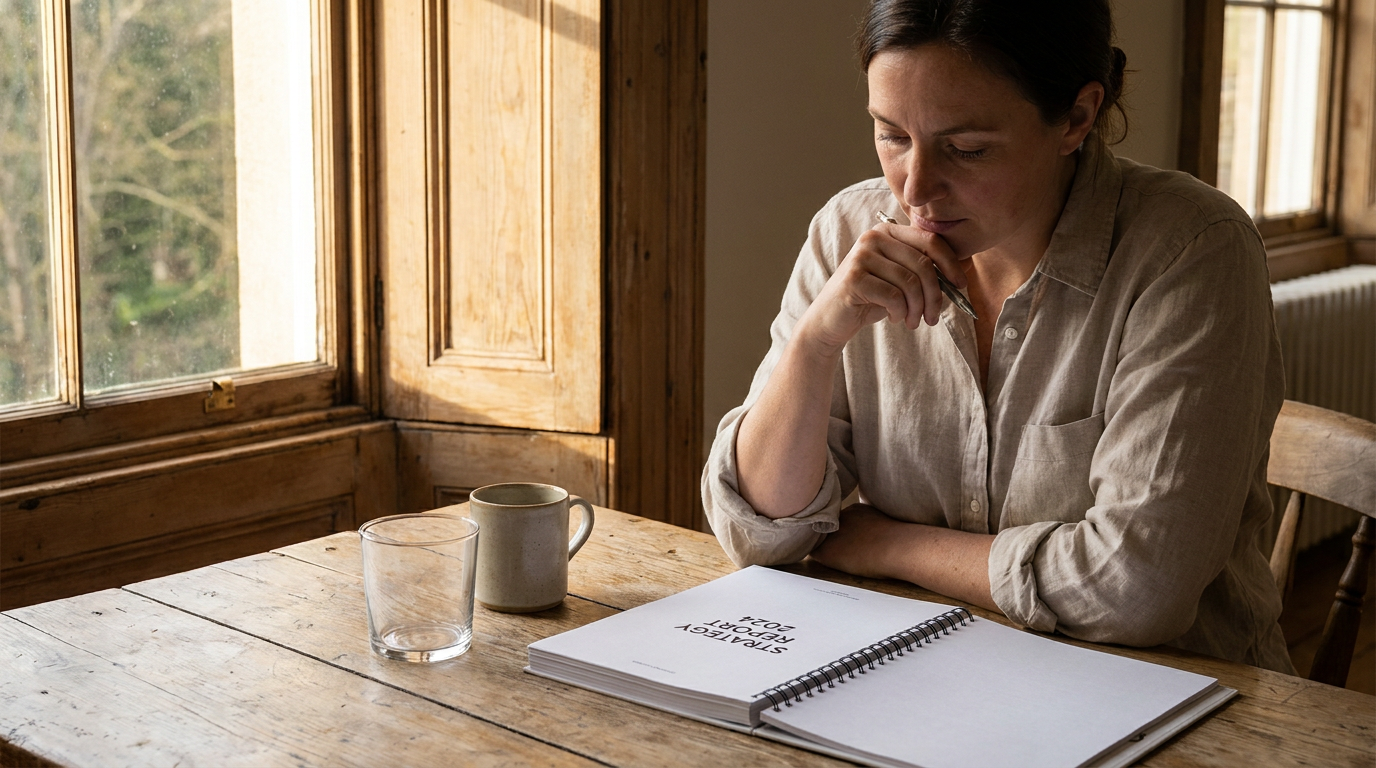
Picture a founder at her kitchen table on a Tuesday night. In front of her sits a beautifully bound 60-page strategy deck. The cover is embossed. The charts are gorgeous. The market landscape analysis runs eleven pages, and the recommendations section uses words like "positioning architecture" and "white space opportunity." She paid five figures for this document. It took four months to produce.
And she still has no drink.
No formulation. No sample she can hand to a buyer. No co-packer lined up. No label that will pass a regulatory review. No path to shelf. Just a very expensive summary of everything she should probably do next, delivered by someone who is no longer answering her emails with the same enthusiasm they had during the discovery call.
If you have lived some version of that story, this article is for you. Here is the truth of it in one line:
A consultant hands you a report. A collaborator hands you a result.
That single distinction, between deliverables and outcomes, is the most underrated decision a beverage brand makes. And the stakes are not abstract. According to Nielsen data reported by Beverage Industry magazine, . When the odds are that steep, the model you choose for developing your beverage is not a detail. It is the difference between shelf presence and a write-off.
roughly 85 percent of new products fail in the marketplace
This is where the choice of a beverage development company matters more than most founders realize. In the pages ahead, we will walk through what a true beverage development company actually does, where the traditional consultant model structurally breaks down, what real collaboration looks like from first sip to shelf, and exactly how to vet the partner you trust with your next product. By the end, you will know precisely which questions to ask and which answers should send you running.
Before we contrast the two models, we need to define the playing field. What does beverage development actually involve? The answer is bigger than most people expect.
What Does a Beverage Development Company Actually Do?
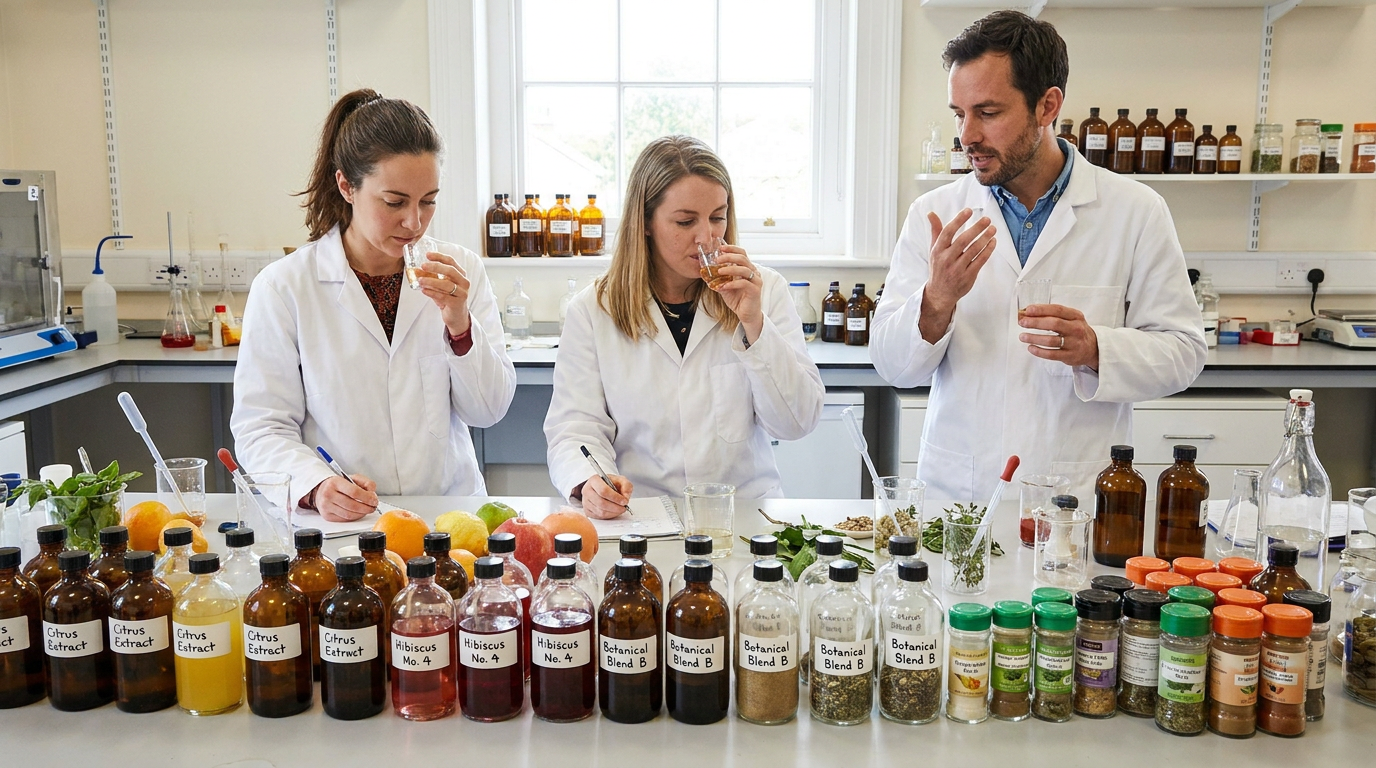
A beverage development company takes a drink from idea to commercial reality. That means concept creation, beverage formulation, sensory and shelf-life work, regulatory compliance, manufacturing scale-up, and go-to-market support, all handled as one continuous process rather than a stack of separate projects. The finished deliverable is not a document. It is a product that exists, tastes right, complies with the law, scales in a real facility, and sells.
That short definition hides an enormous amount of work, so let us unpack the real scope of beverage product development piece by piece.
Recipe and flavor development. Every great beverage starts as a sensory target. Someone has to translate "bright, sessionable, a little smoky, not too sweet" into an actual recipe with actual ingredients at actual usage levels. That is craft and science at once, and it takes people who have done it hundreds of times across categories.
Ingredient sourcing. The flavor house you choose, the sweetener system you commit to, and the functional ingredients you spec all shape your cost of goods, your label, and your shelf life. Sourcing decisions made casually at the bench become expensive problems at 10,000 cases.
Nutritional analysis and label compliance. In the United States, beverages must comply with FDA food labeling rules, and here is the part most first-time founders underestimate: the FDA does not pre-approve your label. As the agency's own makes clear, responsibility for getting the nutrition facts panel, ingredient statement, allergen declarations, and claims right sits entirely with you and your development partner. There is no safety net. Get it wrong and you are looking at relabeling costs, distributor rejections, or worse.
Food Labeling Guide
Co-packer selection and scale-up trials. A recipe that sings in a five-gallon bench batch behaves differently in a 5,000-gallon tank. Heat treatment changes flavor. Carbonation levels drift. Emulsions separate. Someone has to be physically present at the trial run, tasting against the target, adjusting in real time, and negotiating with the facility when minimum runs or tolerances shift.
Launch strategy. Even a perfect liquid needs a route to market: pricing that protects margin, packaging that earns the second look, a distribution plan that matches your operational reality, and a story that buyers can retell.
Now layer on the market context. The beverage space is not just crowded, it is accelerating. Mintel's research on tracked the non-alcoholic segment growing an estimated 10 percent in 2024 alone, and that is one category among dozens moving at similar speed. Functional beverages, ready-to-drink cocktails, better-for-you sodas, adaptogenic sparkling waters: every one of these spaces gets more sophisticated every quarter. The bar for execution keeps rising, which means the cost of slow, fragmented, advice-only development keeps rising with it.
non-alcoholic beverage trends in the US
Here is the key distinction, and it is the heart of this entire article: some firms advise on this process, and others actually do it.
An advisory firm will map the landscape, benchmark the competition, and recommend a direction. A true beverage development company will do all of that and then build the thing, standing next to you from concept to commercialization. We have written before about what that looks like end to end in Confusing these two models is the single most expensive mistake we see brands make. So let us look honestly at the first model, the one most founders encounter first, and examine exactly where it comes apart.
The Menu Collective Way: How We Design, Develop and Deliver Beverages That Actually Work
, and the short version is this: the work does not end when the recommendation is made. That is when it starts.
The Beverage Consultant Model: Where It Breaks Down
The traditional beverage consulting engagement follows an arc so familiar you can set your watch by it.
- The discovery calls. Energetic, insightful, full of promise. You feel heard.
- The audit. Your brand, your category, your competitors, all examined in detail.
- The market landscape deck. Handsome slides. Trend curves. Consumer segments with clever names.
- The recommendations report. Strategic priorities, suggested directions, a roadmap with phases.
- The invoice. Substantial.
- The handoff. A final presentation, warm goodbyes, an offer to "stay in touch."
Then the consultant leaves. And the hard part begins.
Notice what you are holding at the end of that arc: documents. Well-researched, intelligently argued, professionally designed documents. What you are not holding is a beverage. The formulation work, the compliance work, the scale-up trials, the co-packer negotiations, the thousand small decisions that determine whether a product actually ships and actually sells, all of that still sits in front of you. The engagement is complete. The product does not exist.
This is not a failure of the individual consultant's intelligence or effort. It is a failure of structure, and the structural flaws are worth naming one by one.
The deliverables are documents, not drinkable products. A beverage consultant is scoped, priced, and evaluated on the quality of analysis and recommendations. The engagement literally cannot produce a finished beverage because producing one was never in the contract.
Accountability ends at the handoff. When your formulation hits a stability problem in month four, the consultant is on another project. When your co-packer changes its minimum run requirements two weeks before your trial, the consultant is not in the room. The advice was sound at the moment it was given. The market did not agree to hold still.
Incentives reward billable phases, not commercial outcomes. A consulting engagement is successful when its phases complete on time and the client accepts the deliverables. Whether the product eventually performs on shelf has no bearing on whether the engagement was, by its own definition, a success. Read that sentence again, because it explains almost everything.
"A consultant hands you a report. A collaborator hands you a result."
Now, let us talk about money, because it is the question everyone asks and few firms answer plainly. How much does a beverage consultant cost? Beverage consulting fees commonly run from hourly rates in the low hundreds of dollars up to five- and six-figure project retainers for full strategic engagements. But the real cost question is not the fee. The real cost question is what you hold at the end. A $40,000 report that leaves 90 percent of the execution on your shoulders is dramatically more expensive than a larger engagement that ends with a finished, compliant, scaled, shelf-ready product. A report you still have to execute is the most expensive deliverable in the industry.
Connect this back to the failure data and the picture sharpens. FoodNavigator's analysis of the Nielsen research asked directly , and the recurring themes are execution problems: products that did not deliver on their promise, launches that were under-supported, formulations that did not survive contact with manufacturing reality. Advice without execution leaves the riskiest stretch of the journey, everything between "great idea" and "product performing in market," entirely in the hands of the brand, which is usually the party with the least experience navigating it. The consulting model does not cause product failure. It just declines to stick around for the part where failure happens.
why 85 percent of new CPG products fail within two years

So if the advice model is structurally mismatched to the work of building a beverage, what does the right structure look like? Let us flip the frame entirely.
To be fair, and we want to be fair: consultants add genuine value on narrow, well-defined strategy questions. If you need an independent read on a category, a pricing benchmark, or a second opinion on a positioning decision, a sharp beverage consultant earns their fee. The failure is not the people. The failure is asking an advice model to do a building job. You would not hire an architecture critic to pour your foundation.
The Collaborator Model: Shared Ownership from First Sip to Shelf
A collaborator is in the kitchen and in the lab. A collaborator does the beverage formulation with their own hands, tastes every bench iteration against the target, and reworks the recipe when the stability data comes back ugly. A collaborator is physically present at the co-packer trial at 6 a.m., cup in hand, comparing tank samples to the benchmark. A collaborator stays accountable through commercialization, because the thing they are invested in is the product that ships, not the deck that gets presented. When something breaks at month seven, a collaborator does not send condolences. They send a revised spec.
Collaboration is one of those words that gets stamped on everything, so let us define it with uncomfortable precision.
This is the model Menu Collective was built on, and it was built that way on purpose. Stuart McCarroll founded in 2016 after a career spanning more than 45 years in the global food and beverage industry, and he built it explicitly as a collective: a hand-picked group of creative and commercially astute beverage experts who do the work rather than describe it. "Collaborators, Not Consultants" is not a tagline that the marketing team came up with after the fact. It is the operating principle the whole company was assembled around, because Stuart had seen from the inside what happens to brands when advice ends at the handoff.
Menu Collective
The proof lives in the collaborations. Menu Collective has built beverages alongside some of the most demanding names in the industry: , where the team developed curated cocktail and coffee-cocktail programs city by city, designed the bar experience, and trained the staff who would bring it to life. That collaboration earned Range matters here, and it matters more than most brands realize when they are choosing a partner. Any base, any format: canned cocktails, dairy-based beverages, cold brew, functional sparkling waters, non-alcoholic platforms, hot programs, RTDs. A partner who has only ever worked in one category will unknowingly import that category's assumptions into yours. A collective with breadth catches problems, and opportunities, that specialists miss.
coverage in Eaterfull bar development for the Starbucks Reserve Roastery
, which is the kind of third-party validation no deck can manufacture. The client list runs from 7-Eleven, Red Robin, Dairy Farmers of America, and Goose Island to bold start-ups and independent innovators working from a single great recipe and a conviction.
At the center of the Menu Collective process sits an idea worth understanding deeply: the Gold Standard productThe Gold Standard is the benchmark version of your beverage, defined together at the very start of the work. It is the liquid, the flavor, the aroma, the mouthfeel, the story, and the experience, agreed on and documented before scale-up ever begins. From that moment on, every decision in development is measured against it. When an ingredient substitution is proposed to hit a cost target, the question is: does the result still meet the Gold Standard? When thermal processing shifts the flavor profile, the question is: how do we adjust the formulation to get back to the Gold Standard? The benchmark version of your product is not a nice-to-have. It is the contract between your vision and your commercial reality, and a true collaborator defends it through every single stage of development.
.
"We work with you and alongside you to help bring your passion to life in a product."
That line comes from the heart of Menu Collective's mission, and it captures the accountability difference in a sentence. A collaborator's work is not done when the presentation ends. It is done when the product works in the real world, at real volumes, at real margins, in the hands of real customers. Nothing short of that counts as finished.
Words are one thing. Contrast is another. Put the two models directly side by side and the difference becomes impossible to miss.
Beverage Consultant vs. Beverage Development Company: Side by Side
Here is the direct answer for anyone searching for it: a beverage consultant advises and hands off recommendations, while a collaborative beverage development company builds alongside you, owning formulation, compliance, scale-up, and launch support all the way through commercialization. One model ends where the work begins. The other ends when the work is done.
Now let us run the comparison dimension by dimension, so you can see exactly where the two models diverge.
Primary deliverable.
The consultant delivers a report and recommendations. The collaborative beverage development company delivers a commercial-ready Gold Standard product you can hold, taste, and sell.
Involvement.
The consultant works in advisory phases with a defined end date. The collaborator is hands-on from concept to commercialization, in the room for every trial, tasting, and decision that shapes the outcome.
Formulation work.
For the consultant, formulation is typically outsourced to a third party or explicitly out of scope. For the collaborator, beverage formulation is done in-house by expert formulators who own the recipe's journey from bench to tank.
Accountability.
The consultant's accountability ends at the handoff meeting. The collaborator's accountability continues through manufacturing scale-up and launch, because the engagement is defined by the product performing, not the project completing.
Regulatory and compliance.
The consultant flags compliance as a risk for someone else to manage. The collaborator builds compliance directly into the formulation process, so the label and the liquid are developed as one.
Success metric.Read those six dimensions again and notice something important: the difference between the models is not effort, and it is not intelligence. Plenty of brilliant, hardworking people operate inside the consulting model. The difference is structure and incentive. A consultant is structurally rewarded for finishing phases. A development partner is structurally rewarded for finishing products. When you choose between a beverage consultant and a beverage development company, you are not choosing between smart and less smart. You are choosing which outcome the entire engagement is built to produce.
The consultant measures success as a project completed and deliverables accepted. The collaborator measures success as a product performing in market, at volume, at margin.
If you want to pressure-test the collaborator column against reality, the full scope is laid out plainly on the The comparison shows you the what. Now let us walk through the how, using the three-stage framework that turns collaboration from a philosophy into a repeatable process.
Menu Collective services page
: concept and menu design, formulation and commercialization, and go-to-market support, offered as one continuous capability rather than a menu of disconnected phases.
Design, Develop, Deliver: Collaboration in Practice
Menu Collective's entire process runs on three words: Design, Develop, Deliver. Each stage covers work a consultant either ends before, skips entirely, or hands to someone else. Walking through them one at a time makes the collaborator model concrete.
Design: Defining the Gold Standard Together
And here is the uncomfortable truth about the consultant model: a typical consulting engagement ends roughly where this stage ends. The landscape is mapped, the direction is recommended, the concept is described. For a consultant, that is the finish line. For a collaborator, that is the starting gun.
Notice what is already different. The creative work here is grounded in commercial reality from day one: target cost of goods, intended channel, format constraints, and category dynamics all shape the concept while it is still soft clay. A beautiful idea that cannot hit margin is not a beautiful idea. It is a future write-off wearing nice packaging.
Every project starts with people and a benchmark. The Design stage begins by selecting the right beverage experts from the collective for your specific project, because a functional sparkling water and a dairy-based indulgence need different hands. Then comes the defining act of the whole engagement: establishing the Gold Standard product together. Concept direction, flavor architecture, sensory targets, brand story, and the commercial parameters the product must live within, all agreed and documented before a single scale-up decision gets made.
Develop: Turning the Benchmark into a Beverage That Scales
The Develop stage is where beverage formulation earns its reputation as equal parts craft and science. The Gold Standard now has to become a scalable formulation: bench trials iterating toward the target, ingredient systems selected for both flavor and stability, sweetness and acidity balanced against processing effects, shelf-life and stability testing run and rerun until the data holds.
Compliance is built in here, not bolted on later. US beverage labels must satisfy the detailed federal requirements laid out in This is beverage product development at its most demanding, and it is exactly where an advice-only partner is nowhere to be found.
21 CFR Part 101
, covering everything from the nutrition facts panel to ingredient declarations to the rules governing every claim on the can. A collaborator builds compliance into the recipe as it develops, so the formulation and the label grow up together. A consultant flags compliance as a risk in a slide. There is a universe of difference between those two sentences, and it is usually discovered at the worst possible moment.
Deliver: From Finished Formula to Performing Product
A perfect liquid with no route to market is a hobby. The Deliver stage covers sales, marketing, and distribution strategy, co-packer selection and trial support, packaging finalization, and the launch work that turns a finished formulation into a performing product. This is where the collaborator stands beside you at the production trial, tasting the first tank samples against the Gold Standard, and does not sign off until the product at volume is the product you designed.
The Framework in the Wild: Fuego Rojo and Beyond
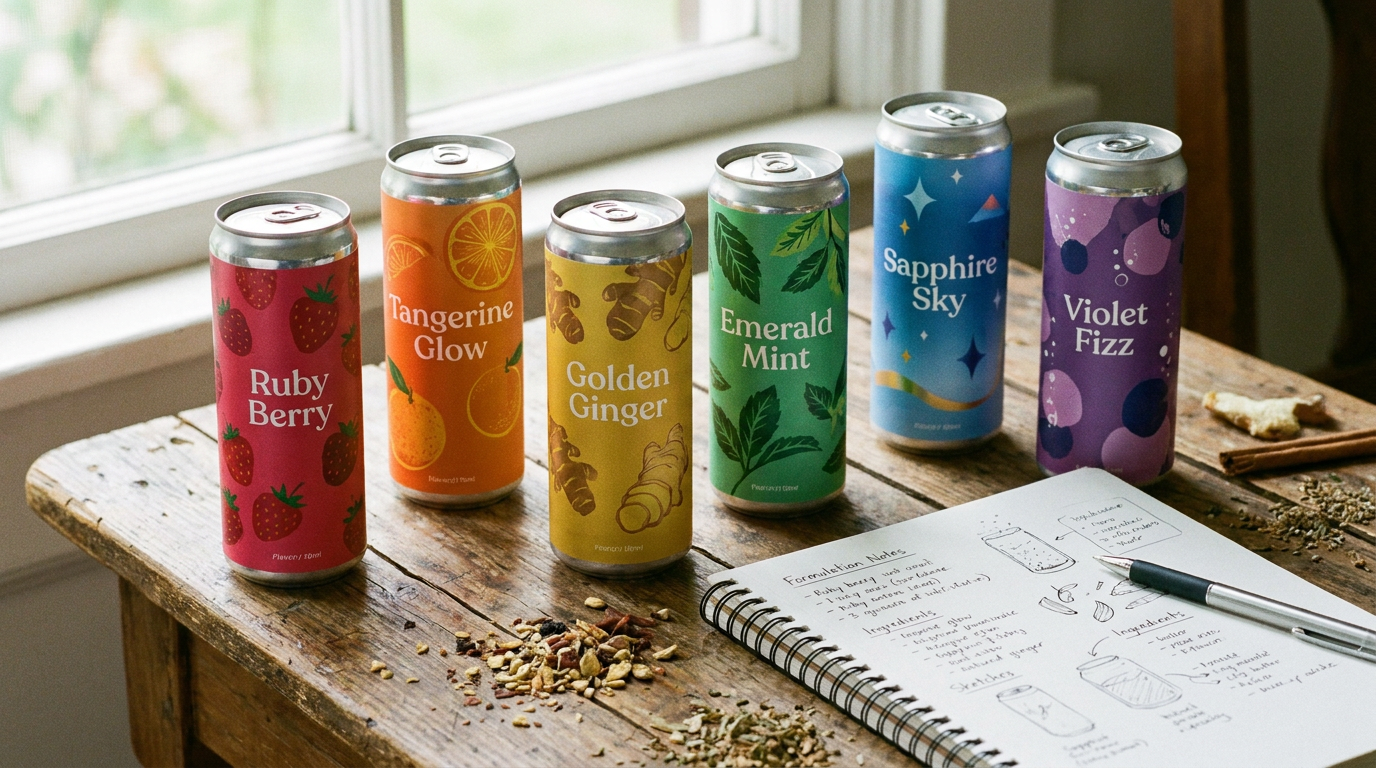
Frameworks are only as good as the products they produce, so here is the model in narrative form. The Fuego Rojo story began with a family michelada recipe served in a Chicago backyard, the kind of recipe friends beg for and strangers ask about. Menu Collective took that recipe , building it into a six-flavor non-alcoholic michelada platform: concept definition, full formulation across every flavor, and co-packer selection to bring it to market. Design, Develop, Deliver, executed end to end on a product that started as a family tradition and became a commercial platform.
from backyard to bottle
And the framework flexes across categories. When a coffee brand wanted to move into ready-to-drink territory, the same process produced an : Gold Standard defined first, then carbonation, fruit elements, and coffee character balanced into a scalable recipe aligned with the brand's identity. Different base, different format, different category. Same accountability from concept to commercialization.
RTD cold brew shandy formulation
The model is clear. The framework is proven. The remaining question is the practical one: how do you evaluate the partners in front of you right now? Let us arm you properly.
How to Choose a Beverage Development Partner: Scenarios and Red Flags
Theory is useful, but decisions happen in specific situations. Here are three scenarios we see constantly, drawn as composites from years of conversations with brands. Find yourself in one of them and the right path gets much clearer.
Scenario One: The Founder with the Great Home Recipe
Under the collaborator model, you define your Gold Standard product together in week one, and the work that follows is the actual work: bench formulation, stability testing, label development, co-packer selection, trial support. The Fuego Rojo story above is this exact scenario, played out to a six-flavor platform on shelves.
Under the consultant model, you receive a market landscape deck confirming that yes, your category is interesting, and a roadmap recommending that you pursue formulation, compliance, and manufacturing. You knew that. That is why you called.
You make something people love. Friends tell you to sell it. You have the recipe, the passion, and the story. What you need is formulation that scales, a compliant label, and a co-packer who will take your volume seriously.
Scenario Two: The Established Brand Extending into a New Category
You have a successful brand and you are moving into an adjacent space, say functional beverages, where the landscape shifts every quarter. Speed to a credible product matters far more than another trends report, because your window is measured in months, not planning cycles. If you want the current state of that particular category, we broke down The consultant model gives you a competitive audit and a recommended positioning. Useful, and six weeks later a competitor launches and the audit is a historical document. The collaborator model puts an expert formulation team on your concept immediately, building a real product while the window is still open. In fast categories, execution speed is strategy.
the functional beverage trends that are actually sticking in 2026
, and the pace of change there makes the point better than any argument.
Scenario Three: The Brand That Already Paid for the Report
This scenario is more common than anyone in the industry likes to admit, and there is no shame in it. The move is simple: bring the report, keep whatever thinking holds up, and hand the building to people who build. A collaborator will treat a solid strategy document as a head start, not a threat.
You hired a beverage consulting firm. You hold the strategy document. It is genuinely good. And you have slowly realized that nobody on your team can execute what it describes, because describing a formulation strategy and building a formulation are different professions.
The Vetting Checklist: Six Questions to Ask Any Partner
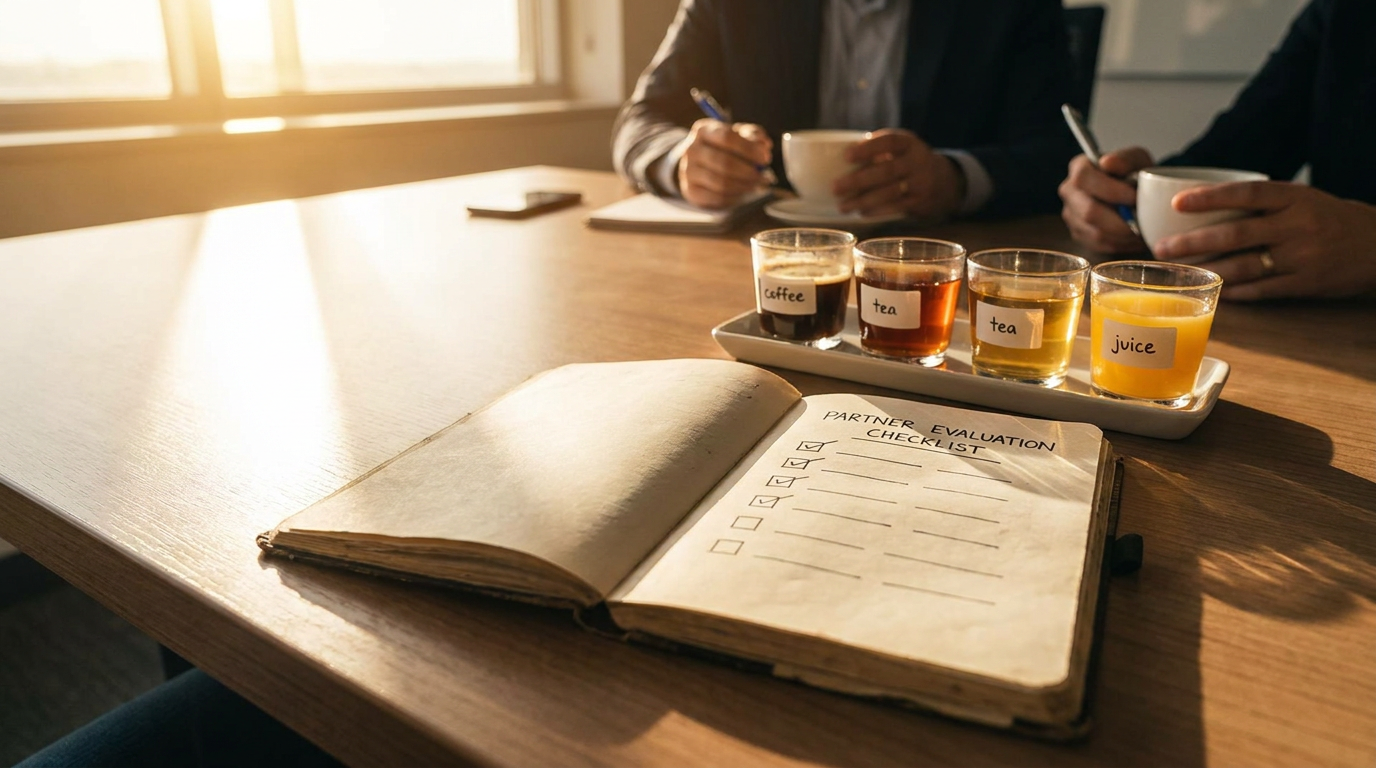
Whoever you are considering, put these six questions on the table and listen carefully to the answers.
- Do you formulate in-house? If formulation is subcontracted or "coordinated," you are hiring a middleman with margin stacked on top.
- Who owns the recipe when we are done? The answer must be you, in writing, without ambiguity. Anything else is a leash.
- Are you with us through scale-up and co-packer trials? Physically present, tasting against the benchmark, not available by phone.
- What does your accountability look like after handoff? Listen for specifics. Vagueness here predicts absence later.
- Can you show finished products, not just frameworks? Real cases with real outcomes, like the ones in the Menu Collective case studies. Frameworks are easy. Finished products are proof.
- Do you define a Gold Standard together at the start? If there is no shared benchmark, there is no shared definition of success, and every disagreement later will prove it.
Red Flags That Should End the Conversation
- Deliverables described exclusively as documents, decks, roadmaps, or audits.
- No bench work, no lab capability, no tasting in the process description.
- Vague or evasive answers about involvement after the handoff.
- A pitch heavy on jargon and light on drinkable evidence.
- No finished products they can point to on an actual shelf.
Any single one of these deserves a hard follow-up question. Two or more, and you already have your answer.
You now have the scenarios, the questions, and the warning signs. Let us close the education loop by answering the remaining questions people search for most, in plain and direct terms.
FAQ: Beverage Consultants, Development Companies, and Costs
What does a beverage development company do?
A beverage development company takes a drink from concept to commercial reality. That includes concept creation, beverage formulation, sensory and shelf-life testing, regulatory and label compliance, co-packer selection, manufacturing scale-up, and launch support. The deliverable is a finished, compliant, scalable product, not a set of recommendations.
What is the difference between a beverage consultant and a beverage development company?
A beverage consultant advises: audits, market analysis, and recommendations, ending at handoff. A collaborative beverage development company builds alongside you: hands-on formulation, compliance built into the recipe, presence at scale-up trials, and accountability through commercialization. One delivers a plan. The other delivers a product performing in market.
How much does a beverage consultant cost?
Beverage consulting fees typically range from hourly rates in the low hundreds of dollars to five- and six-figure project retainers for full strategic engagements. The fee is only part of the cost. The larger cost is execution left undone: a report still requires formulation, compliance, scale-up, and launch, all of which remain on your shoulders after the engagement ends.
What should I look for in a beverage development partner?
Look for in-house formulation, clear recipe ownership that stays with you, hands-on involvement through scale-up and co-packer trials, visible finished products rather than frameworks, and a defined Gold Standard process that sets the benchmark before development begins. A partner missing any of these is closer to an advisor than a builder.
Is Menu Collective a beverage consulting firm?
No. Menu Collective is a beverage development company built on collaboration, founded in 2016 by industry veteran Stuart McCarroll. The team of creative and commercially astute experts works alongside brands from concept to commercialization, defining a Gold Standard product together and defending it through formulation, scale-up, and launch. More answers live on the .
Menu Collective FAQs page
Every question answered, every model examined. Time to bring the argument home.
The Bottom Line: Choose a Beverage Development Company That Builds
We build alongside you, every step of the way. Let's create something new together.
Think back to that founder at her kitchen table with the beautiful binder. Now picture her a year later, holding a cold, finished can with her name on it, fresh off a production run that matched the benchmark. Same founder. Same passion. Different partner. That is the whole difference, and it was a choice.
In an industry where most new products fail, the structure of your partnership decides your odds before your first bench sample is ever poured. Reports do not survive contact with a production line. Collaboration does. The beverage development company you choose either ends its work where yours begins, or stands beside you until the product in your hand matches the Gold Standard product you dreamed up together.
Ready to Work with Collaborators, Not Consultants?
Skip the report and start building. Let's talk about your beverage: the idea in your head, the recipe in your kitchen, or the strategy document gathering dust on your desk. and let's define your Gold Standard together.
Book your free consult with Menu Collective
Prefer to talk it through? Call us at (630) 642-0721. Either way, the first conversation is free, and it will feel different from the discovery calls you have had before. Because we are not scoping a report. We are starting a build.