Here is what almost no one in beverage development will tell you about timelines: most of the people quoting you a number have already decided what you want to hear.
So let's start with the real answer, before anything else.
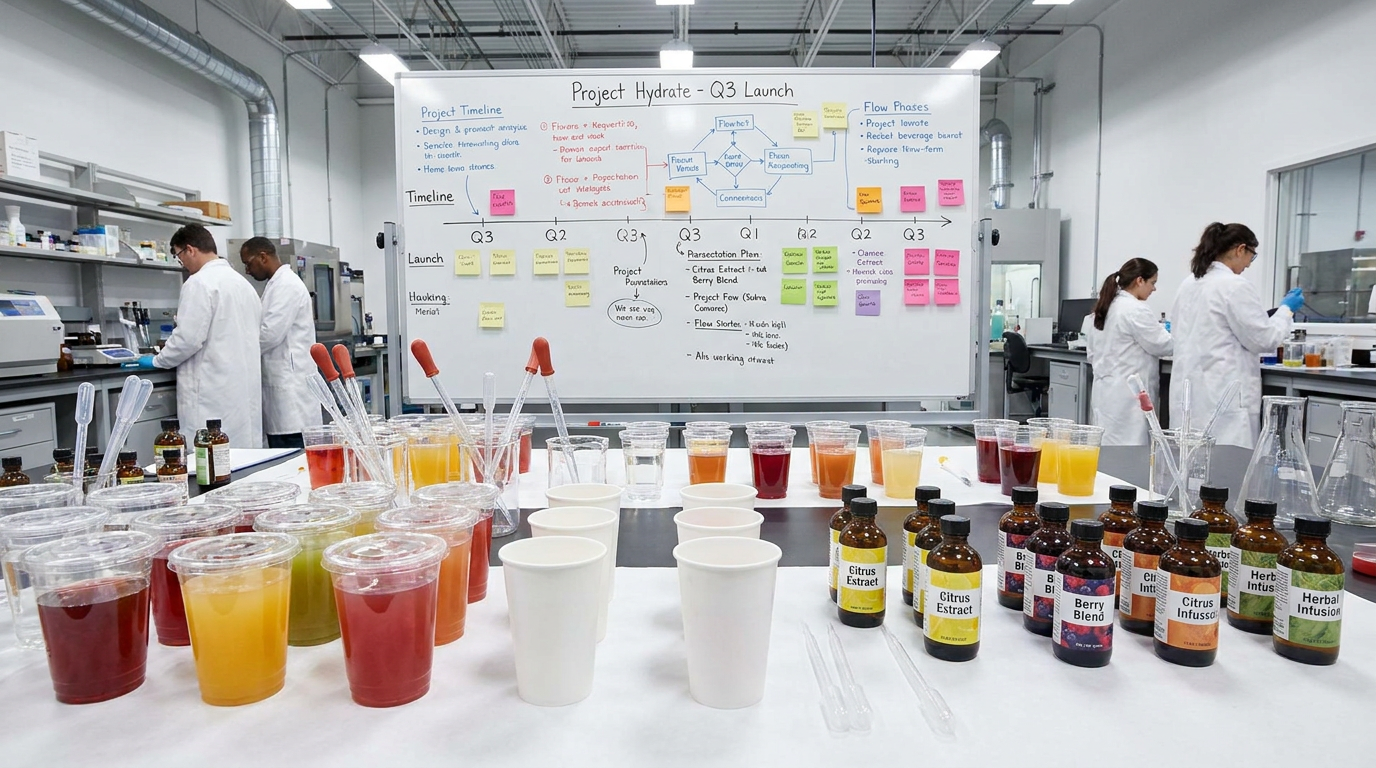
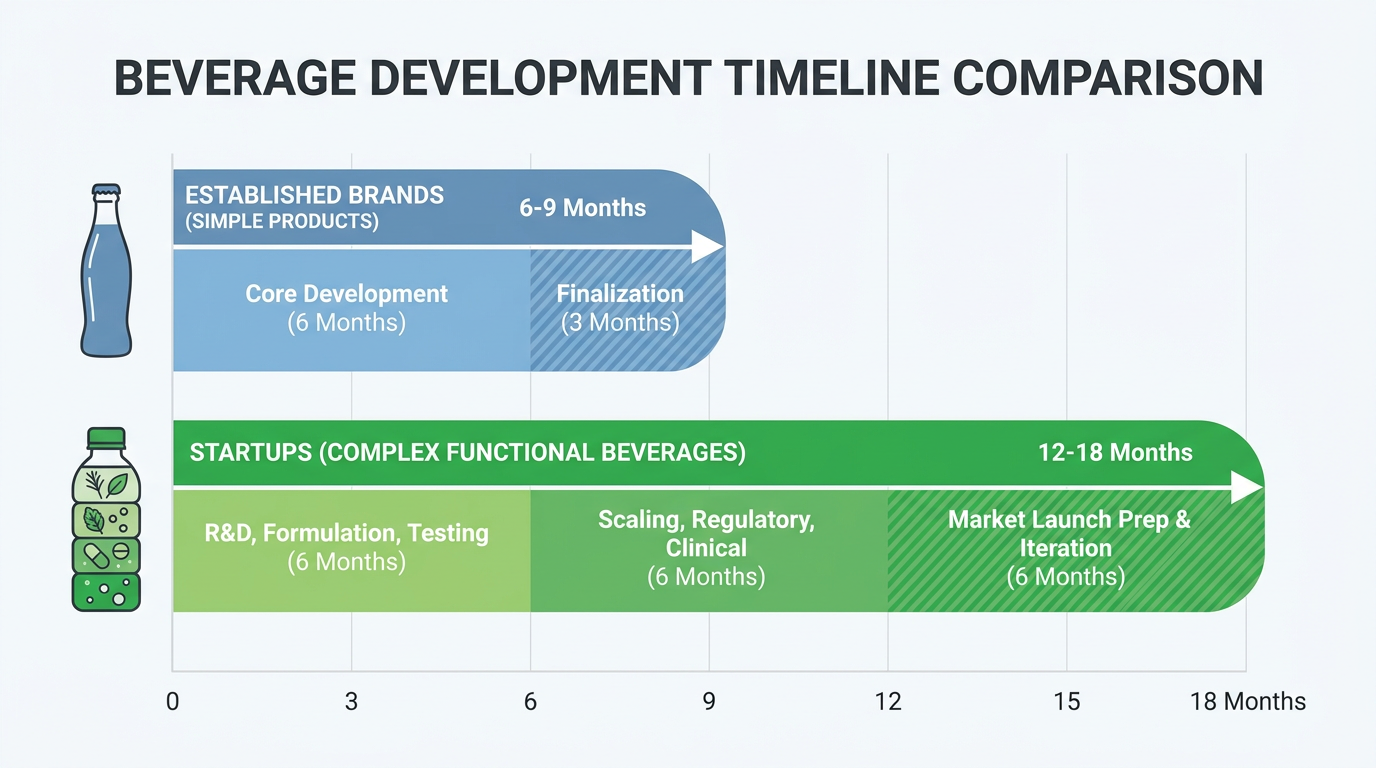
Most beverage products take 6 to 12 months to go from concept to shelf. Simple beverages built by established brands with existing supply chains and co-packer relationships can land in 6 to 9 months. Complex functional or regulated beverages built by first-time founders typically take 12 to 18 months. Those are not aspirational numbers. They are what actually happens.
If you have been shopping for a development partner, you already know the ritual. You ask how long it takes. You get a thoughtful pause, a sympathetic nod, and some version of "well, it really depends." Then you get a proposal with no dates on it. It is maddening, and it is not entirely dishonest — timelines genuinely do vary — but "it depends" is only useful if someone tells you what it depends on. That is what this article does.
This is written for three people. The founder trying to figure out whether a spring launch is realistic or delusional. The brand manager who has a board deadline, a budget cycle, and a innovation slate that has to ship. And the QSR or hospitality operator building a beverage program across dozens or hundreds of locations, where formulation is the easy part and rollout is the mountain.
Here is what you will get, in order:
- Why timelines vary so wildly — the three variables that actually drive your calendar
- A phase-by-phase breakdown with realistic duration ranges for all six stages of beverage product development
- Timelines by project type — simple RTD, functional, alcoholic, hemp, dairy, and QSR programs
- The five things that quietly destroy schedules and how to spot them early
- A compression playbook for going faster without cutting the corners that matter
- Straight answers to the questions people ask right before they sign
No hedging. Answer first, explanation second.
Why Beverage Development Timelines Vary So Much
A beverage product development timeline is not a fixed number — it is the output of three variables: how complex the product is, how mature the company building it is, and how heavily regulated the category is.That single sentence is the whole framework. Everything else in this section is elaboration. But it is worth understanding deeply, because once you can locate your own project along those three axes, you stop guessing at your timeline and start engineering it.
Change any one of those and the calendar moves by months.
Variable One: Product Complexity
Complexity does not add time linearly. It compounds. Each additional functional ingredient does not add a week — it adds a set of possible interactions with everything already in the formula, and each of those interactions is something stability testing might surface at the worst possible moment.
The wellness shot is a different animal entirely. Every active ingredient you add multiplies the interactions you have to test. Botanicals bring bitterness that needs masking, and taste-masking systems interact with sweeteners, which interact with acids, which affect the stability of the very actives you are dosing. Probiotics need to stay alive. Vitamins degrade at different rates. Some ingredients settle, some float, some slowly turn the whole thing an unappetizing brown around week nine.
The sparkling water has maybe six ingredients. Its failure modes are well understood. Carbonation levels, flavor loading, pH, and a sweetener system that does not go weird after four months in a warm warehouse. A competent bench chemist has solved that problem a hundred times.
There is an enormous difference between a lightly sweetened sparkling water and a shelf-stable wellness shot with four botanical actives, a probiotic culture, and a clinically dosed adaptogen.
Variable Two: Company Maturity
This is why the same product concept can be a 7-month project for one company and a 14-month project for another. The formula is identical. The infrastructure is not.
A first-time founder has none of that. Every one of those relationships has to be built from zero, and building them takes calendar time that has nothing to do with how good the idea is. Finding the right co-packer alone can take two months of calls, site visits, and capability matching. Qualifying an ingredient supplier takes weeks. Learning what questions to ask takes even longer, and most founders learn by getting an answer wrong first.
An established beverage brand launching a line extension already has the infrastructure. They have a co-packer on contract with known equipment, known minimums, and a production slot they can book. They have a regulatory person who has reviewed four hundred labels. They have ingredient suppliers with negotiated lead times. They have a decision-making process that has been stress-tested by previous launches. They know what a good brief looks like because they have written dozens.
This one surprises people, because it has nothing to do with the liquid.
Variable Three: Regulatory Category
Alcohol does. Hemp-derived cannabinoids do, differently, in every state. Those categories put a government approval on your critical path, and approvals are the one part of a timeline you cannot sprint through by working harder.
A conventional non-alcoholic beverage in the United States requires a compliant label, honest ingredient declarations, accurate nutrition facts, and claims you can actually substantiate. That is real work, but it is predictable work, and it does not require anyone in Washington to say yes before you can sell.
What the Industry Data Actually Says
Now the benchmark. Beverage Industry's recurring has consistently put the average concept-to-launch time for beverage products in the eight to nine month range, with roughly four in ten companies reporting a development window of six to nine months.
New Product Development research
Sit with that for a second, because it reframes the conversation. The industry average is around eight months. Not three. Not five. Eight. And that average is heavily weighted toward established companies running line extensions with infrastructure already in place — the easiest version of the job.
So when a development shop tells a first-time founder with a novel functional formula that they will be on shelf in 90 days, they are not describing beverage development. They are describing a sales pitch.
The Variable Nobody Puts in the Proposal
Here is the one that does not appear in any timeline chart, and it is frequently the largest single line item on a real project: decision speed.
Not lab speed. Not co-packer speed. Your speed.
Consider a normal tasting round. Samples ship on a Tuesday. The founder is traveling, so the tasting happens the following week. Two of the four stakeholders have opinions that contradict each other. Someone wants to loop in an advisor. A decision gets deferred to the next standing meeting, which is in nine days. Feedback finally arrives — and it is qualitative, contradictory, and impossible to act on precisely. "It needs to feel more premium."Multiply by four or five iteration rounds and client-side decision latency has quietly consumed four months of your calendar. No lab caused it. No supplier caused it. It happened in the gap between samples arriving and someone saying yes.
That round took five weeks. The actual bench work inside it took four days.
The bench team makes their best interpretation, and the cycle starts again.
At Menu Collective, this is the pattern we see most often, and it is the reason our begins by defining what we call the Gold Standard — a precise, agreed articulation of exactly what the finished product must be, sensorially and commercially, before a single sample gets made. It sounds like a soft, strategic exercise. It is actually the hardest-edged scheduling tool in the business.
beverage development process
"The biggest predictor of an on-time launch is not the lab. It is how clearly you defined the product before the lab ever got involved."
Now that you know what moves the number, let's walk through exactly where those months go.
A vague brief does not just risk the wrong product. It guarantees iteration loops with no exit condition, because without a definition of "right," no sample can ever be right — it can only be different.
The Beverage Development Timeline, Phase by Phase
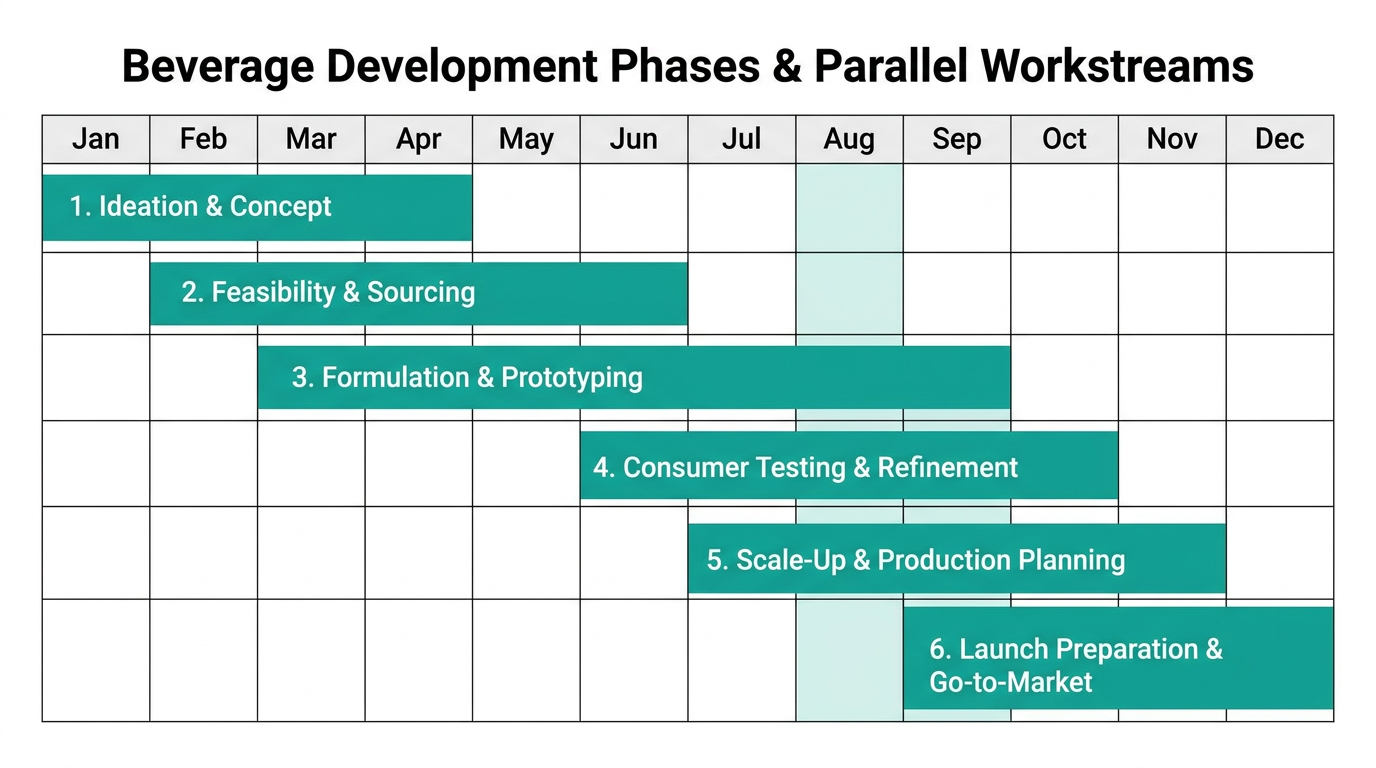
Beverage product development breaks into six phases. Here are the honest duration ranges for each:
- Concept development and brief — 2 to 8 weeks
- Formulation and sensory work — 6 to 16 weeks
- Shelf life and stability testing — 12 to 16 weeks (longer for 12–24 month shelf life claims)
- Regulatory and labeling — 2 to 12 weeks
- Co-packer qualification and pilot runs — 8 to 12 weeks after formula lock
- First production and launch — 6 to 8 weeks
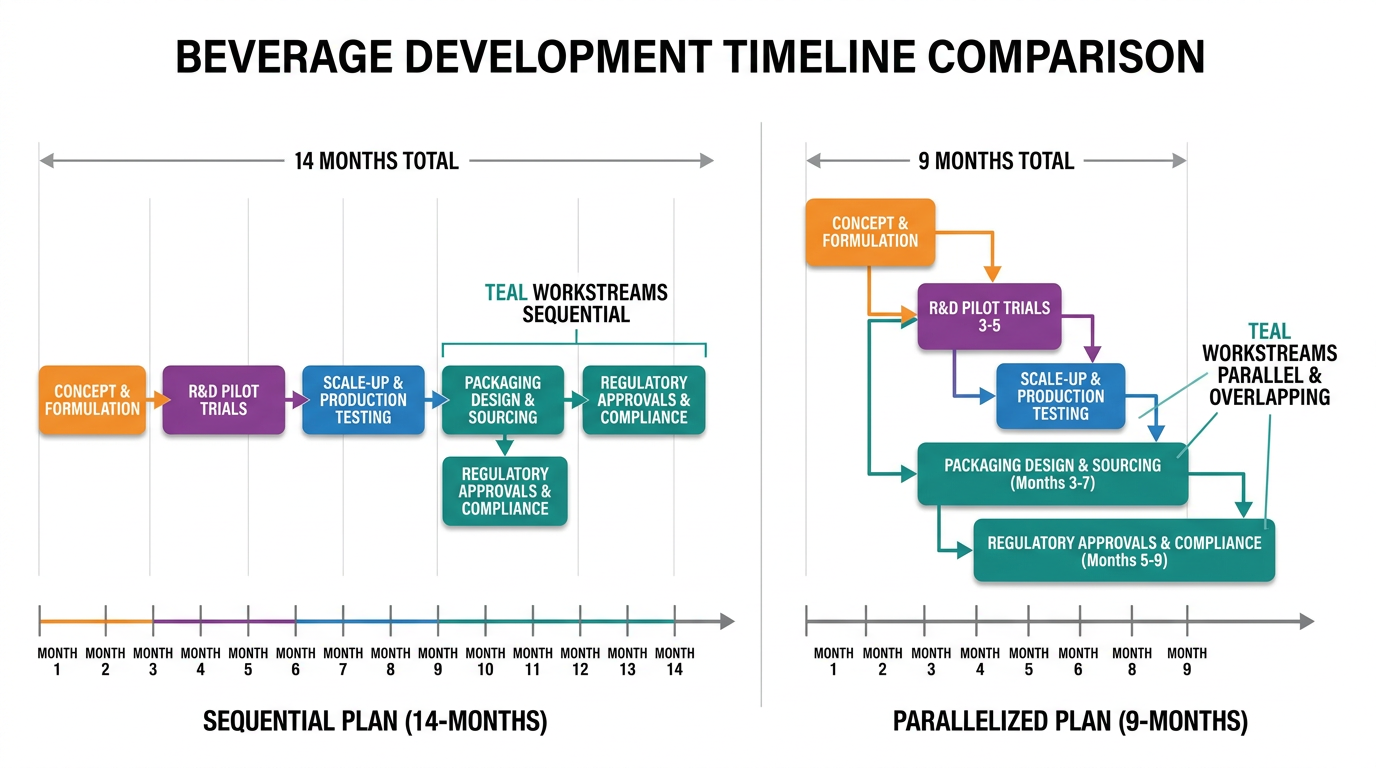
Before you add those up and panic: do not add those up. In a well-run project, these phases overlap substantially. Regulatory review runs alongside formulation. Packaging development runs alongside stability. Co-packer qualification begins while the formula is still being refined. The sum of the parts is around 36 to 72 weeks; the actual elapsed time for a well-sequenced project is meaningfully shorter, because parallel work is the entire game.
Phase One: Concept Development and the Brief (2–8 Weeks)
This is where you decide what you are actually making, and it is the phase most likely to be rushed by people who are excited.
The work here is definition. Who is the target consumer and what occasion are you serving? What is the format, the pack size, the price point, the channel? What does the product need to taste like, and against what reference? What claims does the brand strategy require, and are those claims formulable? What is the target cost of goods, because that constraint will shape every ingredient decision downstream?
Two weeks is achievable when a brand has a clear innovation strategy and an existing product architecture to extend. Eight weeks is realistic when a founder is still deciding between three concepts, or when a QSR operator needs to align marketing, operations, and supply chain before anything can be locked.
Done looks like: a written Gold Standard definition that a stranger could read and understand precisely what success tastes like, costs, and claims. If your brief cannot survive that test, you are not finished with phase one — no matter what the calendar says.
Phase Two: Beverage Formulation and Sensory Work (6–16 Weeks)
Beverage formulation typically takes 6 to 16 weeks, depending on the complexity of the product and how many iteration rounds it takes to hit the target. That range is wide for one reason: iteration count.
Most projects run three to five formal rounds. A round is a full cycle — bench work, sample production, shipping, structured tasting, consolidated feedback, direction for the next iteration. The bench work itself is often the shortest part. The wrapping around it is what consumes weeks.
Beverage formulation is where science and craft genuinely meet, and both halves matter. The science is real: pH targets, water activity, Brix, viscosity, buffering systems, solubility of actives, and the interaction chemistry between every ingredient in the matrix. But the craft is equally real, and it is what separates a technically compliant beverage from one people want a second sip of. Flavor is architecture — top notes, mid-palate, finish, mouthfeel, aftertaste — and building it well is a skill earned over hundreds of formulas.
The functional beverage category is where this phase stretches hardest. Taste-masking a meaningfully dosed active is one of the genuinely difficult problems in the field. You can dose it low enough to taste good and lose your claim, or dose it properly and fight bitterness, astringency, and off-notes for six extra weeks. There is no clever shortcut, only experience with what has worked before.
Done looks like: a locked formula with a documented ingredient statement, confirmed supplier specs, a validated process, and a target COGS you have actually costed rather than estimated.
You can see how this plays out at multi-SKU scale in , where a backyard michelada recipe became a six-flavor commercial platform. Six flavors could have meant six independent formulation projects. Defining the Gold Standard first meant building one validated base architecture and then differentiating across it — which is the difference between a project that fits in a year and one that does not.
our work with Fuego Rojo
Phase Three: Shelf Life and Stability Testing (12–16 Weeks)
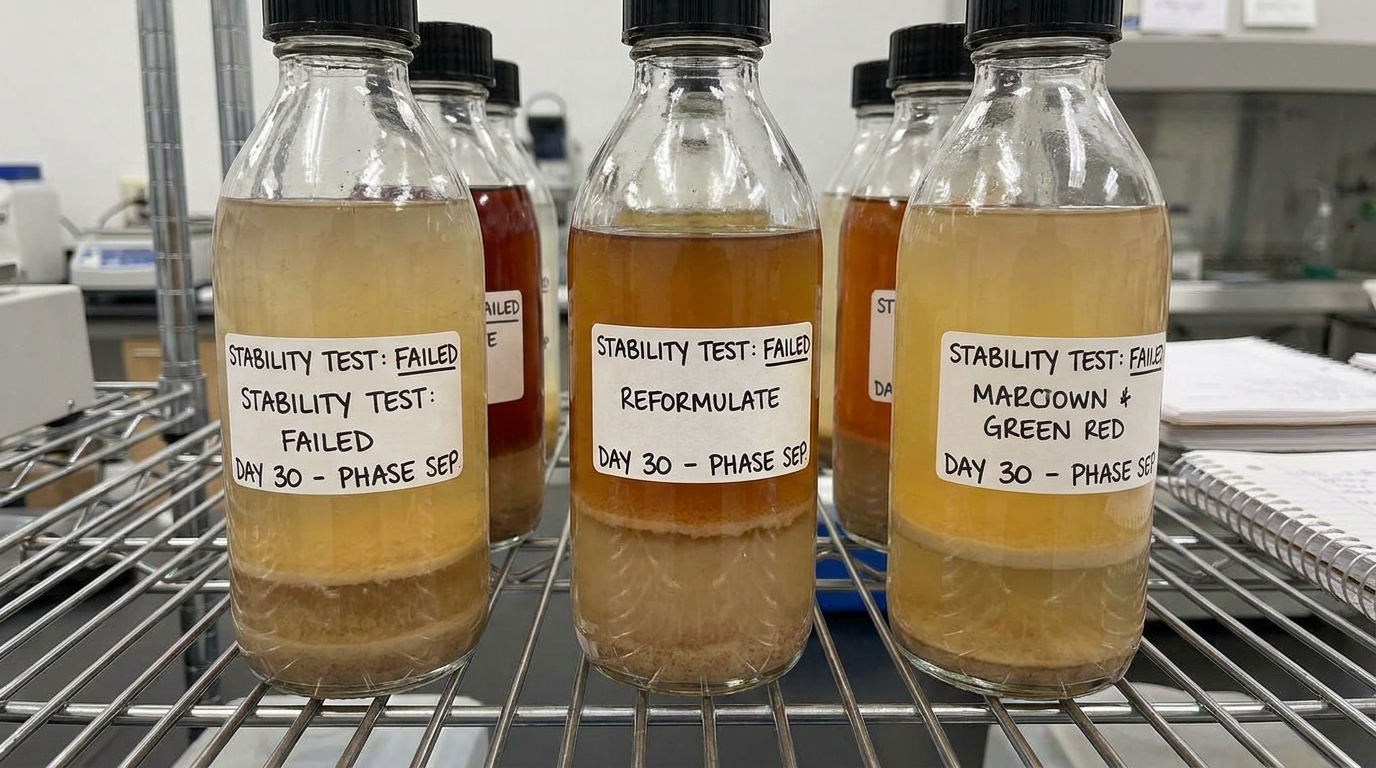
Stability testing answers a question you cannot answer any other way: what does this product look, smell, and taste like after months on a warehouse shelf, a delivery truck in July, and a retail display under fluorescent light? Formulas that are perfect on day one can separate at week eight, fade in flavor by week twelve, brown at week sixteen, or slowly lose the vitamin potency printed on the label.
This is the phase founders most want to skip and most regret skipping.
Accelerated testing is the standard tool. By holding samples at elevated temperatures, you compress months of real-time aging into weeks — the offers a good plain-language overview of how shelf life studies are designed and what they can and cannot tell you. Acceleration is genuinely useful and genuinely limited. It models some degradation pathways well and others poorly, which is why serious programs run accelerated and real-time studies in parallel: accelerated to make decisions, real-time to confirm them.
Food Innovation Center at Oregon State University
The hard truth about this phase is asymmetry. A passed stability test costs you the twelve to sixteen weeks you planned for. A failed one sends you back to formulation and can add two to four months. And you typically find out at week twelve, not week two.
Done looks like: documented data supporting your specific shelf life claim under realistic distribution conditions — not a hopeful assumption.
Phase Four: Regulatory and Labeling (2–12 Weeks)
For a conventional non-alcoholic beverage, this phase is about compliance rather than approval. Nobody has to authorize your launch, but your label has to be right, and "right" is a technical standard with real specificity behind it.
That means an accurate ingredient statement in descending order of predominance, a correctly formatted Nutrition Facts panel, proper allergen declarations, accurate net quantity of contents, and claims that hold up. The is the working reference, and it is more readable than its length suggests.
FDA's Food Labeling Guide
The range is driven almost entirely by claims complexity. A flavored sparkling water making no claims might clear review in two weeks. A product carrying structure/function claims, an organic certification, and a "no added sugar" declaration needs substantiation files, certification paperwork, and careful review of every adjacent word on the can. That is a twelve-week conversation.
Done looks like: print-ready artwork reviewed against the actual final formula, with substantiation documented for every claim on the package.
Phase Five: Co-Packer Qualification and Pilot Runs (8–12 Weeks After Formula Lock)
Scale-up is where theory meets stainless steel. Mixing behaves differently at volume. Thermal profiles change. Filling equipment has opinions about viscosity and foam. Carbonation targets shift between bench and line. Ingredients that dispersed beautifully by hand can clump in a 3,000-gallon tank. Pilot runs exist to find these problems while they are still cheap.
A formula that works in a five-liter bench batch is a hypothesis. A pilot run is the experiment.
The eight-to-twelve-week window covers qualification paperwork, ingredient procurement at commercial volumes, line scheduling, the pilot itself, and the adjustments that follow. Note the trigger: after formula lock. Co-packers schedule in queues, and desirable ones are frequently booked eight to sixteen weeks out.
Done looks like: a successful pilot producing product that matches your Gold Standard, with a documented process, confirmed line speeds, and a booked production slot.
Phase Six: First Production and Launch (6–8 Weeks)
The last stretch: full production, quality release, packaging and coding, warehousing, distributor allocation, and the commercial machinery of actually selling.
Six to eight weeks assumes packaging materials have already been ordered — and this is where many otherwise-clean projects lose a month. Can lead times, custom closures, and printed film all have their own procurement clocks, and those clocks are indifferent to how ready your liquid is.
Done looks like:
Phases are the building blocks. How they stack depends entirely on what you are building — so let's break the numbers down by project type.
product on a truck, retail set dates confirmed, and a sales team with samples in hand.
Beverage Development Timelines by Project Type
Averages are useful for orientation and useless for planning. Here is how to develop a beverage product on a realistic schedule based on what you are actually making. Find yourself below.
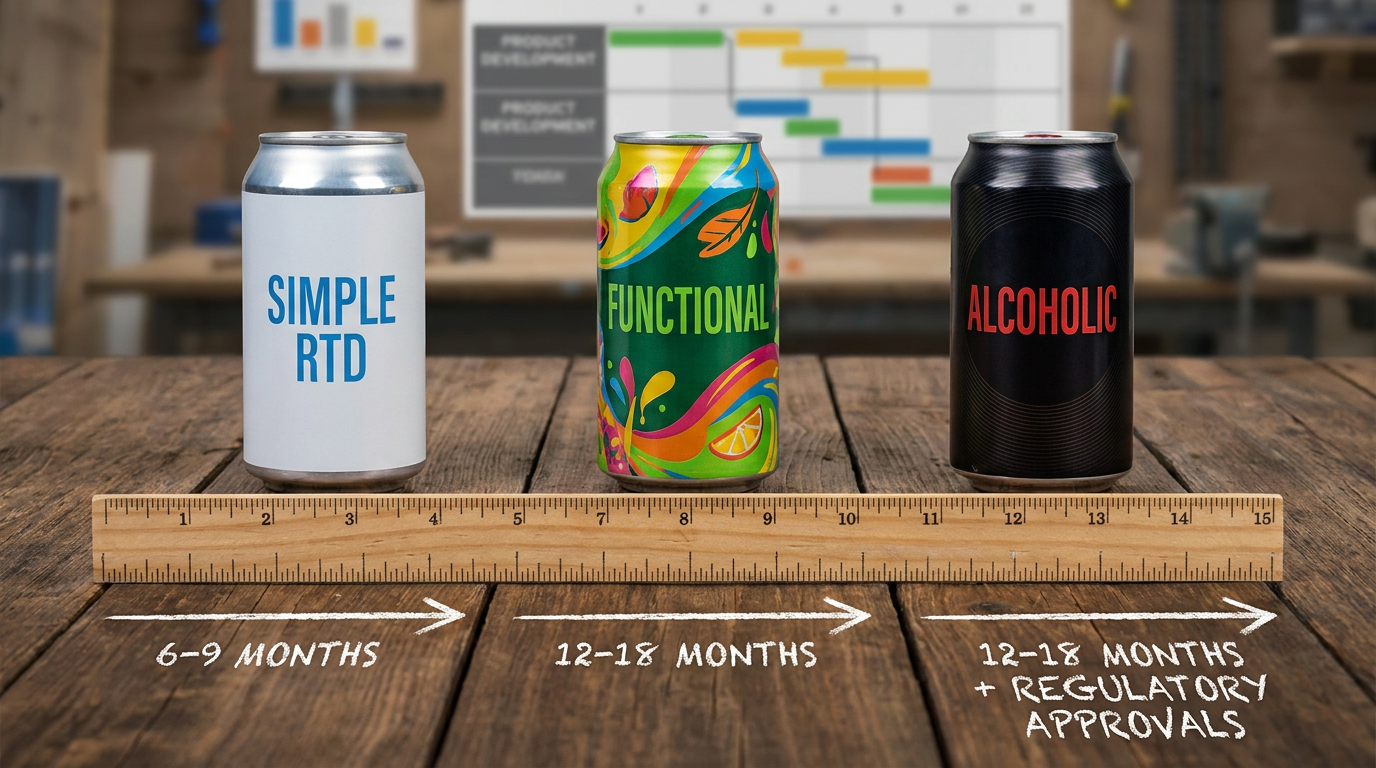
Simple Ready-to-Drink Beverages: 6–9 Months (Established) or 9–12 Months (Startup)
Iced teas, lemonades, flavored waters, cold brew coffees, juice blends, basic sparkling beverages. These are the fastest category in beverage development, and the reason is fewer unknowns.
A simple RTD has fewer ingredients, fewer interactions, and decades of accumulated industry knowledge behind every technical decision. Preservation systems are well established. Stability behavior is largely predictable. Co-packers everywhere have run thousands of batches of exactly this kind of liquid on exactly this kind of line, which means fewer equipment surprises and shorter qualification.
If you are an established brand extending a line, six to nine months is a real target. You are formulating within a known architecture, using approved suppliers, at a co-packer who already knows your specs.
If you are a startup, add roughly three months — not for the liquid, but for the infrastructure. Finding and qualifying a co-packer, establishing ingredient supply, building the regulatory function you do not yet have.
Can beverage development be done in under 6 months? Yes — but only under specific conditions: a simple format, a pre-validated base, an experienced team, an existing co-packer relationship, and a client who makes decisions in days rather than weeks. Break any one of those and you are back to nine months. Break two and you are at twelve. First-time founders with novel products almost never hit sub-six, and anyone promising it without those five conditions in place is selling optimism.
Functional Beverages: 12–18 Months for Startups
Adaptogens, nootropics, protein, probiotics, prebiotics, electrolytes, energy, sleep, gut health, recovery. This is the most commercially exciting category in beverage right now and the one where timelines break most often.
Three compounding reasons.
Stability gets genuinely hard. Actives are not inert. They degrade, oxidize, interact, precipitate, and lose potency — and your label makes a promise about how much is in the can at the end of shelf life, not the beginning. That means overage calculations, potency testing across the study, and reformulation if the numbers do not hold.
Taste-masking becomes the central creative challenge. Efficacious doses of most functional ingredients taste bad. Bitter, earthy, metallic, chalky, astringent — sometimes all at once. Getting to something people willingly drink twice, at a dose that justifies the claim, is where the extra weeks live.
Claims substantiation becomes a workstream.If you are launching a functional beverage, plan for twelve to eighteen months and treat anything faster as upside. The founders who get burned are the ones who budgeted nine.
If you say your beverage supports focus, recovery, or immunity, you need a defensible basis: ingredient dosing consistent with published research, careful language, and documentation you would be comfortable showing a regulator or a competitor's attorney.
Alcoholic and Regulated Beverages: 12–18 Months Plus Federal Approvals
Here is where a genuine plot twist lives, and it is the opposite of what most people expect.
The Alcohol and Tobacco Tax and Trade Bureau is fast. Looking at TTB's own published , median turnaround runs about one day for malt beverages, five days for distilled spirits, and eight days for wine. On the formula side, show medians of roughly four to five days, extending to around eleven days when laboratory sample analysis is required. TTB's stated goal is to process 85% of both label and formula applications within 15 calendar days.
TTB's formula processing timeslabel application processing times
So why do alcohol projects run long?
Sequencing. For many products — anything with added flavoring, coloring, or artificial sweeteners, or anything deviating from its category's standard definition — formula approval must come before you can submit for label approval. And domestic producers cannot produce, bottle, sell, or market the product until that formula approval is granted. These are serial dependencies, not parallel ones. Two five-day approvals stacked behind each other, each preceded by internal preparation and legal review, is not ten days of calendar time.
Rejections. A median assumes a clean submission. A rejected formula or a returned label sends you back to prepare, correct, and resubmit — and each cycle carries your internal turnaround, not TTB's.
State-level compliance. Federal approval is the beginning. Then come state registrations, brand label filings, franchise laws, and distributor appointments — fifty different systems with fifty different clocks.
The lesson is precise: with alcohol, the government is rarely your bottleneck. Your preparation quality and your sequencing discipline are. File the formula early, prepare labels while the formula is under review, and treat every rejection as a two-to-four-week event rather than a five-day one.
Hemp and Cannabis-Adjacent Beverages: The Widest Variance in the Industry
The technical work has its own demands. Emulsion stability for cannabinoid infusions is a real formulation discipline — poorly built emulsions separate, cream, or lose potency, and potency variance is the fastest route to a compliance problem. Third-party potency testing adds cycle time to every iteration.
The regulatory landscape shifts state by state and, frequently, month by month. Potency caps, packaging requirements, testing protocols, labeling language, distribution channels, and licensing all vary by jurisdiction, and legislatures revise them regularly. A formula and label compliant in one state may be non-compliant across the border, and a product designed for today's rules can need revision before it ships.
THC and CBD beverages are the most volatile category to plan around — not because the science is harder, but because the rules are a moving target.
Build serious buffer here, and build regulatory monitoring into the project rather than treating it as a one-time check. This is the category where we most often see timelines set by legislation rather than by chemistry, which is exactly why we — the hardest category rewards process discipline more than any other.
documented our approach to THC and CBD drink formulation
Dairy-Based Beverages and QSR Programs: Different Clocks Entirely
Dairy adds microbiological complexity and cold chain. Thermal processing has to be validated. Protein stability, sedimentation, and mouthfeel over shelf life require dedicated work. Co-packers with proper dairy capability are a smaller pool with longer queues. Refrigerated distribution shortens shelf life and tightens every downstream margin for error.
QSR and hospitality beverage programs invert the usual pattern. Formulation often moves faster
Knowing your baseline is half the picture. The other half is knowing what quietly destroys it.
Menu Collective works across all of it — any base, any format, from canned cocktails to dairy-based beverages, for startups and global brands alike. That range matters for timeline planning, because a partner who has only ever built one category will estimate your project using the only clock they know.
The formulation might take eight weeks. Getting it live across four hundred locations takes considerably longer, and the bottleneck is never the recipe.
— you are frequently building a dispensed or assembled beverage rather than a shelf-stable packaged one, which removes much of the stability burden. But operational rollout moves slower, and it is the real constraint. Every drink must be executable by a crew member during a lunch rush, with equipment that fits behind an existing counter, using ingredients your distribution network can deliver to every location. Then comes training, equipment installation, market testing, and phased rollout.
What Slows Down Beverage Development: The Five Timeline Killers
The five biggest causes of beverage development delays are vague product briefs, failed stability tests, slow client decision cycles, late co-packer selection, and regulatory rework.Notice what is not on that list: bad luck, difficult chemistry, or unreasonable ambition. Nearly every serious delay in this industry is a process failure, and process failures are preventable by people who know to look for them.
1. The Vague Brief
This is the most common cause of delay and the most preventable.
A vague brief sounds reasonable in the room. "We want a refreshing, better-for-you sparkling beverage that feels premium and appeals to younger consumers."Three rounds becomes seven. Seven rounds is four extra months.
Without a defined Gold Standard, every tasting becomes a debate rather than an evaluation. Stakeholders judge samples against private mental images that were never reconciled with each other. One person wants it sweeter, another wants it drier, and both are right relative to briefs that only exist in their heads. The bench team splits the difference, produces something nobody loves, and the cycle repeats.
Every word is agreeable. Not one is actionable. Refreshing how — acidic and bright, or clean and dry? Better-for-you by what measure? Premium in mouthfeel, ingredient story, or price?
The fix costs two weeks at the start: write the definition down, with reference products, sensory targets, and hard constraints, and get every decision-maker to agree to it in writing before the first sample.
2. Stability Failures
Twelve weeks into a stability study, samples start separating. Or the vibrant color has drifted brown. Or the flavor that was bright on day one has gone flat and slightly cardboard. Or vitamin potency has dropped below label claim.
You will not see this one coming, which is what makes it dangerous.
Now you are back at the bench, and you have lost more than the reformulation time. You have lost the twelve weeks of testing you already spent, and you owe another full study on the new formula. That is a two-to-four-month setback in a single discovery.
You cannot eliminate this risk. You can reduce it by using ingredient systems with known stability behavior where possible, by starting accelerated testing as early as a near-final formula allows, and by building contingency into the plan rather than pretending the first formula will pass.
3. Decision Latency
Fix it structurally, not with willpower. Name one decision-maker with final authority. Schedule tasting sessions in advance for the whole project rather than booking them reactively. Set a 72-hour feedback SLA. Use structured evaluation forms so feedback arrives as data rather than as adjectives.
The clearest symptom is a project where the technical work is always finished and the project is always behind.
It rarely looks like a delay. It looks like a busy week, a stakeholder on vacation, an advisor worth consulting, a decision that can wait for the next standing meeting. Each individual deferral is defensible. Stacked across five iteration rounds, they become the single largest block of time in the project — larger than formulation, larger than stability, larger than production.
The silent killer, and the one clients least expect to hear about.
4. Late Co-Packer Selection
Choosing a co-packer afterEvery one of those sends you backward. Reformulating for different equipment means re-running stability. Accepting a higher MOQ blows up your working capital. Waiting for a slot is dead calendar time.
Here is how it goes wrong. You perfect a formula over four months. Then you go looking for a manufacturer — and discover their minimum order quantity is 40,000 units when you planned for 8,000. Or their filler cannot handle your viscosity. Or they have no hot-fill capability and your formula requires it. Or their tank configuration cannot achieve your process. Or their next available slot is in five months.
formula lock is one of the most expensive sequencing mistakes in beverage development, and it is extremely common.
Co-packer capability is a design constraint, not a downstream logistics detail. Bring it into the room during formulation.
5. Regulatory Rework
The classic sequence: a claim gets written into packaging before anyone confirms it can be substantiated. Artwork is designed, approved, and printed. Then legal review flags the claim, the ingredient statement changes after a late formula tweak, or the Nutrition Facts panel no longer matches the final product. Now you are reprinting — and packaging lead times are measured in weeks, not days.
Regulatory delays rarely come from regulators. They come from work that has to be redone.
The rulebook here is The prevention is sequencing discipline: substantiate claims before designing around them, and never send artwork to print before the formula is genuinely locked.
21 CFR Part 101
, the FDA's food labeling regulation. It is specific, it is enforceable, and it does not care about your launch date.
The Sixth One: Supply Chain
Every one of these has a countermeasure. Which brings us to the part most readers came for.
Map lead times for every ingredient and every component early. Identify secondary suppliers for anything critical. Ask "what is the longest lead item in this product?" in month one, not month eight.
A single-sourced novel ingredient with a sixteen-week lead time can become your critical path without anyone noticing until production scheduling. So can custom packaging, specialty closures, or an ingredient that requires import documentation. These items are invisible during formulation — you are working with lab quantities that ship overnight — and then suddenly decisive at commercial scale.
Worth naming even though it did not make the top five, because it hides so well.
How to Compress Your Beverage Development Timeline Without Cutting Corners
Speed in beverage development does not come from rushing. It comes from sequencing — and from not having to redo work. Here is the playbook.
Run Workstreams in Parallel
The default mental model of a new product development timeline is a relay race: finish formulation, hand off to regulatory, hand off to packaging, hand off to production. Each phase waits politely for the last. That model is comfortable, easy to project-manage, and needlessly slow.
This is the single largest lever, and most projects leave it on the table.
Well-run projects look like an orchestra instead. While formulation is in round two, packaging design is developing structure and artwork against known constraints. Regulatory review is assessing claim feasibility on the directional formula. Co-packer conversations are already underway. Supply chain is mapping lead times for the ingredients most likely to make the cut.
Parallelization alone routinely saves two to three months. It requires more coordination and more tolerance for provisional decisions — you are designing packaging before the formula is final — but the risk is manageable when you scope it properly. Develop structure and layout in parallel; hold the ingredient statement and nutrition panel until lock.
Use Pre-Validated Bases Where They Fit
Spend novelty where it differentiates. Use proven systems everywhere else. The founders who insist on inventing every layer usually spend four extra months to produce something consumers cannot detect.
If your differentiation is a botanical blend and a brand story, the sparkling base carrying it does not need to be built from scratch. Proven base systems, established preservation approaches, and known-stable sweetener architectures let you skip solved problems and spend your innovation budget where it actually shows up on the shelf.
Not every component of your product needs to be invented.
Select Your Co-Packer During Formulation
This is not a small optimization. It removes the most expensive category of late-stage surprise entirely.
When you know your co-packer early, you formulate to their equipment, their process capabilities, and their minimums from day one. Scale-up becomes verification rather than discovery. You can book a production slot months ahead instead of joining a queue. You can validate that your packaging format runs on their line before you commit to tooling.
Bring manufacturing into the room while the formula is still moving.
Cap Your Iteration Cycles
Agree upfront: three structured roundsOpen-ended iteration is where good projects go to die slowly. There is always something to adjust. Without an exit condition defined in advance, "almost there" can last a very long time.
Structured means specific. Every round has stated objectives, a fixed evaluation panel, a standardized scoring approach, and a hard feedback deadline. Round one explores direction. Round two refines. Round three optimizes and confirms. If a fourth is needed, it is a deliberate decision with a known cost — not a drift.
, evaluated against the written Gold Standard, with a defined decision at the end of each.
Build Real Buffer Into Stability
Counterintuitive but true: planning for failure makes you faster.
Start accelerated shelf life testing as early as a near-final formula allows rather than waiting for perfection. Hold four to six weeks of contingency for one reformulation pass. Run real-time studies alongside accelerated ones so you are accumulating confirmation data continuously.
A project with buffer that never needs it finishes early. A project with no buffer that hits one stability failure finishes four months late and burns its team's credibility with the board along the way.
"Speed in beverage development does not come from working faster. It comes from never having to do the same work twice."
What You Must Never Compress
Some corners cost more time than they save. Three of them, without exception:
- Never skip stability testing. Launching on assumption is not a shortcut, it is a deferred recall. Product that separates in the trade costs you the retail relationship, the inventory, and the brand — none of which are recoverable on any timeline.
- Never guess on regulatory claims. An unsubstantiated claim is a legal exposure and a reprint waiting to happen. Verify first, design second.
- Never lock packaging before the formula is final. Printed material for a superseded formula is money and weeks in a dumpster.
You can see how this discipline plays out across categories in
These levers work best in the hands of people who have pulled them dozens of times. Which is where a development partner changes the math.
— different products, different constraints, same underlying sequencing logic.
How Menu Collective Keeps Beverage Projects on Schedule
Everything above describes what a well-run beverage development project looks like. Here is how we actually run one.
Our process has three stages — Design, Develop, Deliver — and each maps to a specific part of your timeline.
DESIGN occupies roughly weeks one through eight. This is where we define the Gold Standard: the precise articulation of what your product must be, sensorially, commercially, and strategically. We work through positioning, target consumer, occasion, format, price architecture, and the sensory reference points that make "premium" or "refreshing" mean something a bench team can build toward. It is the least glamorous stage and the highest-leverage one, because it is the stage that determines whether you run three iteration rounds or seven.
DEVELOP covers formulation, sensory refinement, stability and shelf life validation, regulatory compliance, and manufacturing quality. This is where the liquid becomes real and where our range matters — any base, any format, from canned cocktails to dairy-based beverages, functional shots to QSR dispensed programs.
DELIVER covers co-packer coordination, scale-up, pilot runs, first production, and go-to-market. This is the stage where projects most often stall for companies without manufacturing relationships, and where having a partner with existing co-packer networks converts months of searching into weeks of matching.
Collaborators, Not Consultants
That collaborative structure is not a philosophical preference. It is the most effective schedule-compression tool we have, because it attacks the largest hidden cost in most projects.
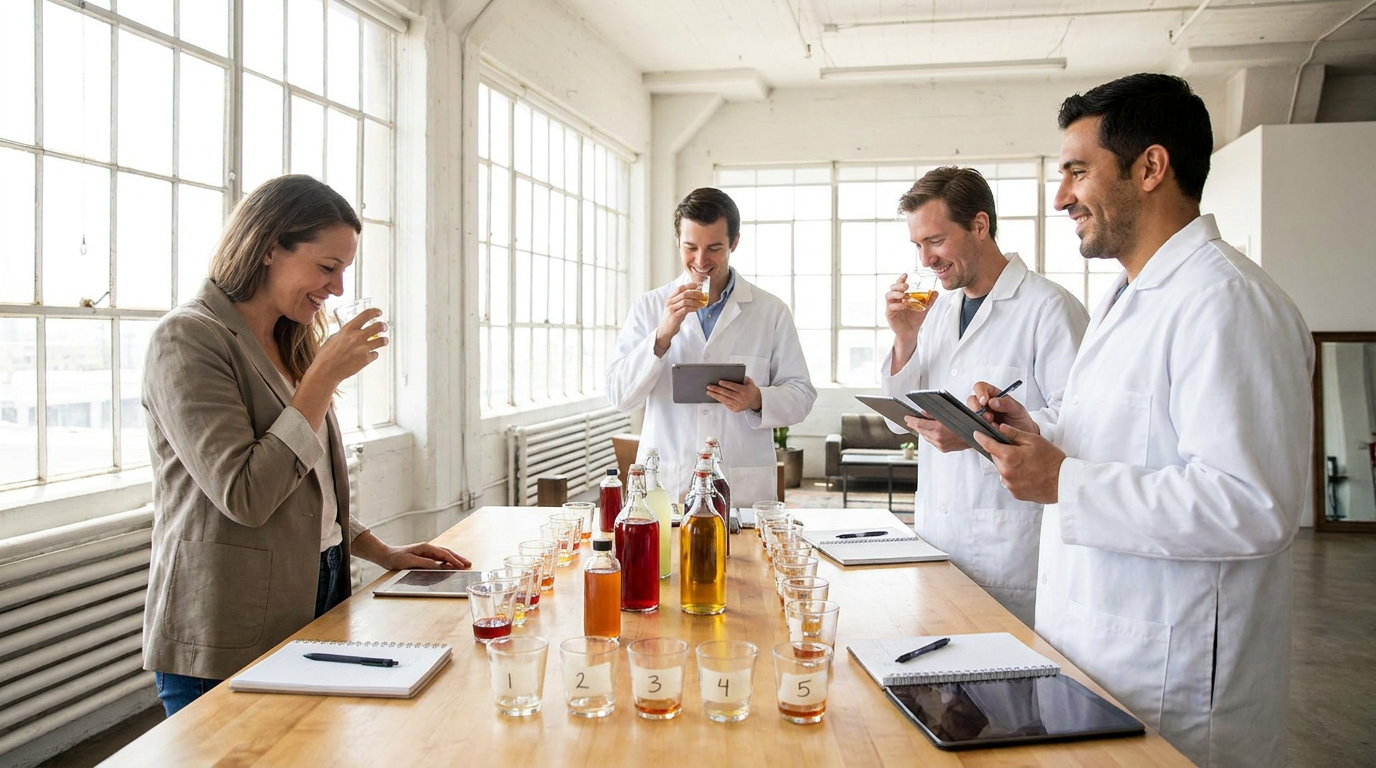
We build alongside you. We are in the tasting room, not emailing results from it. Decisions get made in the room, with the people who can make them, in real time. When a sample is not right, we diagnose why together and set direction the same afternoon rather than three weeks later. When a stability result comes back unfavorable, we are already talking through options before the report is formatted.
Consultants deliver reports. They analyze, recommend, and hand off — and then you wait, interpret, decide, and communicate. Every handoff is a gap, and gaps are where decision latency lives.
That phrase does real work, and it is worth unpacking, because it is directly connected to the timeline killer we named earlier.
The Experience Behind the Estimates
Menu Collective was founded in 2016 by Stuart McCarroll, and our team brings more than 45 years of combined experience across the global food and beverage landscape — . We have collaborated with global brands and independent innovators, in categories from functional wellness to canned cocktails to dairy, and that breadth is precisely why our timeline estimates are grounded rather than generic.
the full story is on our about page
You can see the Gold Standard process at work in , where a backyard michelada recipe became a six-flavor commercial platform. Six SKUs is the kind of scope that spirals when the definition is loose. Defining the standard first turned it into one architecture with disciplined variations.
our Fuego Rojo collaboration
The same reality applies to trend-driven launches, which is worth emphasizing for anyone planning around a moment. We wrote about
what the 2026 FIFA World Cup means for beverage brands
Let's close with the questions that usually come next.
partly to make this point: when development to shelf realistically runs 12 to 18 months, the brands that show up for a cultural moment started well before anyone else was thinking about it. Timeline awareness is not just operational hygiene. It is competitive strategy.
Beverage Development Timeline FAQs
How long does it take to develop a beverage product?
Most beverage products take 6 to 12 months from concept to shelf. Simple beverages developed by established brands with existing co-packer relationships can reach market in 6 to 9 months, while complex functional or regulated beverages from first-time founders typically take 12 to 18 months. Industry research has consistently placed the average at around eight months. Your position in that range depends on product complexity, company infrastructure, and regulatory category.
How long does beverage formulation take?
Beverage formulation typically takes 6 to 16 weeks. Simple formulas with few ingredients and clear targets land at the short end. Functional beverages requiring taste-masking, active stability work, and claims substantiation occupy the long end. The biggest driver is iteration count — most projects run three to five rounds, and disciplined briefs plus fast feedback keep that number low.
Can beverage development be done in under 6 months?
Yes, but only under specific conditions. You need a simple format, a pre-validated base system, an experienced development team, an existing co-packer relationship, and a client organization that makes decisions in days. Line extensions from established brands hit this regularly. Most first-time products with novel formulas cannot, and any partner promising sub-six months without those conditions in place is selling you a timeline rather than planning one.
What slows down beverage development the most?
The five most common causes are vague product briefs, failed stability tests, slow client decision cycles, late co-packer selection, and regulatory rework. Vague briefs are the most frequent and the most preventable — without a defined Gold Standard, iteration rounds multiply without end. Client decision latency is the most underestimated, routinely adding more calendar time than any technical phase.
How much does it cost to develop a beverage?
Cost scales with scope. Formulation-only engagements — where you bring a defined concept and need a production-ready formula — sit at the lower end. Full concept-to-commercialization programs covering strategy, formulation, stability, regulatory, packaging, and co-packer coordination represent a substantially larger investment. Timeline and cost move together: more iteration rounds, more stability studies, and more reformulation passes raise both. The most reliable way to control cost is the same as the way to control schedule — define the Gold Standard precisely before development starts. For a scoped estimate against your actual project, a consultation is the fastest route to a real number.
How long does shelf life testing take?
Accelerated shelf life studies typically run 12 to 16 weeks. Longer shelf life claims need longer validation, and products targeting 12 to 24 months on shelf generally require real-time confirmation alongside accelerated data. Build contingency: a failed stability test sends the formula back to the bench and can add two to four months to the project.
For questions about process, scope, and how engagements are structured beyond timelines, covers the ground in detail.
our FAQs page
The Bottom Line on Beverage Development Timelines
Plan for 6 to 12 months for most beverage products. Plan for 12 to 18 if your product is functional, alcoholic, hemp-derived, or being built by a team doing this for the first time. The industry average sits around eight months, and that average is generous because it is weighted toward companies who already have the infrastructure you may still be building.
But here is what matters more than any of those numbers: timelines are not fate. They are the output of decisions you control. A Gold Standard defined precisely in month one. Workstreams sequenced in parallel rather than in series. A co-packer selected during formulation instead of after it. Iteration rounds that are capped and structured. Decisions made in days rather than deferred to the next meeting. Buffer built for the stability failure that might not come.
Which means the real question was never "how long does it take to develop a beverage product?" The real question is what will you do in month one to make every month after it count? Because the projects that finish on time are almost never the ones that worked the fastest. They are the ones that never had to do the same work twice.
Ready to Put a Real Date on Your Launch?
Let's talk. We will map your product's timeline together, phase by phase, and define the Gold Standard that keeps it on track — no vague estimates, no "it depends."
Book a free consult with Menu Collective and get a realistic schedule for your actual product.
Collaborators, not consultants — from concept to commercialization.