This post is about telling those two products apart, and about building the first kind. We are going to name which cognitive ingredients have real human evidence behind them and which do not, cite the doses that were actually studied rather than the doses that are convenient, and then get into the part most articles skip entirely: what happens when you try to put those doses into a can and keep them there for twelve months.
Both say nootropic on the front.
One of them contains three or four ingredients at amounts that match what was actually given to people in published human trials. The other contains eleven ingredients, most of them present at a small fraction of any studied dose, arranged so that a recognizable name can appear on the label.
Walk the functional set at any decent grocery store and count the cans promising focus, clarity, or flow state. Then turn them around and read the panels. Within about ninety seconds you will find two very different kinds of product sitting on the same shelf at roughly the same price.
That second half matters because it is where nootropic beverage development actually lives. Writing about lion's mane is easy. Getting a real dose of it to dissolve, taste like something a person wants to drink twice, and still assay at label claim at the end of shelf life is a different job. At Menu Collective we , which means we do not get to stop at the interesting part. We have to make the liquid work.
design, develop, and deliver beverages from concept to commercialization
Here is what you will get: an evidence-ranked assessment of the major cognitive ingredients, the formulation constraints that make honest dosing genuinely hard, the regulatory lines that catch this category specifically, and a straight read on what consumers are buying versus what the research supports.
But before we can assess a single ingredient, we have to deal with a problem sitting above all of them. Nobody actually agrees on what the word nootropic means.
What a Nootropic Actually Is, and Why Nobody Polices the Term
The word has a specific origin. It was coined in the early 1970s by Romanian chemist Corneliu Giurgea, who proposed a genuinely strict set of criteria for what deserved the label. A nootropic, in his framing, should enhance learning and memory, protect the brain under adverse conditions, support the mechanisms underlying cortical control, and do all of that with very low toxicity and essentially no sedative or stimulant side effects.
Read that list again and hold it against the functional set. Almost nothing sold today would satisfy it. The stimulant exclusion alone disqualifies most of the category, since caffeine is the backbone of nearly every cognitive drink on the market.
That gap between the original definition and current usage would be a footnote, except for one fact that shapes everything downstream.
There is no regulatory definition of "nootropic" in the United States. The FDA does not recognize it as a product category. It is not a legal classification, it carries no compositional standard, and no agency maintains a list of ingredients that qualify. It is a marketing word.
A word with no definition cannot carry a dosing standard. That is not a loophole in the system. That is the absence of a system.
The consequences are immediate and practical. Because the term means nothing legally, it imposes no evidence threshold and no minimum inclusion level. A drink built on 200 mg of caffeine and a drink containing 5 mg of an obscure botanical extract can both put the word on the front of the can with equal legitimacy, which is to say none.
Regulators do not speak in categories like this. They speak in claims. What you say about a product is regulated with real specificity, as the FDA's guidance on makes clear, while what you call the product is largely unpoliced. That asymmetry explains a great deal of the label behavior in this category. The word is free. The sentence underneath it is not.
structure/function claims
The category has no clean borders either
Developers run into a second problem quickly. A nootropic beverage is not a discrete category so much as an overlap zone. It shares territory with energy drinks, adaptogen drinks, mushroom beverages, sports nutrition, and relaxation products, and those neighbors carry genuinely different consumer expectations and different regulatory treatment.
An energy drink consumer expects to feel something within twenty minutes and has a caffeine expectation baked in. A relaxation beverage consumer expects the opposite direction of effect. A mushroom drink buyer may be shopping a wellness ritual rather than an acute occasion. When you position into the middle of all of that, you inherit every one of those expectations at once, and you will disappoint some portion of buyers no matter what you build. Situating your product deliberately within the wider is not a branding exercise. It determines who buys you twice.
ready to drink landscape heading into 2026
The distinction that structures everything: acute versus cumulative
This is the single most useful frame in the category, and it will recur through the rest of this post.
Acute effects are what the consumer notices within an hour of drinking. Onset, felt intensity, duration. This is what a single-serve beverage occasion actually is: someone buys a can at 2pm because they need something at 2:15pm.
Cumulative effectsThe only question worth asking is whether the liquid in the can delivers on it. Which brings us to the evidence.
None of this means the category is illegitimate. The term is doing real work for brands precisely because consumers understand it as shorthand for "this drink is supposed to help me think," and that is a genuine, reasonable human need. People want to concentrate. They are willing to pay for help. That demand is real and it is not going away.
Here is the tension. Most of the category sells a single-serve, acute occasion while borrowing scientific credibility from research built on daily supplementation over eight to twelve weeks. Those are not the same product and they are not the same evidence. A study showing memory improvement after twelve weeks of daily dosing tells you very little about what one can does on a Tuesday afternoon.
require sustained daily intake, frequently over many weeks, before any measurable change appears. This is how a substantial portion of the most impressive botanical research was designed.
The Evidence Ladder: An Honest Ingredient by Ingredient Assessment
That third item is the one most ingredient roundups omit, and it is the one that determines whether you can actually build the product.
What follows is organized by strength of human clinical evidence, not by popularity. For each ingredient we cover three things: what the human research actually shows, the dose that was studied, and the formulation reality of working with it.
Tier 1: Strong human evidence
Caffeine. The most thoroughly proven cognitive ingredient in existence, and the honest backbone of this entire category. Acute doses reliably improve attention, reaction time, alertness, and vigilance across a large and consistent body of research. A supports what most developers already know from experience: this ingredient works, and it works predictably.
review of caffeine's effects on cognitive and occupational performance
Be precise about what it does not do. Effects on memory consolidation and complex executive function are considerably less consistent than effects on simple attention and reaction speed. Caffeine makes you faster and more alert. It does not reliably make you smarter at hard problems.
Studied doses run roughly 40 mg to 300 mg, with effects on processing speed becoming more reliable above about 200 mg. Two real product issues deserve attention. Tolerance in habitual consumers is substantial, and much of the perceived benefit in regular users may reflect withdrawal reversal rather than net enhancement. And the crash is a genuine product experience problem, not just a physiological one. A consumer who feels worse at 4pm than they did at 1pm has learned something about your brand, and it affects reorder.
Formulation reality: highly soluble, extremely well understood, inexpensive, and bitter at high inclusion. That bitterness is manageable but it stacks with everything else bitter you add.
Caffeine paired with L-theanine. This combination carries one of the better evidence bases in the category for attention and for reduced jitteriness relative to caffeine alone. Several trials, including crossover work on attention and an fMRI study on mind wandering, used 160 mg of caffeine with 200 mg of L-theanine, and a collects the broader literature. Studied pairings cluster between roughly 1:1 and 1:2 caffeine to theanine, and that 160/200 pairing sits at about 1:1.25 inside the band.
systematic review of caffeine and L-theanine
Now the honest qualifiers. Sample sizes in these trials are often small. The cognitive domains tested are narrow, typically attention-switching and reaction time rather than anything resembling general cognition. And the evidence is not uniformly positive: some studies find no additional benefit from the combination beyond caffeine alone at certain doses, and European regulators declined a black tea attention health claim on related grounds. The combination is well supported for what it is. It is not magic.
Formulation reality, and this is why the pairing shows up everywhere: L-theanine is highly soluble, close to flavor-neutral, and genuinely easy to work with at real doses. You can put 200 mg into a beverage without fighting it. That combination of decent evidence and cooperative behavior in solution makes caffeine plus L-theanine the most defensible starting point in the category.
Tier 2: Moderate or promising evidence, with real constraints
Creatine. Evidence for cognitive benefit has grown meaningfully. A found support for memory and some support for processing speed, though certainty of evidence across other cognitive domains was low. Effects appear more pronounced under stress conditions such as sleep deprivation.
meta-analysis of creatine and cognitive function
The dose matters enormously here. Typical studied intake is around 5 g per day sustained over weeks. This is a loading and saturation ingredient, not a single-dose ingredient. Whatever a single can does, it is not what the studies measured.
And then there is the formulation problem, which is severe enough that it gets its own extended treatment in the next section. Creatine monohydrate converts to creatinine in water over time, and the conversion accelerates at lower pH and higher temperature. Most beverages are acidic. You can see the collision coming.
Rhodiola rosea. The evidence here is reasonable but specific. A supports benefit for fatigue-related cognitive performance, particularly under stress or sleep deprivation. Outside that context the findings are weaker and mixed. Studied doses run roughly 100 mg to 600 mg per day.
systematic review of Rhodiola rosea for physical and mental fatigue
One diligence note that affects everything: extract standardization varies considerably between suppliers, which makes cross-study comparison genuinely difficult. Two products both listing 300 mg of rhodiola extract may contain materially different amounts of the constituents the research was built on. Ask what the extract is standardized to before you compare anything.
Bacopa monnieri. One of the better-evidenced botanicals for memory, and also one of the clearest illustrations of the acute-versus-cumulative problem. The and a point to 300 mg to 450 mg per day of standardized extract.
randomized controlled trial in age-associated memory impairmentStatPearls entry on bacopa
The critical detail: effects emerge over roughly eight to twelve weeks of daily intake. Not acutely. Not from one serving.
So putting bacopa in a can positioned as an afternoon focus drink borrows credibility from research whose design does not match the product's use case. The consumer drinking it at 2pm is not running the protocol that produced the result. Say that plainly, internally, before you build the deck.
It is also genuinely bitter and difficult to mask at real doses, which compounds the problem.
Panax ginseng. Some evidence for acute cognitive effects at roughly 200 mg to 400 mg of standardized extract. Findings are more consistent in older or cognitively impaired populations than in healthy young adults, as illustrated by a Formulation reality: a strong, distinctive, earthy flavor that is a real challenge in any light or delicate format. It can work in a bold botanical direction. It will fight you in a clean citrus sparkling water.
randomized trial in mild cognitive impairment
. That distinction matters when your target consumer is twenty-eight.
Tier 3: Popular, but the evidence does not yet match the marketing
Lion's mane (Hericium erinaceus). Enormously popular, and the early research is genuinely interesting. But human clinical evidence remains limited relative to the sheer volume of marketing built on it. Most positive findings come from small trials, and frequently from studies in adults with mild cognitive impairment rather than healthy consumers. Promising is the right word. Established is not.
Here is the buyer diligence point that most coverage skips entirely, and it is the most immediately actionable content in this section.
Extract quality and standardization vary enormously between suppliers, and the distinction between fruiting body material and mycelium grown on grain is real and material. Mycelium-on-grain material carries substantial residual grain, and that grain inflates total polysaccharide numbers without delivering equivalent beta-glucan content. A certificate of analysis showing an impressive polysaccharide figure can be largely reporting starch.
Two questions to ask every supplier, every time:
- Which part of the organism is this extract from? Fruiting body or mycelium, and if mycelium, grown on what substrate.
- What is the beta-glucan content specifically? Not total polysaccharides. Beta-glucan.
Industry coverage on and a both lay out why this distinction changes what you are actually buying.
peer-reviewed comparison of mycelium and fruiting bodiesstandardizing mushroom supplements
Ginkgo biloba. Long history of traditional use, and the modern evidence in healthy populations is largely unimpressive. This is the most skeptical claim in this post, so it gets the most authoritative backing.
The was a large NIH-funded randomized, double-blind, placebo-controlled trial. It followed 3,069 community-dwelling older adults aged 72 to 96, dosed at 120 mg twice daily for 240 mg per day, over a median follow-up of 6.1 years. It found no reduction in dementia incidence and no slowing of cognitive decline versus placebo, across global cognition and every individual domain assessed.
Ginkgo Evaluation of Memory (GEM) study
That is a well-designed, well-powered, long-duration null result. A systematic review titled, bluntly, reaches the same conclusion for cognitive enhancement in healthy people.
Ginkgo biloba is not a smart drug
Ginkgo does not function as a cognitive enhancer in healthy adults. If it is on your panel, it is there for recognition, not for effect.
Citicoline and Alpha-GPC. Choline donors with some supportive research behind them. The important qualifier is that most of it sits in cognitively impaired or older populations rather than healthy adults, and the healthy-adult dataset is thin. The NCCIH review of is a useful summary of how often that pattern repeats across this category.
dietary supplements and cognitive function
Formulation reality: generally soluble and workable, which is a relief. The real constraint is cost per serving at studied doses, which are high enough to move your ingredient cost meaningfully.
B vitamins. B vitamins are essential for cognitive function. That is true, uncontroversial, and almost always presented misleadingly.
Supplementation improves cognition mainly in people who are deficient or have low baseline status. In replete, healthy adults the effects are small to absent, a pattern supported by a Formulation note, stated without judgment: B vitamins are inexpensive, highly visible on a panel, and contribute noticeable color and a distinctive flavor at higher inclusions. The economics of panel appearance explain a lot about how often they show up.
meta-analysis on vitamins and cognitive function in non-demented people
. "Essential for cognitive function" and "improves cognitive function when you add more" are entirely different statements, and a great deal of marketing quietly slides from the first to the second.
The scannable version
For teams reviewing a supplier list, here is the ladder condensed. Each entry runs: evidence strength, studied dose, acute or cumulative, main formulation challenge.
- Caffeine. Strong. 40 mg to 300 mg. Acute. Bitterness at high inclusion, plus tolerance and crash management.
- Caffeine plus L-theanine. Strong for attention, narrow domains. 160 mg with 200 mg in several trials. Acute. Minimal; the most cooperative combination in the category.
- Creatine. Moderate, better for memory. About 5 g daily over weeks. Cumulative. Converts to creatinine in acidic solution, and saturation limits.
- Rhodiola rosea. Moderate, fatigue-specific. 100 mg to 600 mg daily. Mixed, better under fatigue. Extract standardization varies widely by supplier.
- Bacopa monnieri. Good for memory, wrong timeline. 300 mg to 450 mg daily. Cumulative over 8 to 12 weeks. Strongly bitter and hard to mask.
- Panax ginseng. Some acute evidence, stronger in impaired populations. 200 mg to 400 mg. Acute. Distinctive earthy flavor.
- Lion's mane. Limited human evidence relative to marketing. Varies widely. Unclear. Supplier standardization and beta-glucan verification.
- Ginkgo biloba. Does not enhance cognition in healthy people. 240 mg daily in GEM. Neither. Not a formulation problem, an evidence problem.
- Citicoline and Alpha-GPC. Some support, mostly non-healthy populations. High. Mixed. Cost per serving at studied doses.
- B vitamins. Real only in deficiency. Varies. Cumulative. Color and flavor contribution at higher inclusions.
Knowing the right dose is only half the problem, though. The more common failure in this category is not choosing the wrong ingredient. It is choosing the right one and then using far too little of it.
Read that list top to bottom and the category's central problem becomes obvious. The ingredients with the strongest acute evidence are few, unglamorous, and mostly already on the market. The ingredients with the most compelling stories, the ones that make a brand feel new, tend to have the weakest acute case. That gap is exactly where this category's credibility problem lives.
The Dose Problem: What Fairy Dusting Really Costs You
Let us define the term without hedging.
Fairy dusting is including an ingredient at a level far below any studied dose, so that the ingredient's name can legally appear on the label. The function of the inclusion is the label, not the liquid.
This is not a phrase we invented to score points. It is a recognized and openly criticized practice inside the functional beverage and supplement trade, discussed directly in industry coverage of . People in this business already have a word for it, which tells you how common it is.
fairy dusting in functional beverages
The arithmetic, held plainly
Take a second example, because this one is more common than the first. A botanical studied at 400 mg per day, sustained over twelve weeks, appearing at 25 mg in a single can that a consumer drinks occasionally. Now you have two gaps stacked: about six percent of the daily dose, delivered on none of the schedule. The research and the product share a name and nothing else.
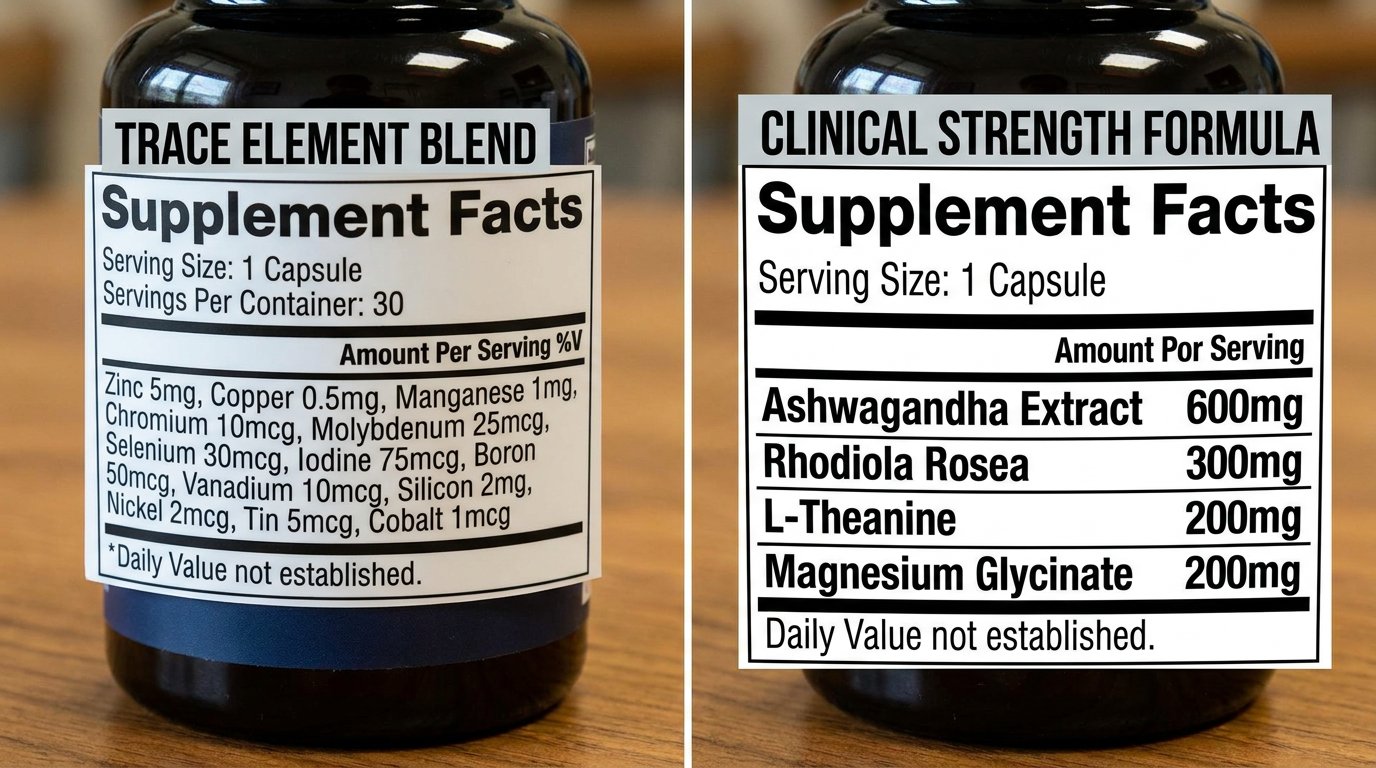
An ingredient studied at 300 mg, appearing on a panel at 10 mg, is present at roughly three percent of the studied amount. There is no reasonable reading of the research that supports an expectation of effect at that level. It is decoration.
An ingredient at three percent of its studied dose is a label decision, not a formulation decision.
Why brands actually do this
Now the part that most criticism of this practice skips, and skipping it is why the criticism usually fails to land. There are three real pressures pushing toward fairy dusting, and none of them is laziness.
Cost. Efficacious doses of premium actives can dominate the cost of goods on a beverage whose retail price is effectively capped by category norms. If your shelf price has a ceiling of five dollars and three actives at studied doses consume most of your available ingredient budget, that is a genuine commercial squeeze, not a moral failing.
Taste. Most cognitive botanicals are bitter, astringent, or both. Bitterness scales with dose. At the amounts the research used, several of these ingredients are extremely difficult to hide in a pleasant beverage. Cutting the dose is the fastest path to a drinkable liquid.
Solubility.These are real constraints. Anyone who tells you otherwise has not built a beverage.
There is a hard physical ceiling on how much active material will stay dissolved in a fixed volume. You cannot wish more into 12 ounces. Exceed it and you get haze, sediment, or a gritty mouthfeel that consumers correctly read as something being wrong.
Why it is still a bad trade
Sympathy granted, the practice remains a poor commercial bet, for three reasons that compound.
Consumer trust. The nootropic consumer is unusually literate about panels. This is a self-selecting audience of people who research things. They will compare your label amounts against published doses, because the research is one search away and they are exactly the kind of person who searches. A panel that does not survive that comparison damages your brand with precisely the consumer most likely to become a high-frequency repeat buyer. You are optimizing the label for the shopper who glances and losing the shopper who reads.
Retail buyer scrutiny. Category buyers see an enormous number of functional launches, and they develop fast heuristics. Dose credibility is one of the quickest ways they separate a serious product from a label exercise. A loud front-of-can claim sitting on top of a thin panel is a recognizable pattern, and it is recognizable because they have seen it a hundred times this year.
Claims substantiation exposure. If your marketing implies a benefit, the substantiation has to support that benefit as delivered by the product as sold. Research conducted at 300 mg does not substantiate a claim on a product containing 10 mg. The gap between the studied dose and your actual dose is the exact size of your exposure. More on this in the regulatory section, because it is the bridge between a formulation choice and a legal one.
There is also a related pattern worth naming: the divergence between what a label says and what an extract actually contains, an issue explored in industry reporting on . Even brands trying to dose honestly can be undermined by material that is not what the specification sheet claims.
excessive dilution of botanical extracts
On proprietary blends
Blends that disclose only a total weight prevent the consumer, and the retail buyer, from verifying any individual ingredient amount. A "Focus Blend, 1,200 mg" tells you nothing about whether the interesting ingredient is 900 mg or 9 mg.
This is legal in supplement labeling, and the FDA's explains what labels are and are not required to disclose. But legality and credibility are different currencies. Opacity is increasingly read as a signal rather than as a trade secret, and the sophisticated buyer's default assumption about an undisclosed breakdown is not a generous one.
questions and answers on dietary supplements
The constructive alternative
Which raises the obvious objection: real doses are genuinely hard to formulate. That objection is correct, and it deserves a proper answer.
Fewer ingredients. Honest amounts. Defensible claims. It is easier to explain, easier to taste, easier to substantiate, and easier for a buyer to believe.
State it simply. A short panel with three or four ingredients at real doses is a stronger product and a stronger story than a panel of fifteen trace inclusions.
Formulation Reality: Why Efficacious Doses Are Genuinely Hard
Everything in this section is a reason that honest dosing is difficult. None of them is a reason it is optional.
Bitterness, and the fact that it scales with the dose you need
The approach that works best in our experience is flavor architecture that gives the bitterness somewhere to go rather than trying to bury it. Citrus and bold botanical directions can carry bitterness credibly, because a consumer expects some bite from grapefruit or ginger and reads it as intentional. Delicate profiles cannot do this. A soft berry or a light melon has no vocabulary for bitterness, so any that escapes reads as a defect.
The working approaches are real but each has limits. Sweetener system selection and balance does meaningful work. Acid and salt modulation can shift bitterness perception more than most teams expect. Bitter blockers help within a range. Encapsulation can physically separate the bitter compound from the tongue, at a cost in complexity and sometimes in mouthfeel.
Most cognitive botanicals are bitter, astringent, or both, and the intensity scales directly with the amount you actually need to include. This is the cruelest arithmetic in the category: the more defensible your dose, the worse your starting liquid tastes.
Low and zero sugar makes it harder, not easier
Here is where two hard problems interact. Most nootropic drinks are also low or zero sugar, because that is what the category and the consumer expect. But sugar is one of the most effective bitterness maskers available, and removing it strips out that masking precisely when you need it most.
High intensity sweeteners then bring their own linger and off-notes, which can stack unpleasantly with botanical bitterness rather than covering it. You end up managing a sweetener tail and a botanical bitterness at the same time, and they interact in ways that are difficult to predict from a paper formula. The growth of low and zero sugar formats is one of the defining forces in the , and in cognitive drinks it collides directly with the taste-masking problem.
2026 RTD category
The solubility ceiling is not negotiable
You cannot dissolve unlimited active material in 12 ounces. Every active competes for the same water.
Exceed the ceiling and you get haze, sediment, gritty mouthfeel, or separation, and consumers read all of those as spoilage regardless of whether the product is safe. Worse, solubility is affected by pH, temperature, and the presence of other dissolved solids, which means ingredients that dissolve perfectly well on their own may not co-exist at the levels you want. A formula that works as four separate solutions can fail as one.
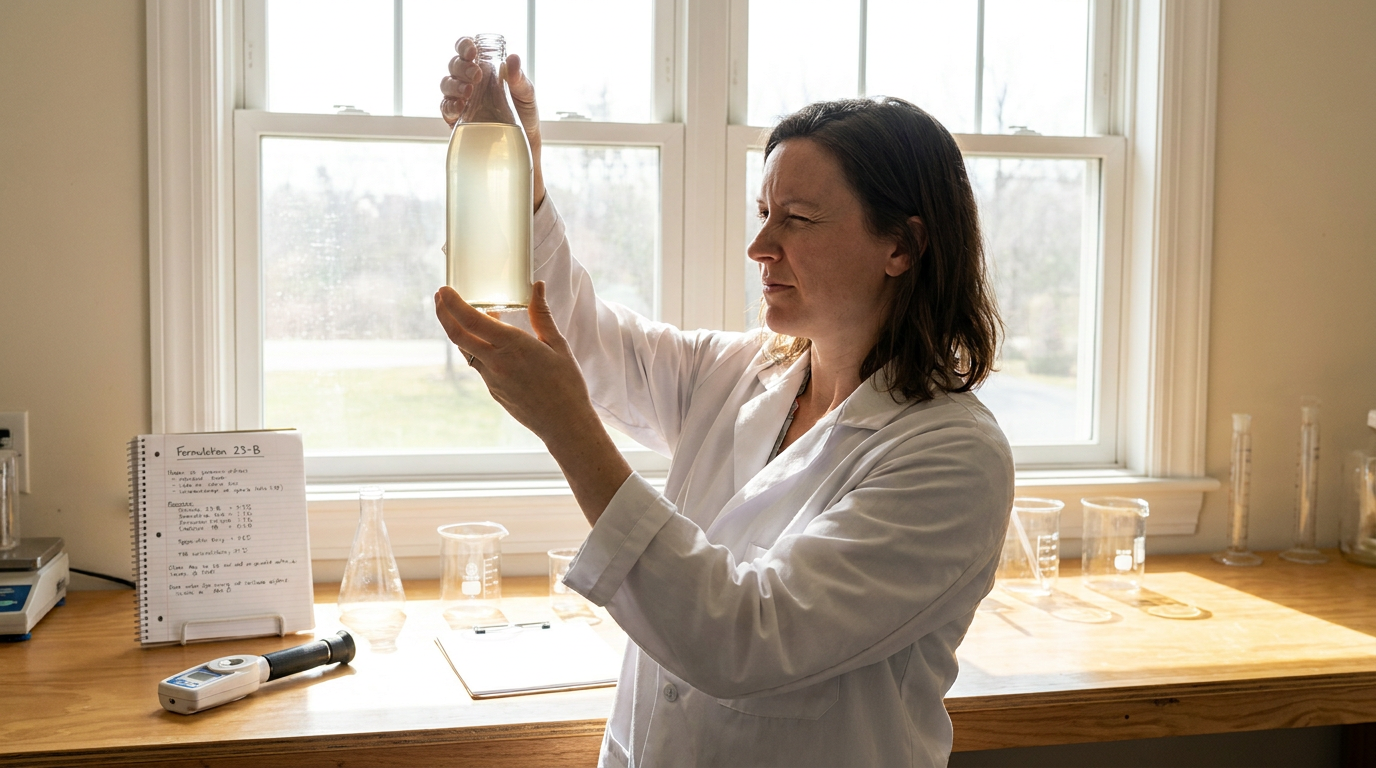
Stability across shelf life is the thing most brands underestimate
A label claim has to hold at the end of shelf life. Not on the day of fill.
Actives degrade through hydrolysis, oxidation, light exposure, and interaction with the acid system. If you declare an amount on a panel, you need analytical data showing that amount is still present at month twelve, under realistic storage and distribution conditions rather than in a climate-controlled office. This is one of the main reasons real development timelines run longer than teams expect, something we cover in our , including the stability testing windows required before you can responsibly claim a 12 to 24 month shelf life.
honest breakdown of beverage development timelines
Creatine, worked all the way through
Creatine deserves extended treatment because it is the clearest illustration in the category of how a well-evidenced ingredient can be defeated by chemistry.
Creatine monohydrate converts to creatinine in aqueous solution. Creatinine is not creatine and does not do what creatine does. The conversion rate depends heavily on pH and temperature, and a Three days. Most beverages live in that acidic range for microbiological safety and flavor reasons, which means the problem is structural rather than incidental.
critical review of creatine bioavailability, stability, and regulatory status
reports the pattern clearly: roughly 4 percent loss at pH 5.5, about 12 percent at pH 4.5, and about 21 percent at pH 3.5, over just three days at 25 degrees Celsius.
Over longer periods the picture gets starker. A found that an effervescent di-creatine citrate solution at around pH 3.6 lost roughly 90 percent over 45 days at room temperature. Temperature during distribution and storage compounds this further, as work on demonstrates. Trucks and warehouses in July are not 25 degrees Celsius.
water activity and temperature effects on creatine stabilitystudy on stability of creatine in solution from effervescent formulations
Then add the solubility constraint. An Trade-offs do exist. Higher pH systems reduce degradation but change your preservation requirements and your flavor options. Buffered approaches and alternative creatine salts have their own profiles and their own costs. Powder formats or two-part systems solve the chemistry cleanly by keeping the creatine dry until use, at a cost in convenience and in the single-serve occasion itself. Each of these is a legitimate path. None of them is free.
analysis of novel forms of creatine
The honest conclusion: a genuinely shelf-stable ready to drink creatine beverage is a hard technical problem. Any brand claiming to have one should be asked, politely and specifically, for end-of-shelf-life assay data. Not a specification sheet. An assay.
puts creatine monohydrate saturation at roughly 14 g per liter at 20 degrees Celsius. A 5 g serving in a 355 ml can is already pressing against that ceiling before you have added anything else that wants to be dissolved.
Interactions, off-notes, and why early samples mislead
This is the single most common reason a project that felt finished has to reopen. Time in package is a required input, not a formality.
Actives react with each other, with the acid system, and with flavor components. Sulfurous, metallic, and cardboard off-notes commonly appear only after weeks in package, which means a bench sample that tastes excellent on day three can be genuinely unpleasant at week eight.
Color, which nobody plans for
Botanical extracts are rarely colorless. Mushroom and root extracts push brown and tan, and those tones fight directly against the bright, clean visual language most cognitive brands want. In clear packaging you also have to manage color drift across shelf life, because a beverage that browns over eight months looks spoiled even when it is perfectly stable.
The cost per serving math
This is precisely the pressure that produces fairy dusting. A team hits the cost wall and responds by trimming every dose a little, and a little more, until nothing on the panel is at a level that does anything.
Walk the logic without inventing supplier prices. Dose several premium actives at studied levels, add the flavor system required to make those doses drinkable, and your ingredient cost can move to a level the category's price ceiling will not support.
The correct answer is different. Reduce the number of ingredients rather than reducing every dose below the level where it works.Even after you have solved taste, solubility, and stability, one more constraint determines what you are legally allowed to say about the product you just built.
Three actives that function beats nine that do not, on cost, on taste, on claims, and on the shelf.
Regulatory Reality: Claims, Classification, and What You Can Say
With that said, innovation teams should understand these lines well enough to make good decisions early, because the expensive version of this conversation happens after the labels are printed.
This section is general information about the regulatory landscape, not legal advice. Have qualified regulatory counsel review your specific product before launch.
Structure/function claims versus disease claims
A structure/function claim describes an effect on the normal structure or function of the body. "Helps support focus" is a structure/function claim. It describes a normal function and does not reference a disease.
A disease claim states or implies treatment, prevention, cure, or mitigation of a disease. "Helps prevent cognitive decline" is a disease claim, and it pushes the product toward being regulated as a drug. The FDA's guidance on draws this line.
structure/function claims
The detail teams miss most often: implication counts. Imagery, testimonials, product names, and even the population you depict can create a disease claim while your written copy stays carefully clean. A can named for memory preservation, marketed with imagery of an older adult, is making an implied claim that the copy never states. Regulators read the whole package.
Conventional food versus liquid dietary supplement
This is the classification question that catches nootropic brands most frequently, and the FDA has issued .
guidance specifically on distinguishing liquid dietary supplements from beverages
The factors include product name, packaging, serving size, recommended conditions of use, marketing practices, and composition. Here is the operational point that matters most: a product can be formulated as a conventional beverage and then drift into supplement territory through its marketing language alone. Telling consumers to take one per day pulls in that direction. Presenting the product as a substitute for a supplement pulls harder. You can change your regulatory classification with a social post.
Why classification changes your operations
The two paths differ in ways that reach into every part of the project:
- Conventional beverage path. Nutrition Facts panel. Ingredients must be approved food additives or generally recognized as safe for that use. Claims governed by food labeling rules.
- Liquid dietary supplement path. Supplement Facts panel. Different ingredient eligibility rules. Structure/function claims require notification to FDA within 30 days of first marketing, and require the disclaimer stating that the statement has not been evaluated by the Food and Drug Administration and that the product is not intended to diagnose, treat, cure, or prevent any disease. Those requirements sit in 21 CFR 101.93.
Ingredient eligibility genuinely differs between the two paths. This is a real trap. An ingredient's presence in a widely sold dietary supplement does not establish that it may be added to a conventional beverage. Seeing something on a shelf is not a regulatory clearance, and "but that brand does it" is not a defense. If you want more detail on compliant ingredient statements and functional claims in practice, our piece on the walks through labeling in an adjacent category facing similar questions.
rise of non-alcoholic spirits
Substantiation, and the direct link back to dosing
The FTC requires that health-related advertising claims be truthful, not misleading, and supported by competent and reliable scientific evidence. The That is the specific exposure fairy dusting creates. It is not a vague reputational risk. It is a gap between your evidence and your formula that anyone can measure by reading two documents side by side.
FTC Health Products Compliance Guidance
Connect this straight back to the dose section, because this is where the two halves of this post meet. Substantiation must support the claim as made, for the product as sold. Research conducted at a dose your product does not contain is not substantiation for your product. It is a study about a different thing.
sets out that standard in detail.
Practical guidance
Four things to do:
- Decide your classification path deliberately at project kickoff, not during label review. It affects ingredient selection, panel design, and claims, so discovering it late means reopening all three.
- Write claims you can defend with data on your actual formula, at your actual doses.
- Keep marketing copy, sales sheets, and social content aligned with the classification you chose. Claims made anywhere can be read together, and a compliant label does not protect an incautious social account.
- Get qualified regulatory review before launch. Every time.
Regulators and formulators are only two of the three parties who decide whether a product succeeds. The third one, the consumer, is buying on entirely different criteria.
What Consumers Are Actually Buying
Consumers do not buy mechanisms. They buy a felt experience and an occasion. Any honest commercial read of this category has to start there.
Scale, briefly
The broader functional drinks market sits in the region of 165 billion dollars globally as of 2025 with high single digit growth projected, according to . Nootropic-specific formats are a much smaller slice, measured in low single digit billions, but growing considerably faster, with Useful for scale setting. Not the interesting part.
forecasts around 15 percent compound annual growthGrand View Research's functional drinks analysis
.
What people actually say they want
Survey data consistently shows energy as the dominant functional benefit consumers seek. puts energy at roughly 60 percent of functional beverage consumers, with cognitive health and focus considerably lower at roughly a quarter. The honest reading: cognitive positioning is a real and growing segment, and it is not yet the mass driver that energy is. Plan your volume assumptions accordingly. A brand that models cognitive demand as though it were energy demand will build to the wrong scale.
FoodNavigator's 2026 survey workBeverage Industry's reporting on functional beverage consumer priorities
puts interest in focus and concentration around 24 percent, ranking behind sleep and gut health.
There is a further nuance worth carrying into your brief. Beverage buyers, compared to supplement buyers, are more likely to be seeking short bursts of mental energy than sustained long-term support. That has a direct formulation consequence. The beverage occasion is inherently an acute occasion. People reach for a can because of how they feel right now.

Occasion is what drives repeat purchase
A study session and a gaming session are not the same product brief. Products that try to serve every occasion tend to serve none of them well, and the panel is usually the first place that confusion becomes visible.
Each one implies different requirements for onset speed, duration, caffeine level, format, and flavor. A study session wants sustained, clean, low-crash performance over three hours. A gaming session wants faster onset and may tolerate a bolder flavor and a bigger format. A long drive prioritizes alertness and duration over anything cognitive in the complex sense. Compensating for poor sleep is the occasion where rhodiola's fatigue-specific evidence is most defensible.
The occasions that matter in this category are specific: getting through the afternoon slump, focus at work, studying, gaming, long drives, and compensating for a bad night of sleep.
The three things winning products do
- They deliver something the consumer can notice. Not something a paper can detect. Something a person can feel.
- They taste good enough to buy again.
- They fit a specific moment clearly enough that the consumer knows when to reach for them.
Miss any one of those and the other two will not save you.
The tension, named honestly
Pretending that tension does not exist is how brands end up with a panel that reads like a literature review and a product experience that delivers nothing the consumer can detect. Or the reverse: a caffeine drink wearing a lab coat.
Caffeine gives you the felt effect. Bacopa gives you the research. They do not overlap.
The ingredients with the best acute felt effect are not the ones with the best long-term evidence. The ingredients with the most impressive research often require weeks of daily intake that a single-serve occasion cannot deliver.
This is the paragraph that matters most in this section, and it is the reason this post exists.
How to resolve it
Three moves, and they work together:
- Build the acute experience on ingredients with acute evidence. Caffeine, caffeine with L-theanine, and where the occasion fits, rhodiola. This is what the consumer will actually feel, and feeling something is what produces the second purchase.
- Be truthful about what the cumulative ingredients are doing, and over what timeframe. If bacopa is on your panel at a real dose, the honest story is a daily habit over weeks, not an afternoon lift. Tell that story properly or leave the ingredient out.
- Consider whether a daily-use positioning is more honest than a single-can promise when your formula genuinely depends on cumulative actives. Subscription and multipack formats exist. They match certain formulas far better than an impulse single does.
Also worth noting: research on indicates that scientifically backed ingredients and brand trust are themselves significant purchase drivers. Dosing honestly is not only the defensible choice. It is increasingly a competitive one.
functional beverage trends
Taste is the commercial point, not the technical one
Evidence, constraints, regulation, and commercial reality. Here is how to turn all of it into a build sequence.
And a note on tone: do not condescend to consumers for buying on feel. Buying on feel is rational. A person has no laboratory, no assay, and no time. Their own experience is the only instrument they have, and using it is good sense rather than naivety. Your job is to make sure that instrument gives them an accurate reading.
A product with a perfect panel that people do not enjoy drinking will not survive its first reorder cycle. Efficacy without drinkability is not a product, it is a supplement in an expensive can.
Taste is the single largest driver of repeat purchase in beverages. Not efficacy. Not panel design. Taste.
How to Build a Nootropic Beverage That Holds Up
- Pick a specific occasion first, then formulate to it. The occasion determines caffeine level, onset profile, duration, format, pack size, and flavor direction. A gaming drink, a morning focus drink, and an afternoon reset are three different products with three different briefs. Decide which one you are making before anyone opens a spreadsheet.
- Define the Gold Standard product before you start bench work. Write down exactly what the finished beverage must deliver, sensorially and commercially, before a single sample is made. For a cognitive drink that means specifying the felt experience, the onset window, the flavor profile, the sweetness level, the cost per unit target, and the claim you intend to make. This becomes the agreed benchmark that every subsequent decision is measured against. It is the core of how we design, develop, and deliver, and skipping it is how projects drift for six months without anyone being able to say precisely when they went wrong.
- Choose few ingredients at real doses rather than many at trace levels. Three or four actives at studied amounts beats fifteen at decorative amounts on every measure that matters: efficacy, taste, cost clarity, claim defensibility, and buyer credibility. A short panel is easier to explain, and things that are easy to explain are easier to trust.
- Solve taste properly rather than treating it as a finishing step. Build the flavor system around the actives from the first bench iteration, not after the functional formula is locked. If your actives are bitter, the flavor architecture has to be designed to accommodate that bitterness from the start. Flavor is not a coat of paint applied at the end. It is structural.
- Verify actives at end of shelf life, not at fill. Run real stability studies under realistic storage and distribution conditions, and assay the actives at the end of the intended shelf life. If the number on your panel is not there at month twelve, you do not have a product. You have a liability with a barcode.
- Write claims you can defend with data on your own formula. Decide your regulatory classification deliberately, keep every piece of marketing language aligned with it, and hold your claims to what your product at your doses can actually support.
- Qualify your suppliers on specifics. Ask for the standardization marker and the actual assay, not the marketing sheet. For mushroom extracts, ask about the plant part and the beta-glucan content. For botanicals, ask about the extract ratio and the standardized constituent. Request certificates of analysis, and then genuinely read them.

Menu Collective was founded in 2016 by Stuart McCarroll, who brings 45+ years across the global food and beverage industry, and we work from Chicago with brands including Starbucks, 7-Eleven, Red Robin, Dairy Farmers of America, and Goose Island. We are . We assemble the right beverage experts for the specific project, define the Gold Standard together, turn it into a scalable and compliant formulation, and help bring it to market. Any base, any format. If you want the practical detail on process, flavor, and timelines, our cover the questions teams ask us most.
beverage development FAQscollaborators rather than an outside adviser who hands over a report and leaves
The Category Is Splitting, and Everyone Can See It
That is a harder brief than fifteen ingredients and a good-looking can. It is also the only version of this business with a second act.
None of this is an argument against the category. Better products are entirely possible here, and some already exist. They are built the same way every time: choose a specific occasion, use a small number of ingredients at amounts that actually do something, solve taste properly rather than late, and make claims that survive contact with the data.
The commercial point, one last time: formulating honestly is not the expensive option in the long run. Reformulating after a retail buyer challenges your panel, or after a claim draws scrutiny, costs considerably more than getting the dose right the first time. The cheap decision at bench is frequently the expensive one at scale.
Caffeine, and caffeine paired with L-theanine, carry the strongest acute evidence in the category. Creatine and rhodiola have real support alongside real constraints, one chemical and one contextual. Bacopa has good evidence on a timeline that does not match a single-serve occasion. Lion's mane is genuinely promising, and the human evidence remains limited relative to how heavily it is marketed. Ginkgo does not perform as a cognitive enhancer in healthy people, and a six-year trial in over three thousand adults is about as clear as that answer gets. B vitamins matter if you are deficient.
The honest summary of the science, without softening:
This category is dividing into brands that formulate at doses supported by human evidence and brands that decorate a label. That gap is widening, and it is becoming visible to consumers, to retail buyers, and to regulators at roughly the same time. That simultaneity is the part worth sitting with, because it means the practice is losing its cover from three directions at once.
Return to those two cans on the shelf.
Let's Talk About What You're Building
Whether you are building a cognitive drink from a blank page or looking at an existing formula and quietly wondering whether the panel would survive a buyer's scrutiny, that is the work we do. We build alongside you, not for you, from concept to commercialization.
. We are based in Chicago, the first conversation is free, and we are happy to tell you plainly whether your idea holds up.
Start a conversation with the Menu Collective team
Not ready to reach out? Our cover the categories, formats, and formulation questions shaping what gets built next.
beverage trends and insights
The regulatory content in this article is general information about the landscape and is not legal advice. Have your products and claims reviewed by qualified regulatory counsel before launch.