
Picture the pallet. Forty thousand printed cans, shrink wrapped, sitting in a co-packer's warehouse with your logo on every one of them. The liquid inside is exactly what you spent eighteen months developing. The artwork is beautiful. Then the retailer's compliance team sends back a one line rejection because your serving size does not match the reference amount for your category, and suddenly those forty thousand cans are forty thousand pieces of expensive scrap. Your launch window closes. Your production slot goes to somebody else. Your investors ask what happened.
Getting your label wrong can stop your launch cold. Here is what the FDA actually requires.
That scenario is not rare, and it almost never happens because a founder was careless. It happens because FDA labeling requirements for beverages are detailed, distributed across multiple regulations, and easy to misread when you are not a regulatory specialist. Most of the people signing off on beverage artwork are founders, brand managers, and marketing coordinators. They are smart, they are thorough, and they are personally accountable for a document written in the language of the Code of Federal Regulations.
This article is a walkthrough. It moves across the label panel by panel, in the same order you would review your own design, so you can hold your artwork next to it and check as you read. The federal rulebook behind all of it is the , which is the single most useful document a beverage founder can bookmark.
FDA Food Labeling Guide for industry
One idea sits underneath everything that follows: compliance belongs in development, not at the print stage. We will make the full argument later.
Here is what the seven sections cover, so you can jump straight to the panel you are worried about. First, which agency governs your product. Then the principal display panel, the ingredient and allergen declarations, the Nutrition Facts panel and serving size rules, claims language, and finally a pre-print checklist you can work through against live artwork.
Before any panel matters, you need to know which agency governs your product. That is where the walkthrough begins.

Read This First: General Guidance, Not Legal Advice
This article is general guidance. It is not legal or regulatory advice.
Federal requirements change. Guidance documents are updated. Proposed legislation is not law until it passes, and bills are reintroduced and revised between sessions of Congress.
Every brand should have its specific label reviewed and verified by a qualified regulatory specialist before the artwork goes to print.
Here is the practical reason this matters. Your product category, your ingredients, your claims, and your container size all change what applies to you. A 12 oz sparkling water and a 2 oz functional shot follow different rules, and so do two products with identical ingredients if one is positioned as a supplement. No article can account for your specific formulation.
This disclaimer appears again near the end of the article, because readers who skim straight to the checklist need to see it too.
With the caution stated, here is the first genuinely useful question: which agency actually governs your drink.
Which Rulebook Applies: FDA, TTB, Beverage, or Supplement
The most expensive label mistake is not a typo or a type size violation. It is following the wrong rulebook entirely, then discovering it after the plates are cut. Before you examine a single panel, sort yourself into the correct regulatory lane.
Alcohol Goes to TTB, Mostly
If your product contains alcohol, your first stop is generally not FDA. Alcoholic beverages largely fall under the Alcohol and Tobacco Tax and Trade Bureau, and most require label approval before they can be sold, through a Certificate of Label Approval. TTB maintains its own and a dedicated That word "mostly" carries weight. Certain low alcohol products, some wines below specific alcohol thresholds, and beers made without malted barley and hops fall under FDA rather than TTB. This is precisely why the question needs verifying rather than assuming. A hard seltzer, a kombucha that ferments past a threshold, and a low ABV aperitif can each land in a different place. If you are in the alcohol space, confirm your agency first and read TTB's requirements rather than this walkthrough.
Certificate of Label Approval (COLA)labeling resources
process, which is a genuine pre-market approval step rather than a self-certification.
Conventional Beverage or Dietary Supplement
Under 21 U.S.C. 321(ff), a product is a dietary supplement if it is intended to supplement the diet, contains a dietary ingredient, is intended for ingestion, and is not represented as a conventional food or as a sole item of a meal or the diet. Read that last clause carefully, because it is where liquid products get complicated. A drinkable product that looks, sells, and behaves like a beverage is difficult to defend as a supplement.
For everyone else, the decisive question is whether your product is a conventional beverage or a dietary supplement. This single classification changes your entire labeling obligation, and it is the question that trips up functional drink brands more than any other.
FDA has addressed this directly in its , which is the definitive federal source on this exact question. If you are asking yourself is my drink a beverage or a dietary supplement, read that guidance in full. It is short and it is written for people in your position.
guidance on distinguishing liquid dietary supplements from beverages
Your Marketing Pushes the Product Across the Line
A brand that files a Supplement Facts panel while marketing the drink like a soda has a problem, and it is not a problem you can fix with a footnote. Your artwork, your website, your social content, and your retail placement all form part of the evidence.
Serving size suggests a category. Container format suggests a category. A 16 oz resealable can with a wide mouth reads as a beverage. A 2 oz shot with a dosing cap reads differently. Product name matters, and so does the imagery on your packaging. A can photographed on a beach beside a surfboard is selling refreshment. Recommending your product for use with meals, or positioning it as a replacement for coffee or soda, points toward conventional beverage.
Here is the part founders find genuinely surprising. You do not get to decide your category by declaring it on the panel. How you name, package, position, and promote the product influences how FDA views it.
Different Panels, Different Rules
Conventional beverages carry a Nutrition Facts panel under . Dietary supplements carry a Supplement Facts panel under , which uses different serving size conventions and requires an "Other ingredients" line beneath the panel.
21 CFR 101.3621 CFR 101.9
Here is how the two categories compare across the dimensions that shape your artwork.
Governing regulation
- Conventional Beverage: 21 CFR 101.9
- Dietary Supplement: 21 CFR 101.36
Nutrition panel type
- Conventional Beverage: Nutrition Facts
- Dietary Supplement: Supplement Facts
Serving size basis
- Conventional Beverage: Derived from the Reference Amount Customarily Consumed for the product category under 21 CFR 101.12
- Dietary Supplement: Based on the manufacturer's recommended serving, expressed in a common household measure
Ingredient presentation
- Conventional Beverage: A single ingredient list in descending order of predominance by weight
- Dietary Supplement: Dietary ingredients appear within the Supplement Facts panel, with remaining ingredients listed in an "Other ingredients" statement beneath it
Allergen declaration
- Conventional Beverage: Required, covering all nine major food allergens
- Dietary Supplement: Required, covering all nine major food allergens
Structure/function claim disclaimer
- Conventional Beverage: Not required
- Dietary Supplement: Required, using the exact statutory DSHEA wording
FDA notification for structure/function claims
- Conventional Beverage: Not required
- Dietary Supplement: Required, within 30 days of first marketing the claim
Dual-column labeling
- Conventional Beverage: Required when the container holds 200 to 300 percent of the RACC
- Dietary Supplement: Not applicable in the same form, since supplement servings are not RACC derived
That comparison is worth screenshotting before your next artwork review.
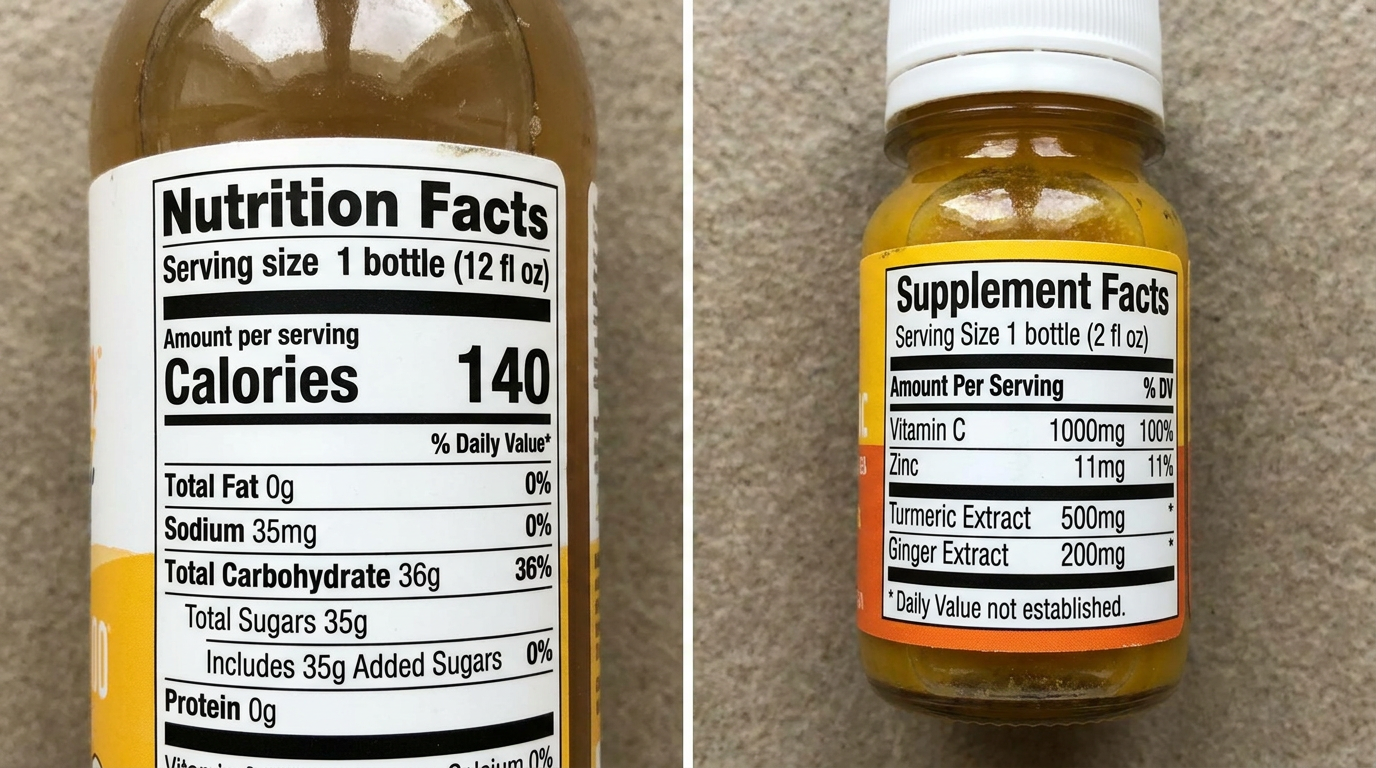
The reason this decision belongs early is that it cascades into everything downstream. Category determines panel type. Panel type constrains your back-of-pack layout. Claims strategy depends on category. Container format signals category to a regulator. These are formulation and format decisions, which is exactly why they sit in the DESIGN stage of
Menu Collective's Design, Develop, Deliver process
Now that you know which rulebook governs you, start the walkthrough where the shopper starts.
rather than in a packaging review three weeks before print.
The Principal Display Panel: What Shoppers See First
Three mandatory elements live here.
The Principal Display Panel, or PDP, is the portion of the label most likely to be displayed, presented, shown, or examined under customary conditions of display for retail sale. On a rectangular carton that is intuitive. On a cylindrical can or bottle it is calculated from the container's surface area, which catches people out, because the PDP on a cylinder is a defined proportion of the total surface rather than simply "the side with the logo on it." That calculation matters because several type size requirements are pegged to the area of the PDP.
The front of your package is the most contested real estate in your business. Your designer wants clean space. Your investors want the brand mark bigger. Your retail buyer wants shelf impact. FDA wants three specific pieces of information, and FDA is the one with enforcement authority.
The Statement of Identity Is Not Your Brand Name
This is the requirement minimalist design most often breaks.
Your label must carry the common or usual name of the product, stated plainly enough that a shopper knows what they are holding. It must appear in bold type, in a size reasonably related to the most prominent printing on the panel, and it must be one of the principal features of the front of the package.
A brand name tells a shopper who made it. A statement of identity tells them what it is. Only one of those is required by law.
"Sunbeam" is not a product. "Sparkling mango yerba mate beverage" is a product. "Hydrate" is a mood. "Electrolyte drink mix, lemon lime flavor" is a statement of identity. You can absolutely have both, and most successful brands do. What you cannot do is assume that a beautifully set wordmark and a flavor descriptor in six point type satisfy the requirement.
Net Quantity of Contents Is Not a Design Variable
Your PDP must declare how much product is in the container, expressed in both US customary and metric units. The governing text sits at None of that is negotiable, and none of it is a designer's aesthetic call. If your art director has centered the volume statement in the middle of the can because it balances the composition, the composition needs to change.
21 CFR 101.105
Type size is tied to the area of the principal display panel, so a larger panel requires larger type. Placement is regulated too. The net quantity statement belongs in the bottom 30 percent of the panel, set generally parallel to the base of the container. There are minimum separation requirements from other printed matter.
, and it regulates more than the words.
Name and Place of Business, and Why Co-Packers Complicate It
This trips up emerging beverage brands constantly, because most of them are not manufacturers. You developed the formula, you own the brand, you sell the product, and a co-packer three states away actually makes it. In that arrangement your name goes on the label with the appropriate qualifier. Printing your company name and address unqualified, as though you operate the filling line, is a misstatement.
Your label must carry the name and address of the manufacturer, packer, or distributor. If the firm named is not the actual manufacturer, the statement must be qualified with a phrase that reveals the connection, such as "Distributed by" or "Manufactured for."
The "Distributed by" question only arises once a co-packer enters the picture, and that relationship shapes far more than one line of small print. It affects your minimum order quantities, your scheduling, and your timelines, which is covered in detail in this honest breakdown of .
how long beverage product development takes
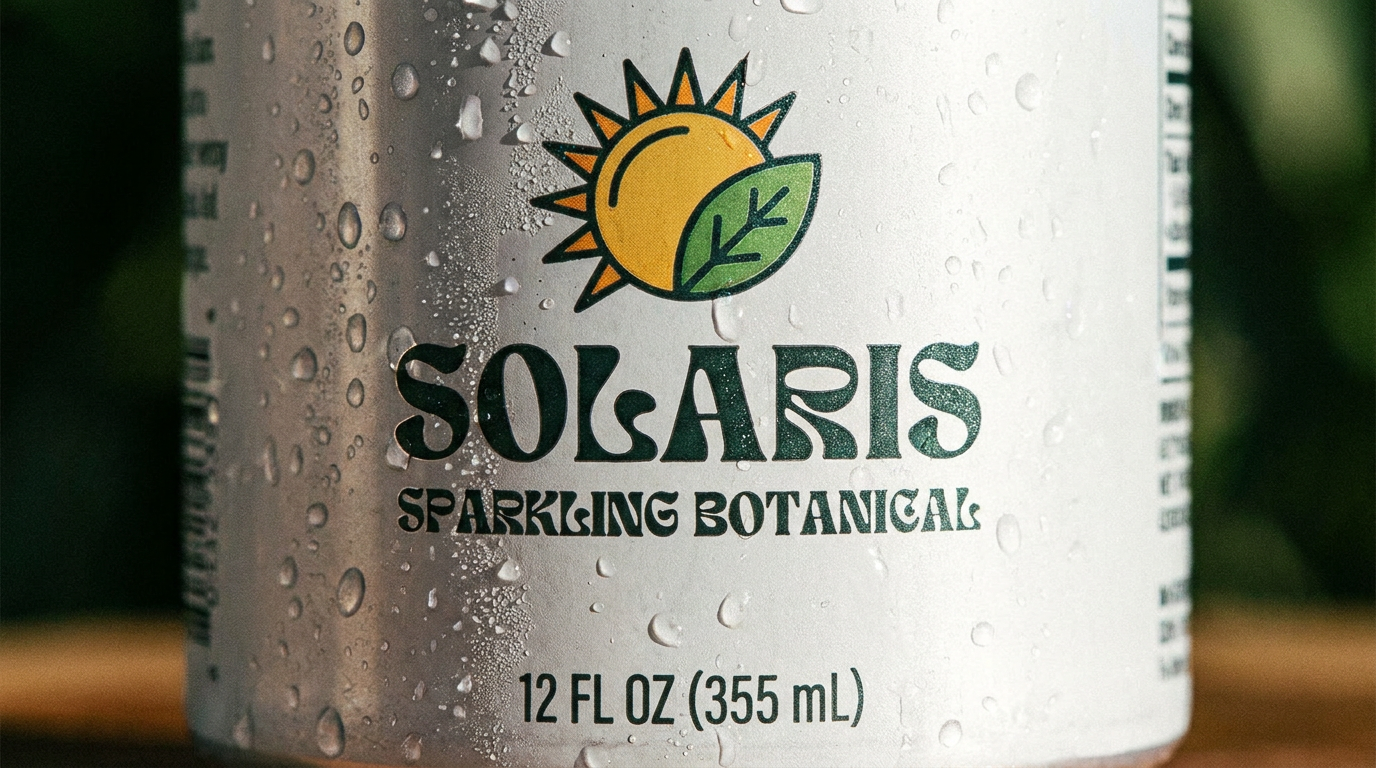
Put those three elements together and you understand why stripped back label designs get sent back for revision. There is a floor on how much text the front of your package must carry, and that floor exists before you have added a single word of marketing copy. Plan for it in the design phase and it becomes a creative constraint. Discover it after the artwork is approved and it becomes a redesign.
The front of the can is the smaller half of the problem. Turn the container around, because the information panel is where most compliance failures actually live. The
covers both in plain language, and it is worth keeping open as you read the next two sections.
Ingredient Lists and Allergens on the Information Panel
The information panel is the label surface immediately to the right of the PDP. It carries your ingredient declaration, your allergen statement, your nutrition panel, and your business address. It also carries the highest consumer safety stakes on your entire package, which is why it deserves more attention than it usually gets.
Descending Order of Predominance by Weight
Every ingredient must be declared by its common or usual name, listed in descending order of predominance by weight. The governing section is That is not a compliance issue. It is a positioning issue that the compliance requirement exposes, and it is another reason formulation and label strategy belong in the same conversation.
21 CFR 101.4
In a beverage this rule has a consequence founders sometimes do not anticipate. Water is almost always first, because water is almost always the heaviest component. That is fine and entirely normal. What follows is more revealing. Your ingredient order tells any careful reader roughly how your formula is built, including whether your hero botanical appears before or after your sweetener. Competitors read labels. Buyers read labels. Journalists read labels. If your marketing leads with an ingredient that sits eighth in the list behind three sugars, someone will notice.
.
Common or Usual Names, Not Marketing Names
Compound ingredients require care. If you buy a pre-blended base that itself contains multiple components, those sub-ingredients must generally be declared, typically in parentheses following the name of the compound ingredient. Suppliers do not always volunteer complete breakdowns, so ask for full ingredient statements in writing at the sourcing stage rather than at the artwork stage.
You cannot list "our proprietary botanical blend" as an ingredient on a conventional beverage. Ingredients are declared by the names people actually use for them.
Collective Listings Are a Limited Allowance
Be precise about what that allowance is. It is a narrow, specific permission for defined categories, not a general license to obscure your formula. It does not extend to functional actives, sweeteners, acids, preservatives, or botanical extracts you would prefer to keep quiet. Certified color additives must be declared by their specific names rather than hidden inside a collective term.
Limited allowances exist for spices, flavorings, and colors. This is why "natural flavors" is a permitted collective term rather than a demand to itemize forty aroma compounds.
The Nine Major Food Allergens
There are nine major food allergens: milk, eggs, fish, crustacean shellfish, tree nuts, peanuts, wheat, soybeans, and sesame.
Sesame became the ninth major allergen on January 1, 2023 under the FASTER Act, confirmed on . Date this correctly, because plenty of label templates still circulating in the design community list only eight. If your artwork was adapted from a file created before 2023, verify it against the current nine.
FDA's page on sesame as the ninth major food allergen
Two Compliant Declaration Methods
You have two options, and both are acceptable.
Method one, declare within the ingredient list. Name the allergen source in parentheses beside the ingredient.
- Compliant:
Water, oat base (oats), cane sugar, natural flavors, tricalcium phosphate, sea salt, gellan gum - Compliant:
Water, cold brew coffee, almond milk (almonds), cane sugar, natural flavors
Method two, use a separate "Contains" statement. Place it immediately following the ingredient list, in type no smaller than the ingredient list itself.
- Compliant:
INGREDIENTS: Water, cold brew coffee, almond milk, cane sugar, natural flavors. CONTAINS: Almonds.
What does not work:
- Not compliant:
Water, cold brew coffee, plant milk, cane sugar, natural flavorswith no allergen source identified anywhere. - Not compliant: A "Contains" statement placed on a different panel, separated from the ingredient list by other copy.
- Not compliant:
May contain traces of tree nutsused as a substitute for declaring an allergen that is a deliberate ingredient. Advisory statements about cross contact do not replace a required declaration.
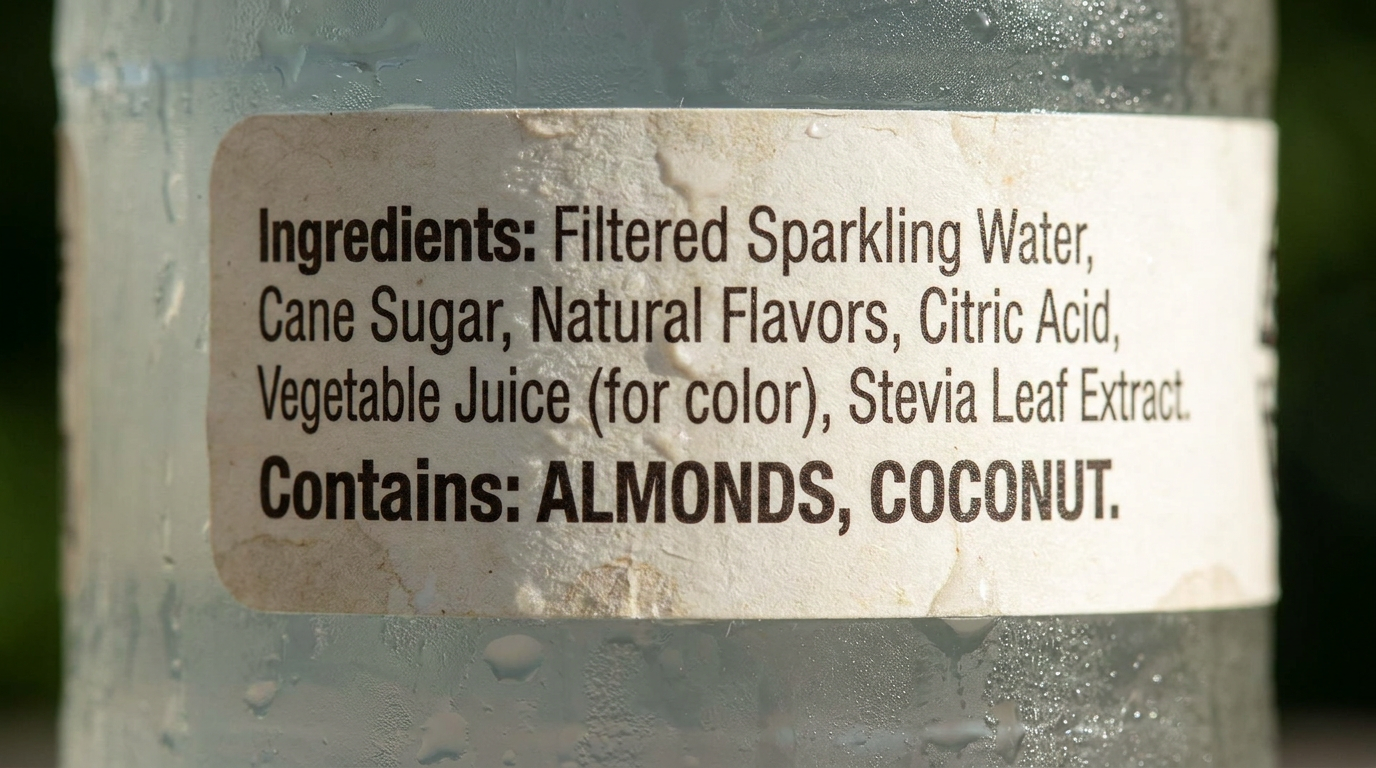
Here is the practical risk, stated plainly. Undeclared allergens are a leading driver of food recalls in the United States. On this panel, an error stops being a reprint cost and becomes a safety event, with consumer harm, retailer notification, and public recall documentation attached to your brand name permanently. FDA's
You now know what goes in the drink and how to declare it. Next comes how much of it counts as a serving, which is where container size decisions come back to bite.
Treat allergen review as a two person check every single time artwork changes, including flavor line extensions where the base recipe was assumed to be identical.
covers the fuller picture, including cross contact controls at the manufacturing stage.
Nutrition Facts, Serving Size, and the RACC Trap
If you are wondering how do I calculate serving size for my beverage, the short answer is that you largely do not. Regulation calculates it for you. That single fact catches out more beverage founders than any other requirement on the label.
Start with the panel itself, governed by .
21 CFR 101.9
Mandatory Nutrients in a Fixed Order
The Nutrition Facts panel declares calories, total fat, saturated fat, trans fat, cholesterol, sodium, total carbohydrates, dietary fiber, total sugars, added sugars, and protein. The order is fixed by regulation. It is not a layout decision, and rearranging it to put a flattering number higher is not available to you.
The Vitamin and Mineral Requirements Have Changed
Vitamin D and potassium are now required declarations. Calcium and iron remain required. Vitamins A and C are no longer mandatory and may be declared voluntarily.
That change matters commercially, because outdated templates are still in circulation and a panel listing vitamins A and C as though they were mandatory is a signal that the file has not been updated. FDA's is the clearest plain-language confirmation, and carry the technical implementation detail your designer needs.
FDA's industry resources on the label changessummary of the changes to the Nutrition Facts label
Added Sugars, the Most Commercially Sensitive Line You Will Print
Added sugars must be declared in grams and as a Percent Daily Value, indented beneath Total Sugars, formatted as "Includes _For beverages this is frequently the number that determines whether a shopper picks up the can. It is also the number most likely to send a formulation team back to the bench late in the process, because a sweetness profile that tested beautifully in a sensory panel can look unappealing once it is expressed as a percentage of a daily value. Model your added sugars declaration during formulation, not after.
g Added Sugars." Amounts under 1 g may be declared as "less than 1 g." Amounts under 0.5 g may be declared as "0 g."
Prominence and Type Size
Serving Size, Servings Per Container, and Calories must be more prominent than the surrounding information, set in bold, and meet defined minimum type sizes. Metric equivalents are required alongside household measures. The panel has a specified format, and shrinking it to reclaim space for a design element is not a permitted trade.
The RACC Trap
Here is the requirement that costs beverage brands the most money.
Your serving size must derive from the Reference Amount Customarily Consumed for your product category, published in the reference amount tables at . Go and look up your own category, because the RACC differs between carbonated soft drinks, juices, coffee and tea beverages, and meal replacement drinks.
21 CFR 101.12
You cannot make your calorie count look better by declaring a smaller serving. The reference amount is set by regulation, not by ambition.
Every founder eventually asks the same question in some form. Can we call it two servings? Almost always, no. The reference amount reflects what people actually consume in one sitting, based on consumption data, and it applies to your product whether or not it flatters your nutrition panel.
Dual-Column Labeling and Why Your Can Size Decides Your Layout
Containers holding between 200 and 300 percent of the RACC require dual-column labeling, presenting one column of values per serving and a second column per container. If the entire package contains 200 percent of the RACC or less, it is labeled as a single serving, because people can reasonably be expected to drink the whole thing at once. FDA's page on explains the mechanic accessibly.
serving size on the Nutrition Facts label
Worked example
Assume a RACC of 12 fl oz for your product category.
A 12 oz can is 100 percent of the RACC. Single serving, single column.
A 16 oz can is approximately 133 percent of the RACC. Still at or below 200 percent, so it is labeled as a single serving. Every number on your panel now reflects the full 16 oz, including calories and added sugars.
A 28 oz bottle is approximately 233 percent of the RACC. That lands inside the 200 to 300 percent band, so dual-column labeling applies. You now need two columns of values and meaningfully more panel space.
Run this calculation for your own container before you commission artwork, using the reference amount for your specific category.
Read that example again and notice what it means. Your container decision, usually made for cost, shelf presence, or filling line compatibility, directly determines your panel format. Choosing a 16 oz can instead of a 12 oz can changes the numbers printed on your label. Choosing a large format sharing bottle can force a dual-column layout that your back panel was never designed to accommodate.
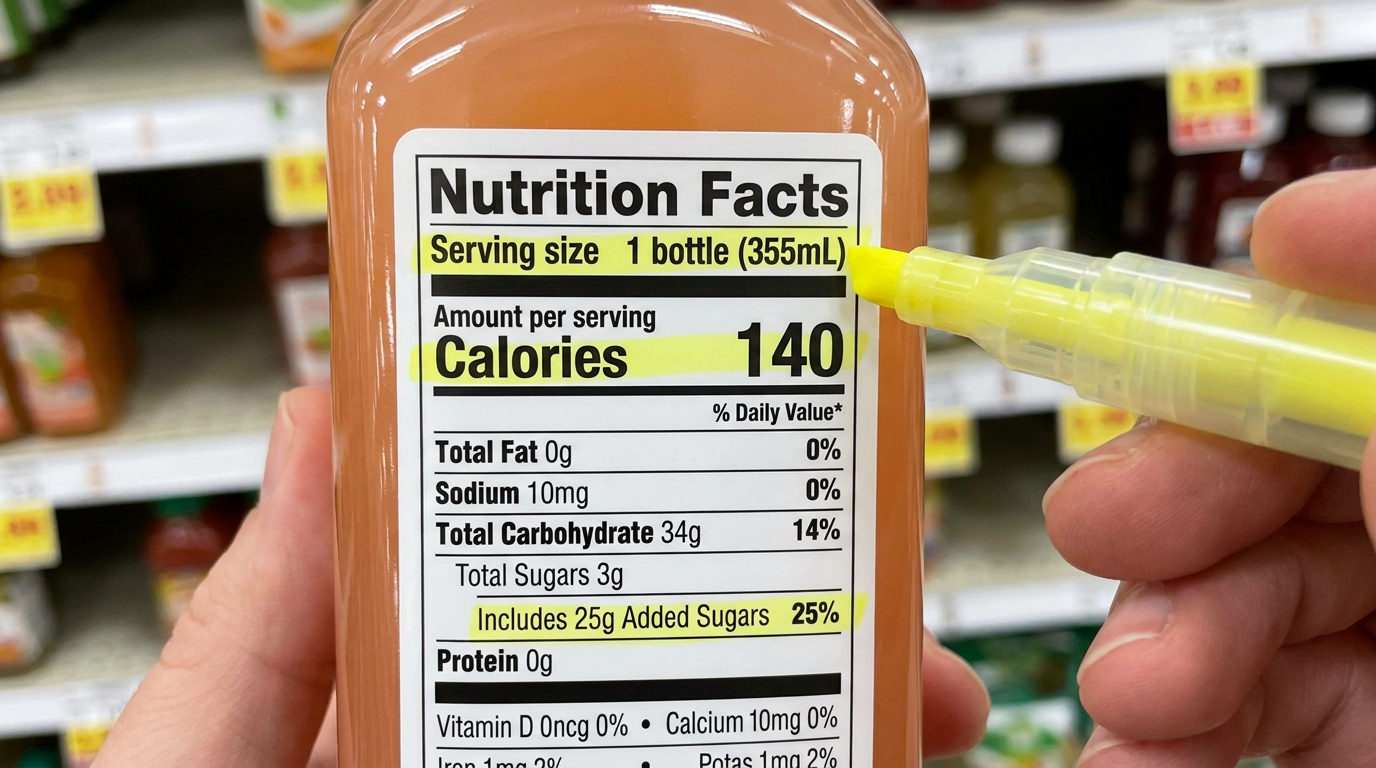
This is exactly the kind of downstream cost that surfaces when format decisions are made in isolation from regulatory and production realities. A container change late in the process can trigger new artwork, a new filling trial, and a revised co-packer quote, which is covered in this breakdown of
what beverage development actually costs
Numbers on the panel are governed by measurement. The words on the front of the can are governed by something stricter.
.
Claims: Where Functional Beverage Brands Get Into Trouble
Functional beverages sell on benefit. That is the entire commercial proposition, and it is why the category has grown the way it has. It is also why claims language is where otherwise careful brands quietly reclassify their product, invite enforcement attention, or find themselves marketing an unapproved drug without ever intending to.
This is the section to read twice.
The good news is that the line is well documented and consistently applied. FDA's overview of is the authoritative starting point, and it covers all three claim types you need to understand.
label claims for conventional foods and dietary supplements
Health Claims Must Be Authorized
Two things follow from that. First, you cannot invent a health claim, however solid you believe your evidence to be. Second, an authorized claim comes with specified wording and specified conditions of use, including eligibility requirements your product has to meet. Health claims can never imply that your product treats, cures, or prevents disease.
A health claim links a substance to a reduced risk of a disease or health-related condition. These are not free to write. They must be authorized by FDA, whether as authorized health claims, health claims based on authoritative statements from other federal scientific bodies, or qualified health claims supported by emerging evidence and accompanied by qualifying language.
Structure/Function Claims Are Available, With Conditions
A structure/function claim describes how a nutrient or ingredient affects the normal structure or function of the human body. "Supports immune function" is a structure/function claim. So is "helps maintain healthy digestion."
These require no FDA pre-approval, which is why they are the workhorse of functional beverage marketing. That freedom comes with obligations. The claim must be truthful and not misleading, and you must have substantiation for it before you print it. FDA's Substantiation means competent and reliable scientific evidence relating to your ingredient at your dose in your format. A study on a concentrated extract at a clinical dose does not substantiate a claim for a trace inclusion of the same botanical in a sparkling water. If a regulator or a competitor asks what supports your claim, "it is a well known traditional ingredient" is not an answer.
structure/function claims page
sets out the definitional detail.
The Disclaimer Distinction, Stated Carefully
On dietary supplements, structure/function claims require the statutory DSHEA disclaimer, worded exactly as follows:
This statement has not been evaluated by the Food and Drug Administration. This product is not intended to diagnose, treat, cure or prevent any disease.
The wording cannot be modified, shortened, or paraphrased, as set out in the . Supplement marketers must also notify FDA within 30 days of first marketing the claim, following the process described on .
FDA's page on structure/function claim notificationsDietary Supplement Labeling Guide, Chapter VI on Claims
Conventional foods and beverages do not legally require that disclaimer.This is where a specific and common error occurs. Beverage brands add the disclaimer reflexively, because they have seen it on other functional products and assume it offers protection. It does not function as a shield. Worse, printing a supplement disclaimer on a product you are otherwise marketing as a conventional beverage sends a mixed signal about which category you believe you are in. Know your category, then apply the disclaimer only if it belongs to you.
Their claims must still be truthful, not misleading, and substantiated, but the DSHEA statement is a supplement obligation.
Saying What You Want to Say, Compliantly
The most useful thing this article can give you is language. Here are five pairs drawn from real functional beverage territory.
Immunity
- Crosses the line:
Boosts immunity to fight off colds - Stays on the right side:
Contains vitamin C, which supports normal immune function - Why the first fails: naming a specific illness turns a function statement into a disease prevention claim. "Fight off colds" tells the shopper the product prevents an illness, which is drug territory. The second version describes a normal bodily function and ties it to a specific nutrient.
Inflammation and joint pain
- Crosses the line:
Reduces inflammation and joint pain - Stays on the right side:
Made with turmeric, traditionally used in wellness rituals - Why the first fails: inflammation and joint pain are health-related conditions, and promising to reduce them is a treatment claim. The second version describes the ingredient and its traditional use without promising a physiological outcome.
Sleep
- Crosses the line:
Helps you sleep, a natural alternative to sleep medication - Stays on the right side:
Contains magnesium and L-theanine to support relaxation - Why the first fails: positioning your drink as an alternative to a medication invites direct comparison with a drug, which implies your product does what that drug does. The second version stays with relaxation, a normal function, and names the ingredients responsible.
Detox
- Crosses the line:
Detoxifies your liver - Stays on the right side:
Cold pressed celery, cucumber, lemon, and ginger juice - Why the first fails: it asserts a therapeutic effect on a specific organ, with no authorized claim behind it and no realistic substantiation available. The second version simply says what is in the bottle, which for a fresh juice brand is frequently the strongest thing you can say.
Energy
- Crosses the line:
Cures afternoon fatigue and treats brain fog - Stays on the right side:
Contains caffeine from green tea to help you feel alert - Why the first fails: "cures" and "treats" are disease language regardless of what follows them. The second version describes an ordinary effect of a named ingredient.
The difference between supporting a function and treating a condition is the difference between a beverage and an unapproved drug.
Notice the pattern across all five. The compliant versions are more specific, not vaguer. They name the ingredient, they describe a normal function, and they avoid disease vocabulary. They are also, in most cases, better marketing copy, because they give the shopper a reason to believe rather than a promise to discount.
Nutrient Content Claims Have Defined Thresholds
"Sugar free" has a defined maximum. "Excellent source of" requires a specific percentage of the Daily Value per serving. "Light" carries defined meanings that depend on the reference product. You cannot use any of them loosely, and a product that misses a threshold by a fraction of a gram misses it entirely. Check your numbers against the definitions before your copywriter falls in love with a phrase.
Terms such as "low sodium," "excellent source of," "sugar free," "light," "reduced," and "high in" are defined by regulation with specific numerical thresholds. They are regulated terms, not descriptive adjectives.
The Caffeine Question, Stated Accurately
Many published articles on beverage labeling state that FDA requires caffeine content disclosure. That is not correct, and the error is widespread enough to be worth stating plainly.
There is currently no general FDA requirement to declare total caffeine content per serving on conventional beverages. If caffeine is added as an ingredient, it must appear in your ingredient list like any other ingredient. Quantitative disclosure in milligrams is a different matter, and no general mandate exists for it.
FDA has issued guidance addressing pure and highly concentrated caffeine products sold as dietary supplements, covered on . That is a specific safety concern about concentrated bulk products, and it is not a labeling mandate for ready to drink beverages.
FDA's page on pure and highly concentrated caffeine
Legislation has been proposed that would change this. , introduced in the 117th Congress, would have required disclosure of caffeine content for products containing more than 10 mg per serving, along with a statement of whether the caffeine was added or naturally occurring. That bill did not become law. The Food Labeling Modernization Act concept has been reintroduced in later sessions, including , which remains pending in committee. Verify the current status yourself rather than taking anyone's word for it, including ours.
H.R. 8385 in the 119th CongressH.R. 4917, the Food Labeling Modernization Act
Now the commercial recommendation, stated without hedging. Disclose your caffeine content voluntarily. Consumers increasingly look for it, particularly parents and people managing sensitivity. Retailers increasingly ask for it during category review. Competitors in energy, coffee, and functional tea already print it, so its absence reads as evasion rather than restraint. Voluntary disclosure builds trust, and it positions you ahead of a requirement that keeps returning to Congress.
Claims sensitivity intensifies in categories where the ingredient itself is tightly regulated. Developing a compliant product in that environment means treating claims strategy and formulation as one workstream, which is how we approached the
cannabis THC and CBD drink formulation for Lyre's
Every panel is now covered. Here is what to do with it.
.
Your Pre-Print Label Checklist and the Cost of Errors
Work through this against live artwork, ideally with two people and a printed proof rather than a screen.
- [ ] Agency confirmed. FDA or TTB, verified rather than assumed, with low alcohol edge cases checked.
- [ ] Category confirmed. Conventional beverage or dietary supplement, tested against your marketing, container format, and serving size, not just your intention.
- [ ] Statement of identity present. Common or usual name, bold type, size reasonably related to the most prominent printing on the panel.
- [ ] Net quantity correct. Both US customary and metric units, correct type size for the panel area, positioned in the bottom 30 percent.
- [ ] Name and place of business. Complete address with the correct qualifier if you are not the manufacturer.
- [ ] Ingredient list ordered correctly. Descending order of predominance by weight, common or usual names, sub-ingredients of compound ingredients declared.
- [ ] Allergens complete. Checked against all nine, including sesame, using either the in-list method or a "Contains" statement immediately following the ingredient list.
- [ ] Nutrition or Supplement Facts panel correct. Right panel type for your category, mandatory nutrients present in the fixed order, vitamin D and potassium included.
- [ ] Serving size derived from the correct RACC. Looked up for your specific product category, not chosen.
- [ ] Dual-column applied where required. Calculated for containers between 200 and 300 percent of the RACC.
- [ ] Every claim classified and substantiated. Health, structure/function, or nutrient content identified for each phrase, with evidence on file at your dose and format.
- [ ] Disclaimer applied only if you are a supplement. Exact statutory wording, unmodified, plus FDA notification within 30 days.
- [ ] Caffeine disclosure decided deliberately. Not by default, and documented either way.
- [ ] Final review completed by a qualified regulatory specialist, with the FDA Food Labeling Guide open beside the proof.
What Getting It Wrong Actually Costs
Set aside the anxiety and look at the numbers, because the commercial case is straightforward.
Reprints of committed packaging runs. Printed cans and labels are usually ordered at volume for unit economics. A compliance error after the run is committed means writing off the entire order, not correcting a file.
Relabeling and rework on finished goods. If product is already filled, you are paying for manual labor, storage, and handling on stock you have already produced, at a per unit cost that frequently exceeds the original label cost.
Delayed launches. Missing a seasonal window or a retailer reset date can cost a full cycle. A summer hydration product that slips past May is waiting until next year.
Rejected retailer submissions. Major retailers screen labels before they screen product. A rejection at that stage does not just delay you, it consumes credibility with a buyer you spent months reaching.
Recalls. Direct costs including retrieval, disposal, and notification, plus brand damage that persists in search results long after the product is corrected.
Lost co-packer slots. Production calendars are booked in advance. Miss your window and you rebook weeks or months later, at whatever the current rate is, behind whoever took your slot.
Why Timing Beats Diligence
Look back at what we covered. Serving size determines container format. Category determines panel type. Claims determine what substantiation you need on file, which determines what evidence you should have generated during formulation. Allergen declarations depend on supplier documentation you should have collected at sourcing. Every one of those decisions belongs in development, months before anything reaches a printer.
Notice something about that list. Almost every cost is a consequence of timing, not of carelessness. The brands that get hit are rarely the ones that did not care. They are the ones that treated labeling as a final design task rather than a development decision.
That is why regulatory compliance sits inside DEVELOP in , alongside scalable formulation and quality manufacturing. It is a sequencing observation before it is anything else. Compliance considered during development shapes better decisions. Compliance discovered at print only generates costs, as the timelines in and the cost ranges in both show.
what beverage development actually costshow long beverage product development takesMenu Collective's Design, Develop, Deliver framework
A reminder before you act on any of this. This article is general guidance. It is not legal or regulatory advice. Federal requirements change and guidance documents are updated. Proposed legislation is not law until it passes. Your category, ingredients, claims, and container size all change what applies to you. Have your specific label reviewed and verified by a qualified regulatory specialist before the artwork goes to print.

Conclusion
None of this puts a compliant label out of reach. Founders navigate it successfully every day, with good information, an early start, and the right people around the table.
Three areas carry the most risk in beverages specifically. Serving size and the RACC, because the reference amount governs your panel and your container choice quietly commits you to a format. Allergen declaration, because that is where a labeling error becomes a safety event. Claims language on functional products, because that is where enthusiasm crosses into a category you did not intend to enter.
The pattern worth carrying away is about sequence. Labels do not fail at the printer. They fail at decisions made months earlier about category, container, and claims, decisions that felt like branding or cost questions at the time and turned out to be regulatory ones.
FDA labeling requirements for beverages are detailed, but they are knowable. Every requirement in this walkthrough is published, public, and checkable. The regulations are online, the guidance documents are written for industry, and the reference amount tables are a lookup rather than a mystery. Nothing here depends on insider knowledge.
Get Compliance Right During Development, Not at Print
The brands that avoid label problems are not the ones with the best lawyers. They are the ones that handled compliance while the product was still being built.
Menu Collective designs, develops, and delivers beverages. Regulatory compliance sits inside DEVELOP, alongside scalable formulation and quality manufacturing, because that is where those decisions actually get made. We are collaborators, not consultants. We build with you, not for you. Any base, any format, from start-ups launching a first SKU to established brands extending a range. You can see the full scope of our before you reach out.
beverage development services
This article is general guidance. Have a qualified regulatory specialist verify your specific label before printing.
Bringing a drink to market, or fixing one that stalled?