
Sit with that for a moment. You are talking about adding a full bar program to a company whose entire operational identity is built around coffee. The equipment is built for coffee. The staffing model is built for coffee. The service rhythm, the muscle memory, the ticket flow, the pacing of a morning rush: all of it is coffee. Now put a cocktail program inside that room and make it feel like it belongs there.
That distinction sounds like a small one until you see what the assignment actually was. Starbucks opened its first Reserve Roastery in Seattle, then set out to open five more across the globe. These were never meant to be coffee shops with better lighting. A Reserve Roastery is a flagship experience venue, a destination built around the theater of coffee itself: casks, pipes, roasting equipment, and a room designed so that guests can watch a bean become a beverage. Then came the harder ambition. Starbucks wanted these flagships to be a curated experience where coffee and tea were integrated into a full cocktail menu.
When Starbucks wanted something extraordinary, they did not hire a consultant. They called on a collaborator.
That is the project. ran across four cities, in four markets, with four different sets of expectations about what a drink should be. Menu Collective worked Milan, then New York City, then Tokyo. Then the team was asked to repeat the success in Chicago. There is a pleasing symmetry in that last one, because Menu Collective is a Chicago outfit, founded in 2016 by Stuart McCarroll, working on the Chicago Roastery. Home turf, highest visibility.
Full bar development for the Starbucks Reserve Roastery
Four workstreams carried the program: cocktail development, regional variants, bar design, and staff training. This piece walks through all four, and it goes deep on technique, because technique is the actual story. Anyone can publish a highlight reel. What follows is closer to a shop floor tour.
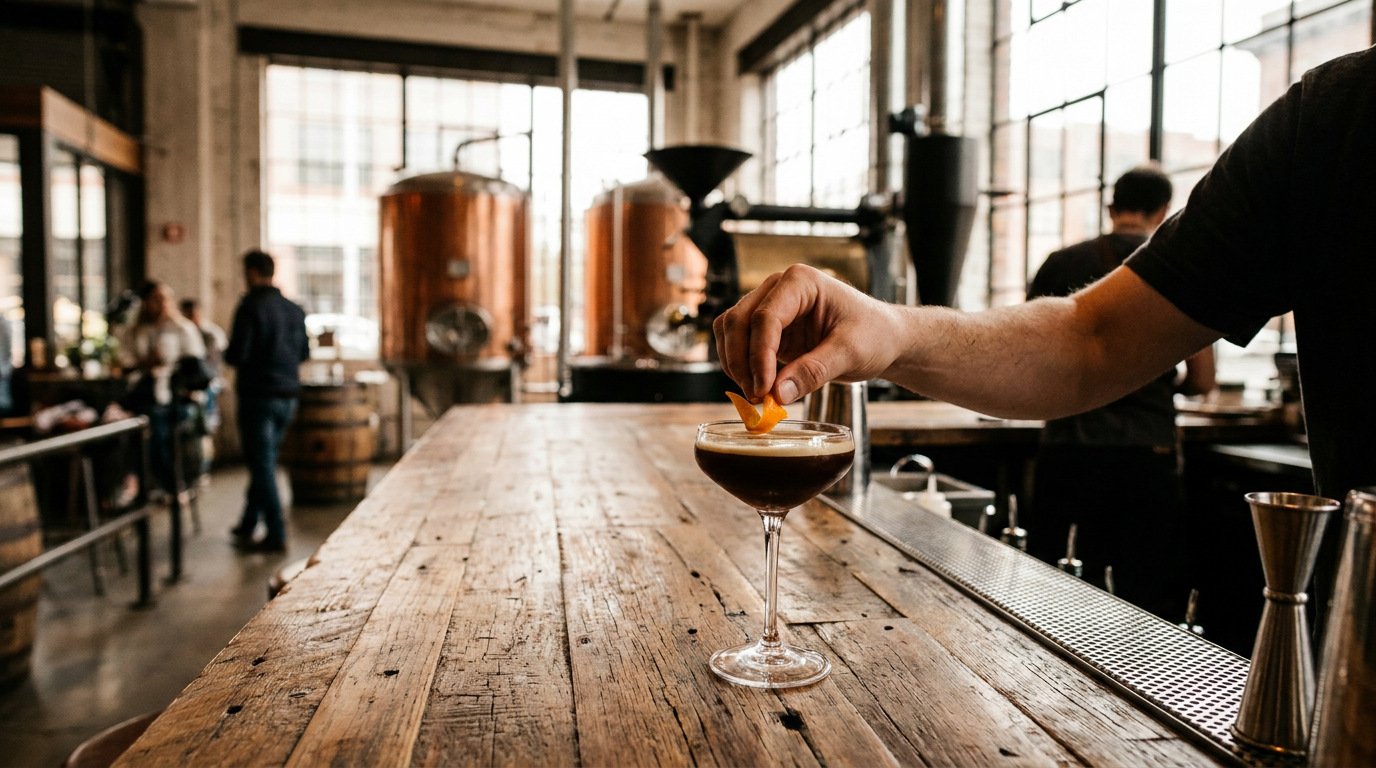
Before any of the craft made sense, though, the brief had to be pinned down precisely. So let's start where the work started.
The Brief: Build a Bar That Belongs Inside the Reserve World
That is the line the entire program turns on. A bar inside a Roastery cannot feel bolted on. It cannot feel like a revenue idea that arrived in a slide deck and got installed near the back wall. It has to feel native, as though it had always been there, as though the room had been designed around it from the first sketch. Guests walking into a Roastery have come for coffee. The cocktail program has to earn its place inside that expectation rather than compete with it.
Coffee stays the hero.
Every good project has one constraint that everything else orbits. This one had a clear one.
What does "native" mean in practice? It means the drinks read as That constraint rules out an enormous amount of otherwise good work. A beautifully balanced cocktail that happens to contain coffee is a failure by this standard if the coffee is doing background duty. The coffee has to be legible. Present. Identifiable as the thing you came for.
Starbucks Reserve
first and cocktails second. Coffee and tea are not garnish. They are not a novelty ingredient dropped into an otherwise conventional drink so the menu can claim a theme. They are the reason the room exists, and they have to be the reason each drink exists too. A guest should taste the coffee and understand immediately why this drink could only be served here.
Setting the Gold Standard Before Anything Gets Measured
A program with this much visibility needs an agreed benchmark before a single ingredient is measured. That is the idea, and it does a specific job: it converts a set of opinions into a set of criteria.
Gold Standard product
A Gold Standard is not a mood board and it is not a flavor preference. It covers three things at once.
- Sensory experience. What should this drink taste like, smell like, and feel like in the mouth? What is the coffee doing? Where does it sit against sweetness, bitterness, acidity, and alcohol?
- Operational feasibility. Can this be built correctly, at speed, by a trained team, during a full-room rush, with the equipment that exists in the room?
- Commercial positioning. Does this belong on this menu, at this price, in this market, next to these other drinks?
Agree that first and the rest of the process becomes a matter of judgment against a standard. Skip it and you get a tasting session that turns into a debate about personal taste, which is a debate nobody wins.
Ruthless Selection Beats Volume of Ideas
Here is a number from the project that is worth understanding properly. A high level internal tasting of 30 to 50 cocktails narrowed the field to the menu worthy winners.
The instinct is to read that as a productivity statistic. It is not. Generating 30 to 50 cocktails is the easy part of that sentence. Any competent development team can produce fifty drinks. The achievement is the cut: the willingness to look at a drink that genuinely tastes good, that somebody in the room is proud of, and to say it does not clear the standard.
Ideas were the starting point. They were never the endpoint. A drink that survives that funnel has been tested against sensory intent, against buildability at peak service, and against whether it belongs on a Starbucks Reserve bar menu at all. Most do not survive. That is the process working.
Coffee stays the hero.
With the brief defined, the obvious question is why this was hard. The answer is not brand strategy. It is coffee itself.
The Craft Challenge: Why Coffee Is a Difficult Cocktail Ingredient
Coffee is one of the most demanding ingredients you can put behind a bar. It is unstable, it is made fresh for every drink, and it behaves differently depending on how you extracted it ten seconds earlier. Most people encounter coffee cocktails as a single famous drink and assume the category is simple. It is not. Here is what a development team is actually managing.
Extraction Method Does Not Give You Three Versions of One Ingredient
It gives you three different ingredients.
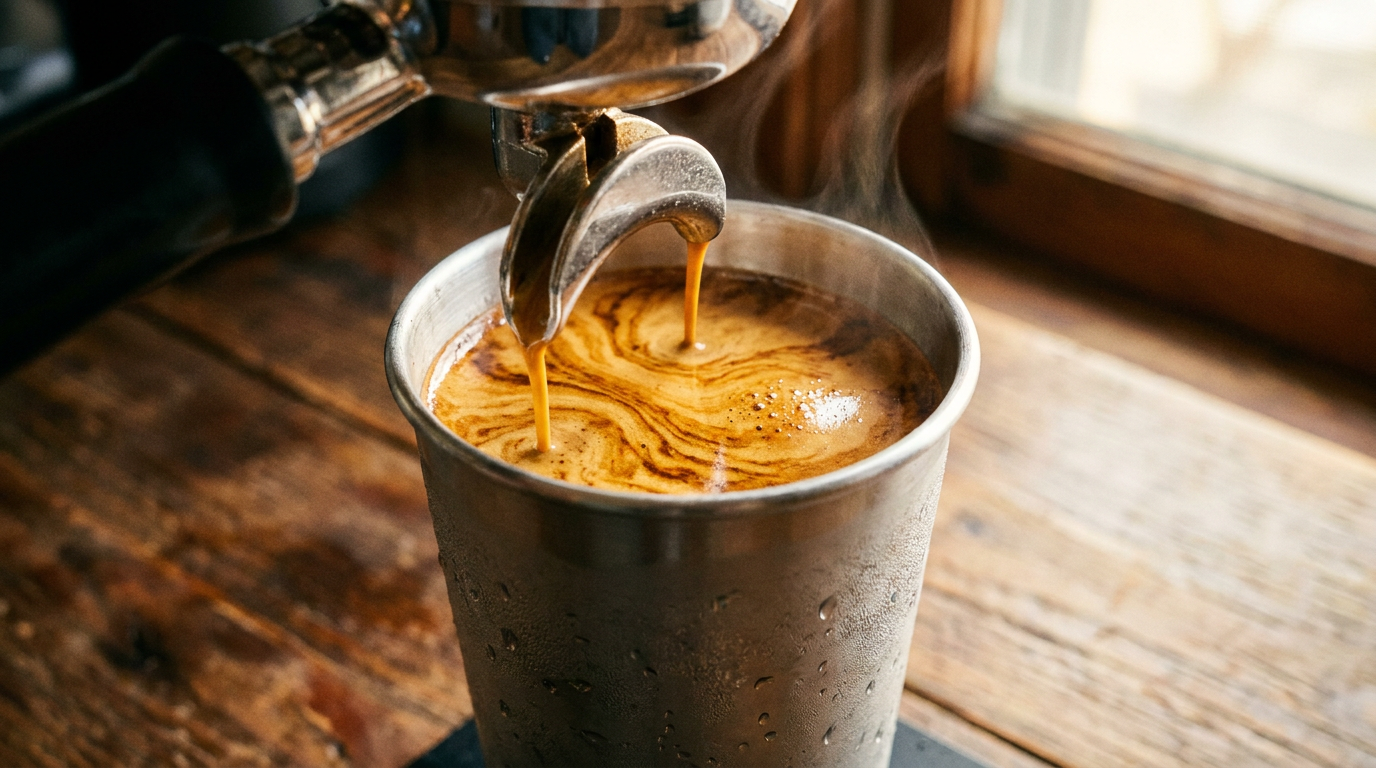
Espresso is pulled at Filter coffee is a different animal entirely. Brewed at atmospheric pressure, with a paper filter stripping most of the oils on the way through, it arrives lighter, clearer, and more aromatically distinct. Nothing is emulsified. There is no crema. What you gain is clarity and brightness. What you lose is body.
roughly nine bars of pressure
, which is nine times atmospheric pressure, and that force does something no other brew method does. It drives a high concentration of dissolved solids into the cup, it emulsifies oils that would otherwise stay in the grounds, and it carries dissolved carbon dioxide out of the coffee. The result includes crema, which is not decorative foam but a genuine oil-in-water micro-emulsion: gas bubbles from roasting CO2, stabilized by lipids, proteins, polysaccharides, and melanoidins acting as surfactants that hold the bubble films together.
Cold brew is the third ingredient. Extracted slowly without heat, , reading as softer, rounder, and more floral, with less of the sourness, bitterness, and harshness that hot extraction can pull. It is the gentlest of the three and the most forgiving next to a spirit.
cold brew produces a measurably different sensory profile
Choosing between them is not a preference. It is a formulation decision that changes texture, aroma, acidity, and how the drink behaves in the glass over the next four minutes.
Acidity and Bitterness Misbehave Next to Alcohol
Spirit choice compounds it. Oak aged spirits arrive with tannins that compete with coffee's own bitterness and astringency rather than complementing them, and the two can stack into something harsh. Lighter spirits leave more room and let coffee character show clearly. Darker spirits soften coffee bitterness with caramel and vanilla sweetness, which sounds like the answer until you notice the coffee has disappeared under it. Solving bitterness by burying the hero defeats the entire brief.
Put them next to a high proof spirit and the arithmetic changes. Ethanol raises the perceived sharpness of acidity and amplifies perceived bitterness. A coffee that tasted vibrant on its own can turn thin or astringent the moment it meets the spirit. Nothing was wrong with the coffee. The context changed what the palate reports.
Coffee's acids read as brightness when you drink coffee. Citric acid gives citrus lift, malic acid gives an orchard fruit quality, and chlorogenic acids contribute bitterness and structure rather than sourness. On their own, in a cup, they are what makes good coffee taste alive.
Roast Level Is a Formulation Decision, Not a Sourcing One
None of these is correct in the abstract. Each is correct for a specific drink, which is why roast selection sits inside the recipe rather than upstream of it.
Medium roasts often deliver the most stable crema, which matters when foam is part of the drink's identity.
Lighter roasts preserve citric and malic acid and hold onto fruit and floral aromatics. Bright and expressive in a cup. In an alcoholic build, that same brightness can turn sharp and edgy once ethanol amplifies it.
Darker roasts push organic acids down and roast-derived compounds up. Quinic acid rises as chlorogenic acids break down, bitterness increases, and oils migrate to the bean surface. You get nutty, roasted, chocolate character and more body, plus more bitterness to manage.
Roast is where the chemistry gets decided before anyone touches a shaker.
Oils Are What Make a Coffee Cocktail Feel Expensive
The emulsified lipids and proteins that pressure extraction pulls into espresso are responsible for the Handle them well and the drink is velvety. Handle them badly and it turns coarse, with large unstable bubbles that break into a slick instead of a tight, fine-textured crown. Same ingredients, same recipe, completely different guest experience. Texture is where amateur coffee cocktails give themselves away.
mouth-coating body
that separates a great coffee cocktail from a thin one. They give viscosity. They carry volatile aroma compounds and hold flavor on the palate after the swallow. They form the films that let foam survive more than a few seconds.
Temperature and Time Are Part of the Recipe
This is why professional builds treat tempering the shot, pre-chilling components, glass temperature, and ice quality as recipe specifications rather than housekeeping. Ice is an ingredient. Glass temperature is an ingredient. A recipe that does not specify them is not finished.
The lipid films destabilize as temperature drops abruptly, so foam structure becomes erratic. The ice melts fast because it is absorbing a lot of heat quickly, so dilution runs away from you and the drink loses concentration. And that additional water thins out the dissolved CO2 and surfactants that foam depends on, so what foam does form is weaker. Volatile aromatics flash off in the process, taking complexity with them.
Hot espresso hitting ice is a thermal shock, and it causes three problems simultaneously.
Consistency Is the Hardest Part, Because the Base Is Made Fresh
Beans degas as they age, changing crema behavior. Grinders heat up over a busy service and shift particle distribution. Humidity changes how grounds behave in the basket. Left alone, a drink built identically at 6pm is not the drink that was built at noon.
Every other ingredient behind a bar arrives stable in a sealed bottle. Coffee does not. It is manufactured on site, per drink, by a person, from a raw material that drifts.
Teams hold the line by treating dose, yield, time, and temperature as specifications carrying the same authority as a spirit measure, and by calibrating against a reference throughout service rather than only at open. The wider industry has been wrestling with the same throughput and consistency problem from other directions, including
putting espresso martinis on draft
Now scale all of that to four cities with four different palates.
Every one of these variables sits underneath every drink on a Starbucks Reserve bar menu. Build coffee-forward drinks where the coffee stays present and legible rather than buried, and you have solved a formulation problem, a service problem, and a training problem at the same time.
to protect speed and repeatability during a rush. That is a reasonable answer to a real constraint, and the fact that serious operators reach for it tells you how hard the underlying problem is.
Four Cities, Four Palates: Milan, New York, Tokyo, and Chicago
Fully independent local menus solve relevance and destroy coherence. Each city gets something tailored and genuinely appropriate, and the brand stops meaning one specific thing. Five Roasteries with five unrelated bar programs is five bars, not one program.
One identical menu everywhere is coherent. A guest in Tokyo and a guest in Milan get the same brand promise, the same drinks, the same reference points. It is also generic, and it quietly ignores that palates differ, that service norms differ, and that ingredient availability differs by market. It treats local difference as a rounding error.
Global beverage programs fail in one of two predictable directions, and it is worth stating the tension honestly before describing how it was resolved.
One Framework, Four Expressions
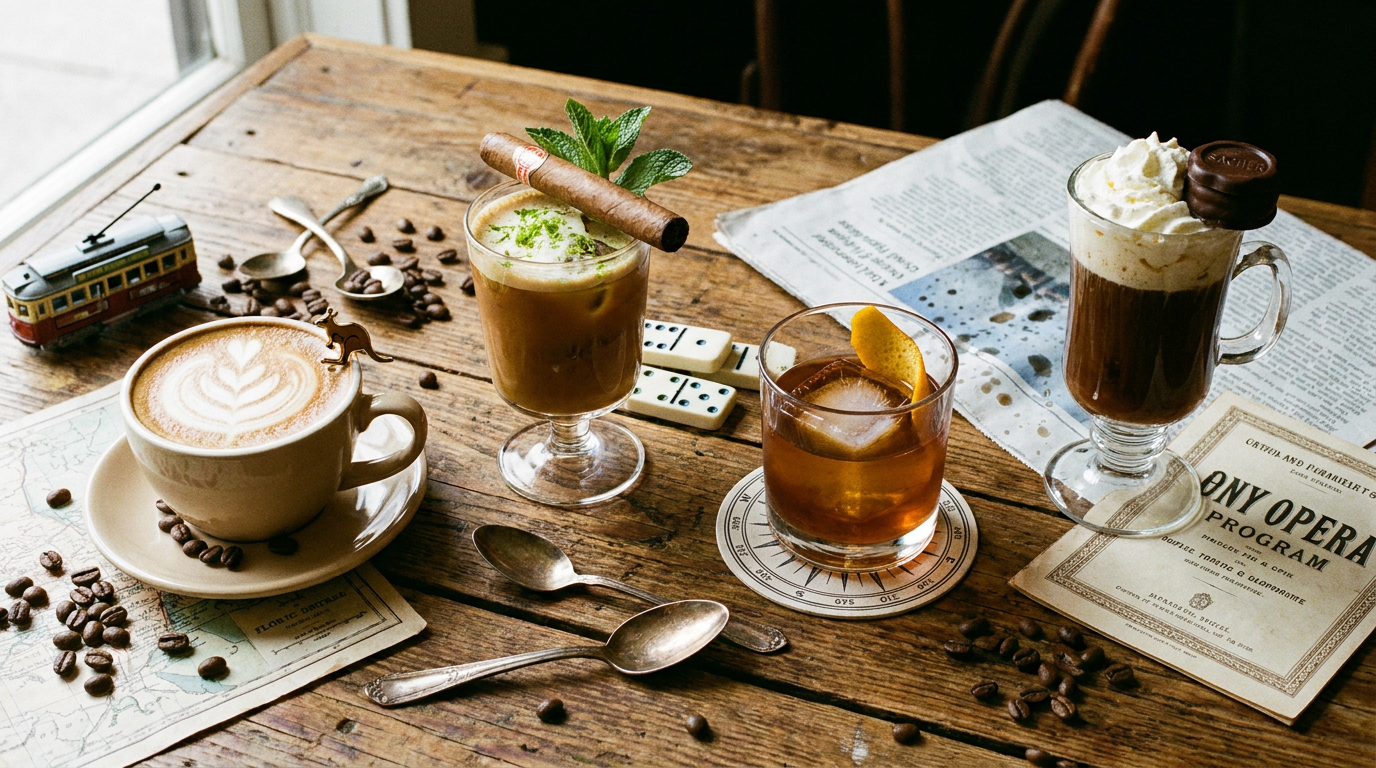
The answer was a shared framework with regional expression. A global superset of signature cocktails appears on every Reserve Roastery bar menu, and each city also carries That structure does real work. The shared signatures mean the program has an identity that travels, so a guest recognizes the Reserve bar experience wherever they encounter it. The exclusives mean each Roastery has something that could only exist in that city, which gives locals a reason to feel ownership and gives travelers a reason to seek out a specific location. Neither half works without the other.
regional drinks exclusive to that city
Coherence at the core. Personality at the edges.
.
Fieldwork, Not Desk Research
This is why the drinks landed as local rather than as an outsider's idea of local. There is a specific failure mode in global menu development where a team assembles national signifiers from a distance and produces something that reads as costume. Fieldwork is the defense against it.
That phrasing matters. Not "what do people in this market drink," which you can pull from a report. The question was narrower and stranger: what does a guest here expect when this particular brand serves a cocktail? That is a question about brand meaning in a local context, and there is no dataset for it. You get it by going, standing in rooms, watching how people order, and noticing what time of day the room fills.
Concept development started with multiple site visits and research in each global market, specifically to understand local consumer expectations of the marriage between Starbucks and cocktails.
What Each City Actually Contributed
The published inspirations are concrete and specific, and each one demanded something different from the development process.
Milan. Architecture in Italy drove the drink development. Not Italian ingredients as a shortcut, but the built environment: proportion, structure, the relationship between ornament and form. Milan also sits inside a drinking culture with genuine aperitivo tradition, which carries its own expectations about timing, about bitterness tolerance, and about what a pre-dinner drink is for. A market comfortable with bitter is a market that gives you room to let coffee's own bitterness stand rather than sweetening around it.
New York City. A market with its own pace and volume expectations. New York bars operate at a tempo that puts pressure on any build with multiple steps, and guests arrive with a broad frame of reference from one of the most competitive cocktail cities in the world. Whatever goes on the menu is being compared to a lot of other drinks.
Tokyo. Seasonality in Japan contributed to the cocktails. Japanese drinking culture carries a deep sensitivity to season and to precision, where a drink appearing at the right moment in the year is part of its meaning. Precision expectations run high in Japanese bartending, which raises the bar for consistency and for execution detail.
Chicago. The history of Chicago drinking culture inspired the menu. Chicago has deep roots and strong local character in its bars, a genuine sense of its own lineage. A menu drawing on that history has to earn it with people who know the reference.
Framed as considerations rather than invented specifics, those four inputs produced four distinct expressions of one family. The same collaborative framework has since been applied across very different categories, which you can see across : any base, any format.
Menu Collective's case studies
Being Asked Back Is the Result
From what guests drink, then, to the room where the drinks get built.
Being asked back, city after city, and then being asked to go back to the beginning and fit the flagship that predated the program: that is the result. Clients do not hand you the next market because the deck was persuasive. They hand it to you because the last one worked.
Milan. Then New York City. Then Tokyo. Then Chicago. And after those four, the original Seattle Roastery, the one that started it all, was retrofitted with a bar menu.
There is no published sales figure here, and inventing one would be worse than useless. The outcome statement is the sequence itself.
Chicago: Where Bar Design and Menu Development Stopped Being Separate Jobs
Chicago is also where the most important argument in this whole project becomes physical.
Menu Collective is based at 1210 W Lake St in Chicago. The team was asked to help build the bar program at the Chicago Roastery. It is difficult to overstate how much sharper the incentives are when the venue is in your own city and the people you know will be sitting at that bar within a week of opening.
A Menu and the Room That Produces It Are One System
A tasting room is a laboratory. A Friday night is the real world. The gap between them is measured in steps, reaches, and seconds.
That sequence produces predictable failures. Where the equipment sits determines what is buildable during a rush. A drink that requires too many steps, or too many trips across the well, or one specialty tool stored at the far end of the bar, will fail at peak service no matter how beautifully it performed at a tasting. It will fail slowly, too, which is worse. The bartender will start cutting a corner. Then another. Within a month the drink being served has quietly stopped being the drink that was developed, and nobody made a decision to change it.
Most beverage development treats these as separate jobs, sequenced. Someone designs a bar. Someone else writes a menu. The menu shows up after the room is finished and adapts to whatever it finds.
Beautiful Design Met Functional Efficiency
The division of labor in Chicago is the whole point, and it is worth stating plainly because it is genuinely unusual.
Starbucks had designers design the bar. Menu Collective added functionality to it.
Beautiful architectural design met functional operational efficiency, and neither party could have produced that result alone. The designers built something worthy of a flagship, a bar that belongs in a room people photograph. What they were not positioned to know is what happens to that geometry when four bartenders are working it at once, when the ticket rail is full, and when every third drink requires a fresh espresso pull.
That knowledge comes from having stood behind a bar during a rush. So the work was additive rather than corrective: keep the design, make it work at volume.
What "Functionality" Actually Covered
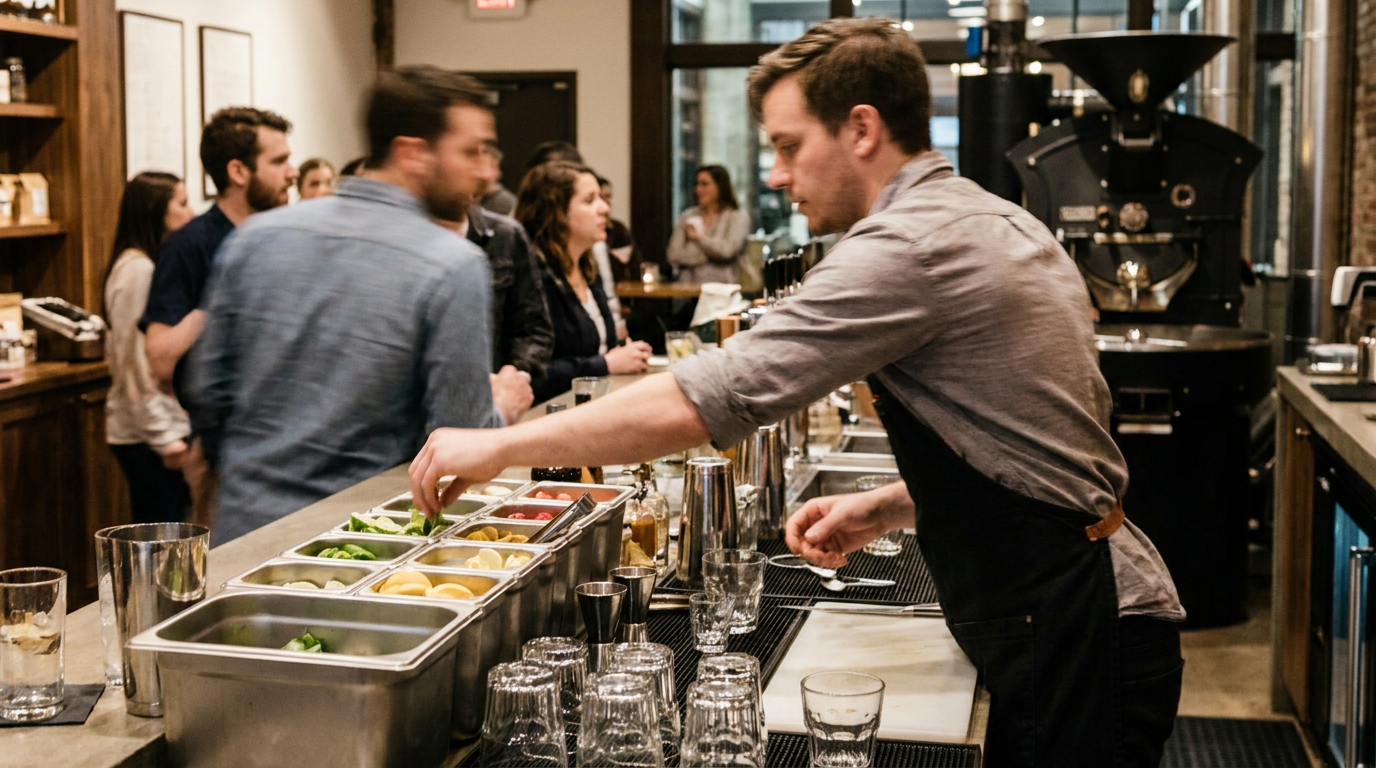
Workflow, prep stations, and inventory systems were optimized to support high quality service, reduce errors, and streamline drink preparation. In practice that means a series of unglamorous, decisive questions.
- Where does a bartender stand to build the highest volume drink on the menu, and what can they reach without moving their feet?
- Which components get batched and prepped ahead, and where do those containers live so the reach is short and the rotation is obvious?
- How does the espresso workflow interleave with the cocktail workflow, given that both are competing for the same hands during the same rush?
- Where is the ice, and how many times per drink does someone cross the well to get to it?
- How does inventory get counted, restocked, and rotated without pulling someone off the line mid-service?
- When an error happens, and errors happen, what is the fastest path back to a correct drink?
None of that is glamorous. All of it determines whether the program survives its first busy Saturday.
A Roastery Bar Is Watched
Every sensory detail was treated as part of the program: ingredient presentation, glassware, the whole visual grammar of the bar. The goal was for the bar to read as an extension of the Roastery's story rather than a separate business operating inside the same building.
The naive framing treats this as a tradeoff, spectacle against speed. It is not. Speed and theater have to be designed together, because a bartender fighting a poorly laid out station does not look like a craftsperson. They look rushed. Efficient movement is what reads as expertise. Design the workflow properly and the theater comes free, because competence performed at speed is genuinely compelling to watch.
That changes design decisions. It affects where things sit, how the bartender moves, which parts of the process are worth surfacing and which are better kept tidy. Presentation of ingredients becomes part of the room's visual language. Glassware stops being a container and becomes part of the story.
A Roastery is designed around visible process. That is the premise of the room: the coffee is made in front of you, and watching it is part of what you came for. The bar inherits that expectation. Nothing happens under the counter. Every reach, every pour, every strain is on display, sometimes to guests seated close enough to read a label.
There is a further complication specific to this venue type. Guests can see the build.
Why This Cannot Be Delivered as a Document
Here is the contrast that matters, and it is the reason sit alongside formulation as standing capabilities rather than favors.
bar design and operational integration
A recipe deck cannot tell you that your beautiful bar has a bottleneck at the ice well. A deck does not know where the ice well is. It does not know that the third step of a signature build requires a reach that collides with the person working the station beside you. It does not know that the glassware chosen for its look does not stack in the available space.
Only being in the room can tell you that. That is the difference between advice and building.
"Menu Collective has an unparalleled ability to take a brief and a conceptual desired customer experience and apply their mixology wizardry to create a truly magical cocktail program."
Keith Jacobsen, Brand Manager, Starbucks
The Chicago Roastery's drinks program went on to attract real press attention, including coverage from
A well designed bar and a great recipe still amount to nothing without the people who execute them. Which brings us to the part of the project that matters most.
in its rundown of what to eat and drink at the venue. Rooms like this get looked at closely, which is its own argument for getting the operational details right before opening day.
Turning Baristas Into Bartenders: Why Training Is the Whole Argument
Building capability inside the client's team is what makes a program survive contact with reality. That is not a philosophical position. It is an observation about what happens to menus after handover.
That sentence is the entire thesis of this section and arguably of the whole project. It is also the point where the difference between two working models becomes unmistakable. One model delivers a menu and leaves. The menu is correct, the photography is good, the specs are documented, and then the engagement ends. What happens next is that the program degrades, quietly, in execution, until the drinks being served bear a family resemblance to the drinks that were developed and nothing more.
A recipe is worthless if the team cannot execute it consistently.
Respect the Craft That Already Exists
But a bar is genuinely different work. New equipment. New techniques. A different pace. Different service standards. And different responsibilities, including alcohol service, which carries legal and duty-of-care weight that has no equivalent on the coffee side. Pretending the gap is small does the team a disservice. Naming it accurately is what lets you close it.
A skilled barista already possesses things a bar program desperately needs: precision under time pressure, calibrated sensory judgment, an understanding of extraction variables, comfort with equipment that punishes carelessness, and the habit of adjusting to a raw material that changes through the day. Those are transferable and valuable. Nobody is starting from zero.
Baristas are highly skilled. This deserves saying clearly, because the phrase "turning baristas into bartenders" can be read as an upgrade, and it is not one.
The Concrete Skills
Training covered a specific and practical set of competencies.
- Shaking and stirring to a target dilution. Not shaking until it feels cold. Shaking to a number, understood as a spec, and knowing why that number was chosen.
- Building in the correct order. Sequence changes texture, integration, and how the drink behaves in the glass. Order is not arbitrary.
- Double straining. Knowing when it matters, why it matters, and what the drink looks like when it is skipped.
- Ice handling and quality. Ice as an ingredient with specifications, not as a supply item that lives in a bin.
- Tempering an espresso shot before it hits ice. Directly addressing the thermal shock problem, protecting foam structure and controlling dilution.
- Reading a ticket rail. Sequencing multiple drinks, batching common steps, and knowing what to start first.
- Managing rhythm during a rush. Pace, recovery, and the discipline to keep moving without accelerating into errors.
- Holding a spec when the room is full. The hardest one. Anyone can build correctly with time. The test is building correctly at capacity.
That last point connects back to the chemistry. Because the base ingredient is prepared fresh for every drink, consistency training matters more here than in almost any other bar context. Teams need reference points and calibration habits, not just a printed recipe card. They need to know what correct tastes like, so that when the grinder has warmed up and the beans have aged a week, someone notices and adjusts rather than serving drift.
Teaching the Story, Not Only the Spec
It is also how a program keeps its identity after the developers go home. Specs live in documents, and documents get filed. Stories live in people, and people tell them to the next person hired. Teaching the story is capability transfer. It is the difference between a client who owns their program and a client who depends on someone else to maintain it.
But there is a more durable reason to teach the story. A team that understands why a drink was built the way it was makes better decisions when something goes wrong. They know what the drink is trying to be, so when an ingredient is unavailable or a component is off, they can protect the intent rather than mechanically following steps that no longer serve it. Understanding is more resilient than instruction.
That second part is doing enormous work. A bartender who can build a drink perfectly but cannot explain why it exists leaves the guest experience half finished. In a Roastery, where the entire premise is that process and provenance are interesting, a drink without a story is a missed opportunity repeated hundreds of times a day.
Menu Collective conducted week-long training sessions in Chicago. Staff were trained not only to create the drinks, but to tell the story of the cocktail and its reason for being.
Here is the detail that elevates the Chicago work beyond standard onboarding.
Collaborators, Not Consultants
This is where the positioning stops being a slogan and becomes a description of method.
Menu Collective are . The distinction is not about tone or attitude. It is about where involvement ends. Advice ends at the recommendation. Collaboration ends when the client's own team can run the program without you and would rather have you back for the next one anyway.
collaborators, not consultants
Which is why is a standing part of Design, Develop, Deliver rather than an optional extra billed separately at the end. The Deliver phase is not a handover ceremony. It is the phase where the thing actually starts working, and skipping it means everything before it was theoretical.
staff training
We build with you, not for you.
"It's been a blast building our Starbucks Reserve bar experience and signature coffee cocktail portfolio with MC!"
Keith Jacobsen, Brand Manager, Roastery and Reserve at Starbucks
That is one client's experience. The more useful question is what this pattern means for anyone currently choosing who to work with.
What This Means If You Are Choosing a Beverage Development Partner
Strip the famous name off this project and a pattern remains, and the pattern is more useful than the logo.
Notice where the difficulty actually sat. Not in generating cocktail ideas. Fifty of those existed early. Every stage that determined whether this program succeeded happened afterIf the hardest and most valuable parts of a beverage program happen after the recipes are approved, then evaluating a partner on recipes alone is evaluating them on the easiest part of the job.
the recipes were signed off: the market fieldwork that made regional drinks feel local, the operational design that made the Chicago bar buildable at volume, and the training that made the team capable of running it without supervision.
Five Questions Worth Asking Anyone
Here is a checklist any brand manager can use, including on partners other than us. Some of these are questions competitors will answer well, and that is fine. Better that the industry gets held to a higher standard.
- Will they define a Gold Standard with you before formulating, or will they start with recipes? A partner who starts mixing before you have agreed what success tastes like, costs, and requires operationally is deferring every hard conversation to the point where changing course is most expensive.
- Will they visit the markets and the rooms, or work from a brief and a deck? Fieldwork is expensive and it is the difference between drinks that feel local and drinks that feel like an outsider's guess.
- Can they speak to workflow, equipment placement, and speed of service, and not only to flavor? Ask them where the ice well should go. The quality of the answer, or the absence of one, is diagnostic.
- Will they train your team, and will they teach the story as well as the spec? Training is the cheapest insurance available on a beverage investment, and it is the most commonly cut line item.
- Are they accountable through execution, or does their involvement end at handover? Ask directly what happens in week six. The answer tells you which model you are buying.
What a Consultant Hands Over
- A recipe deck and specification sheets
- Recommendations documented for internal action
- A tasting presentation and sign-off session
- An engagement that concludes at delivery
- Responsibility that transfers to you on the final day
What a Collaborator Builds With You
- An agreed Gold Standard defined before formulation begins
- Market research conducted in the actual rooms and cities
- Drinks proven buildable at peak service, not only at a tasting
- Bar workflow, prep stations, and inventory systems designed around the menu
- A trained team who can execute the specs and explain the reasoning
- Accountability that runs through launch and into live service
Design, Develop, Deliver, Mapped to This Project
The framework is not decoration. It maps cleanly onto everything described above, which is the best test of whether a process is real.
Design defined the Gold Standard and drove the market research. It established what coffee-forward meant in practice and what each city required before a single drink was formulated.
Develop turned concepts into buildable, repeatable drinks. Thirty to fifty cocktails tasted and cut down to menu worthy winners, with the coffee chemistry, spirit pairing, temperature control, and dilution management resolved along the way.
DeliverThat is concept to commercialization in one continuous arc, with nobody handing a folder across a table halfway through and wishing you luck.
covered bar functionality, training, and storytelling. The room made to work, the team made capable, the program made self-sustaining.
The Same Posture at Any Scale
It would be easy to read this as something that only happens for global brands with flagship budgets. It is not.
The same collaborative posture applies whether the client is a multinational or an independent innovator. Compare this project with the , a six-flavor build for a founder-led brand. Utterly different scale, identical method: define the standard first, develop against it, and stay involved until the thing works in the real world. Any base, any format.
Fuego Rojo non-alcoholic michelada platform
behind this brings 45+ years of experience across the global food and beverage landscape, gathered as a collective rather than an agency org chart, since Stuart McCarroll founded Menu Collective in 2016. The ambition has always been to transcend the industry norm, and the industry norm is precisely the model where somebody delivers a beautiful document and disappears.
The team
Extraordinary Outcomes Come From Partners Who Stay in the Room
The best measure of a collaboration is not the opening. It is the ordinary Tuesday six months later, when the drink is still right.
That is what Design, Develop, Deliver is built to produce, and it is why the goal has never been simply to meet the brief. It is to transcend the industry norm and build things that keep working in the real world long after the launch photographs are taken.
Here is the closing argument, as plainly as it can be put. A menu is an artifact. A program is a capability. Only one of those survives the handover.
Look at what each stage actually required. Coffee had to be understood as the difficult, living ingredient it is, unstable by nature and unforgiving of imprecision. Four markets had to be held together by a framework strong enough to mean something and loose enough to let Milan be Milan and Tokyo be Tokyo. A beautiful room in Chicago had to be made to work at full capacity without losing what made it beautiful. And a team of skilled coffee professionals had to become bartenders who could hold a spec on a Saturday night and explain why the drink in front of you exists.
Starbucks did not need advice. They needed people who would build alongside them: in four cities, through formulation, through the physical bar, and through training the people who would pour the drinks every day after everyone else went home.
Let's Build Something Together
If you are weighing up a beverage development partner, there are two easy next steps.
Start a conversation. Book a free consultation through and tell us what you are trying to build. Let's make a drink.
Menu Collective
Or see more of the work first. Browse the to see the same collaborative approach applied across categories, from RTD cold brew to functional beverages to full bar programs.
full case studies
Whether you are starting from scratch or scaling up something that already works, we are ready to build alongside you.
Menu Collective. 1210 W Lake St, Chicago, IL.