
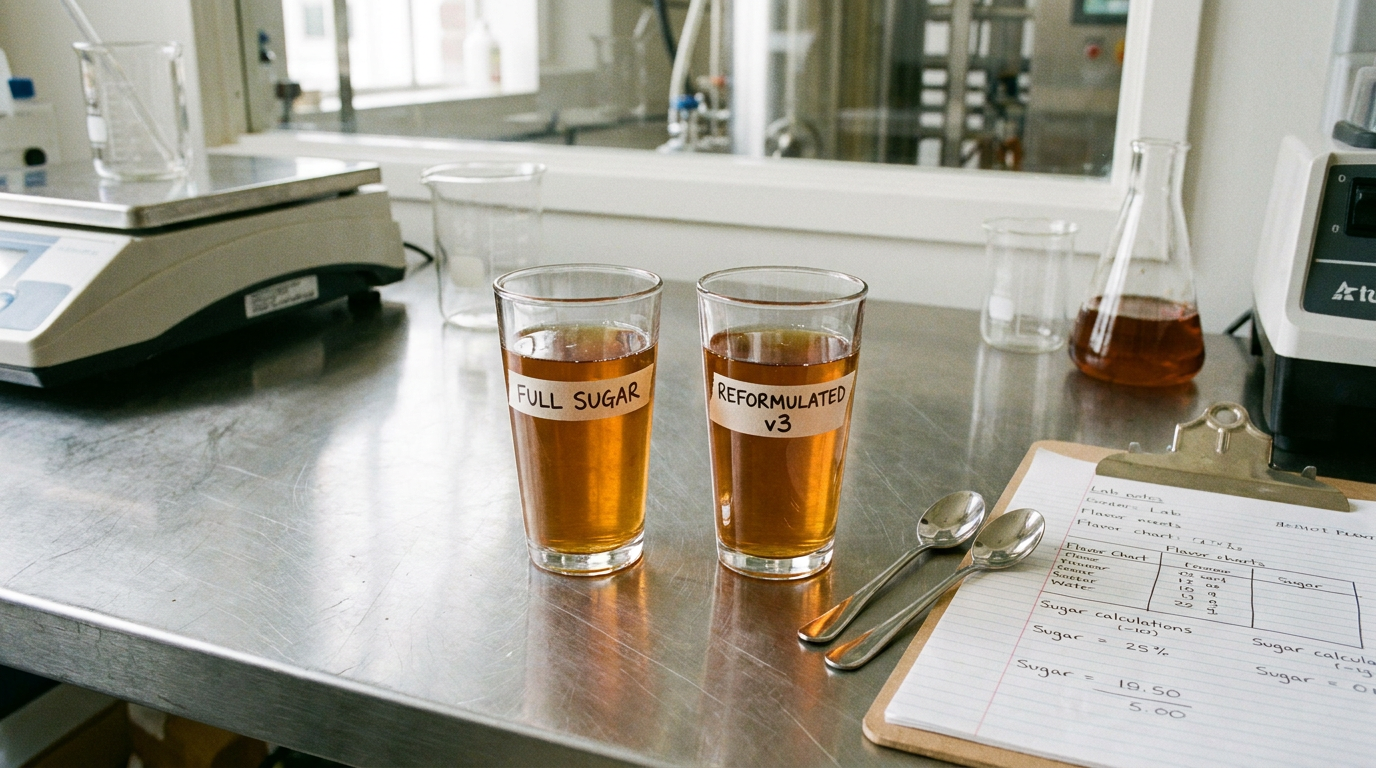
Here is the scene that plays out on development benches every week. A team pulls 40 percent of the sugar from an established product. They drop in a stevia blend, run the numbers, and match the sweetness on paper. The sample comes back from pilot. Everyone tastes it. And something is wrong. The drink is thin. The acid has teeth it never had before. The fruit note that used to sit in the middle of the palate has gone missing entirely, and the sweetness arrives half a beat late and then refuses to leave. The panel cannot articulate what happened. They just know it is not the product anymore.
Cutting sugar is easy. Anyone can pull sugar out of a formula. Keeping the taste is the hard part, and that is the part nobody warns you about.
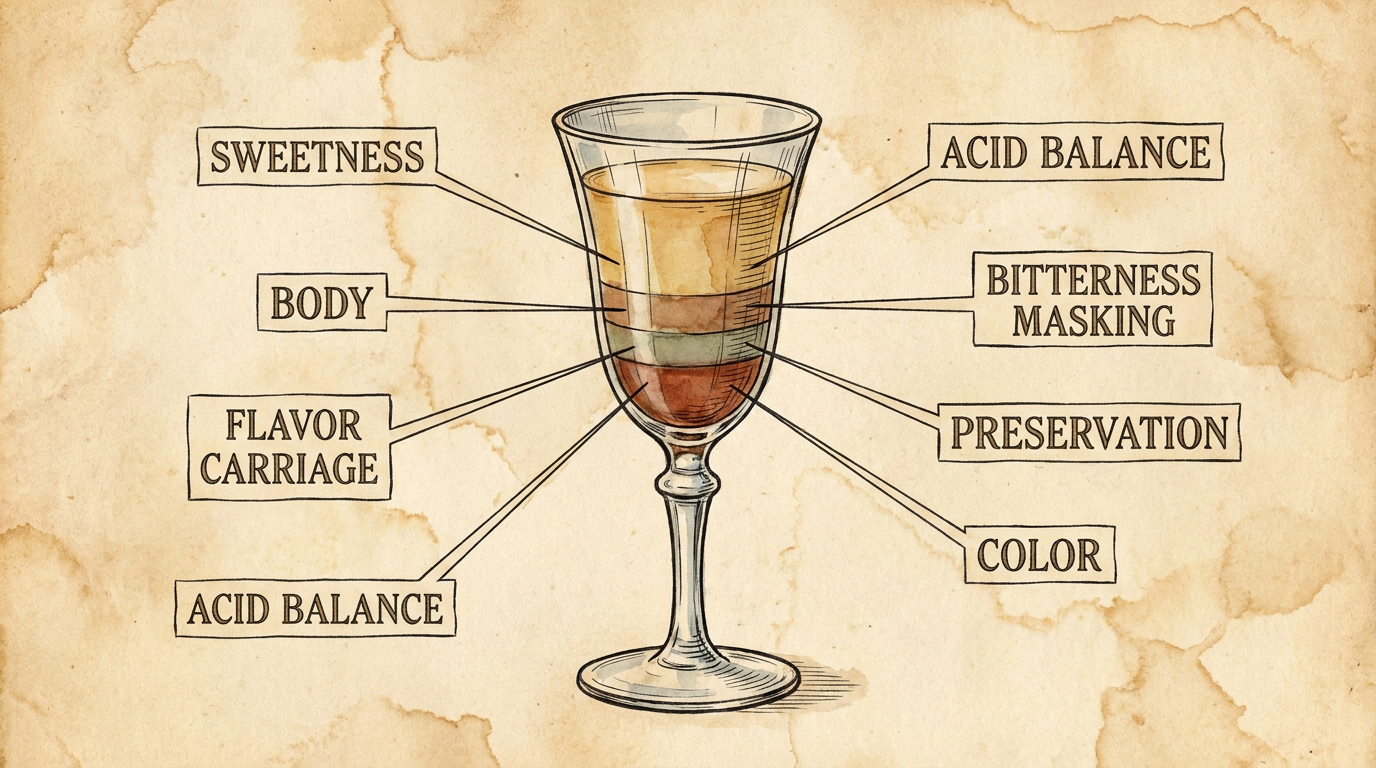
That failure is not a mistake in execution. It is a mistake in framing, and it is the reason most low sugar beverage reformulation projects stall. Sugar is not one ingredient doing one job. It is one ingredient doing seven jobs. Remove it and you have not removed a sweetener, you have removed seven functions at once. Teams that replace only the sweetness are solving one seventh of the problem and then wondering why the other six sevenths taste broken.
This article covers what sugar actually does in a beverage, an honest assessment of every sweetener on the market including the trade-offs supplier literature skips, the timing concept that explains why a drink can measure right and still taste wrong, how to rebuild body and rebalance the flavor system, how to sequence the change commercially without losing your loyal base, what you are legally allowed to put on the label, and how to test the result so it holds up at month six instead of just at fill.
Menu Collective has been solving this problem since 2016, across canned cocktails, dairy-based beverages, coffee, botanicals, and everything between. What follows is how the work actually gets done.
Sugar Does Seven Jobs, Not One
When you take sugar out of a beverage formula, you are not removing a flavoring. You are removing a structural ingredient. At 10 percent of the total weight of the product, sugar is doing physical work in that liquid, and most of that work has nothing to do with tasting sweet.
Break it into its actual functions and the scale of the problem becomes obvious.
Sweetness. The obvious one. It is also the only function most reformulations account for, which is precisely why so many of them fail. Match the sweetness, congratulate the team, ship the sample, watch it come back rejected.
Body, viscosity, and mouthfeel. This is the function that surprises people most. Sugar contributes real dissolved solids to a liquid. A full-sugar carbonated soft drink typically carries somewhere around 10 to 11 percent sugar solids by weight. That is not a trace addition, that is a tenth of the product. Take it out and what fills the space is water. The drink goes thin, the texture flattens, and the finish that used to linger pleasantly on the palate simply disappears. The number you will watch move here is Brix, the standard measure of dissolved solids in a solution, expressed as degrees Brix. When Brix drops from 11 to 4, you have not just made the drink less sweet. You have made it structurally different liquid.
Flavor carriage and aroma release. Sugar changes how volatile aroma compounds behave. It alters how they partition between the liquid and the air above it, which changes what reaches the nose in the headspace of the container and what reaches the olfactory receptors retronasally while someone is drinking. Change the sugar matrix and the identical flavor, dosed at the identical level, reads differently. Fruit notes flatten out. Top notes spike and become harsh. The middle of the flavor, the part that gives a drink its character and its length, drops out. The flavor did not change. The vehicle carrying it did.
Acid balance. Sweetness masks acidity, and this is the single most common surprise in a sugar reduction. Cut the sugar and leave the acid system untouched, and the exact same acid load at the exact same concentration now tastes sharp, sour, and aggressive. Nothing changed in the acid. The counterweight walked out of the room. Teams routinely spend weeks chasing an acidity problem that does not exist as an acidity problem at all.
Bitterness masking. Sugar suppresses bitter notes, and beverages are full of them. Botanicals, functional actives, cocoa, coffee, citrus peel, and hop-derived compounds all contribute bitterness that full-sugar formulations quietly hide. Pull the sugar and that bitterness walks straight to the front of the profile. There is an additional irony here: several of the high-intensity sweeteners brought in to replace sugar contribute bitterness of their own, so the reformulation removes the masking agent and adds new material that needed masking.
Preservation and water activity. Sugar lowers water activity, the measure of unbound water available in a product to support microbial growth. Lower water activity means fewer opportunities for spoilage organisms. Sugar is part of the preservation system, not an innocent bystander to it. This is a food safety and shelf life consideration, not a footnote. When you reduce sugar substantially, the preservation system has to be re-engineered rather than inherited. The same structural logic shows up in other categories: when a producer removes alcohol from a spirit, they discover that the alcohol was carrying preservation, body, and aroma delivery simultaneously, which is why .
preservation is the job nobody sees until it fails
Color and browning. In products where Maillard browning or caramelization contributes to the finished appearance and flavor, sugar is the substrate that makes those reactions possible. Remove it and you remove the pathway. This matters most in dairy-based beverages, coffee products, and anything that receives significant heat treatment during processing. The drink comes out paler and tastes less developed, and no amount of sweetener addresses either issue.
Seven functions. One ingredient. And a reformulation brief that usually reads "reduce sugar by 40 percent" as though it were a single-variable change.
You did not remove a sweetener. You removed a structural ingredient that happened to taste sweet.
Once a team internalizes that, the whole project reorganizes itself. The question stops being "which sweetener do we use" and becomes "which system rebuilds all seven functions." That is a harder question, and it is the correct one.
Naturally, the next question is what tools exist to bring those functions back, starting with the one every team reaches for first.
The Sweetener Toolkit: An Honest Assessment of Every Option
The governing principle of this entire section fits in one sentence: no single sweetener replicates sucrose. Anyone offering a one-for-one drop-in replacement is selling something, and what they are selling will not survive a consumer panel.
Every option in the toolkit is a set of trade-offs. Here is the honest version of each, including the parts that do not appear in supplier literature.
Stevia, or steviol glycosides. Steviol glycosides are the sweet compounds extracted from the stevia leaf, and the distinction between the individual glycosides matters enormously. Reb A (rebaudioside A) is the workhorse: widely available, inexpensive, and thoroughly established. It also carries the characteristic lingering sweetness and the licorice-like off-note that consumers identify instantly and describe as "that diet taste." Reb M (rebaudioside M) has a substantially cleaner profile, much closer to sugar, with far less of that tail. It costs considerably more and has historically been supply-constrained, though bioconversion and fermentation-derived production routes have improved availability meaningfully. One regulatory detail most articles get wrong: steviol glycosides sit under GRAS notices, meaning Generally Recognized As Safe determinations submitted to FDA, rather than food additive approvals. The sets out which sweeteners sit in which category, and the distinction matters when a regulatory team reviews your claim substantiation.
FDA's overview of high-intensity sweeteners
Monk fruit, or Siraitia grosvenorii extract. A clean profile and strong consumer label appeal, which is most of why brands ask for it by name. The constraints are cost and supply rather than function. It is rarely used alone in a commercial beverage, and like steviol glycosides it is permitted through GRAS notices rather than additive approval.
Allulose. This one deserves the most attention, because it behaves differently from everything else on the list. Allulose is a rare sugar, meaning it occurs naturally but in very small quantities, in figs, raisins, and wheat. It is structurally a sugar, and it behaves like one. It contributes real dissolved solids, real body, and real browning, at roughly 0.4 kcal per gram and around 70 percent of the sweetness of sucrose. That combination makes it the strongest single tool available for mouthfeel restoration, because it is not mimicking body, it is providing it. Its label position is what makes it commercially decisive, and that gets its own treatment further down in the labeling section. The honest constraint: digestive tolerance limits how much you can include before consumers notice, so allulose functions as part of a system rather than as a total replacement for sucrose.
Erythritol and the other polyols. Polyols are sugar alcohols, a class of carbohydrates that deliver sweetness with reduced caloric contribution. Erythritol brings a distinct cooling sensation on the palate, an endothermic effect as it dissolves. That cooling is an asset in a mint or citrus product and a genuine liability in a vanilla, dairy, or dessert-flavored one, where it reads as odd and out of place. Every polyol carries a digestive tolerance threshold that caps inclusion, and those thresholds are lower than most formulators expect.
Sucralose, acesulfame potassium, and aspartame. Functional, inexpensive, thoroughly characterized, and approved by FDA as food additives. Each carries a known profile issue. Sucralose has a lingering sweetness that builds across repeat sips. Acesulfame potassium, usually written Ace-K, brings a bitter metallic note at higher levels, which is why it is almost always blended rather than used alone. Aspartame is heat and pH sensitive, with real shelf life implications in a low-pH beverage held at ambient temperature for months. For many brands the larger constraint now is consumer label resistance rather than technical function, and the two questions are worth separating carefully. documents what is permitted and safe, which is a different question from what a shopper will accept on an ingredient statement. A brand manager has to navigate both, and conflating them leads to bad decisions in both directions.
FDA's summary of aspartame and other sweeteners in food
Soluble fibers and fiber syrups. These contribute body and some sweetness at the same time, which makes them structurally useful rather than merely sweet. They get full treatment in the mouthfeel section, because that is the job they are really doing.
Blending is the actual answer. Different sweeteners have different onset and decay curves, meaning they arrive on the palate at different speeds and leave at different speeds. Combining them flattens the overall temporal profile toward something much closer to sugar. Blending does something else equally valuable: it lets you keep each individual sweetener below the concentration at which its characteristic off-note becomes perceptible. Two sweeteners at moderate levels frequently outperform one sweetener at a high level, even when total sweetness intensity is identical.
Common pairings that work, and why:
- Ace-K with sucralose. Ace-K arrives fast and fades, sucralose arrives slower and lingers. Together they cover the full time course, and each sits below its own off-note threshold.
- Reb M with allulose. Reb M supplies high-intensity sweetness at low inclusion, allulose supplies the solids, the body, and the browning that Reb M cannot. This is the pairing that most closely reconstructs what sucrose was doing.
- Stevia with a soluble fiber. The fiber restores dissolved solids and softens the stevia tail by giving the mid-palate something to hold onto.
- Monk fruit with erythritol. A clean-label pairing where the erythritol contributes bulk and the monk fruit contributes intensity, best suited to formats where the cooling effect complements the flavor direction.
Even with the right blend selected, teams still produce drinks that measure correctly and taste wrong. The reason is almost always timing.
Choosing a blend is not a procurement decision made from a spec sheet. It is a formulation decision made against a specific product, a specific flavor system, a specific pH, and a specific shelf life. The right blend for a citrus sparkling water is the wrong blend for an oat-based coffee beverage.
The Sweetness Curve: Why Your Drink Measures Right and Still Tastes Wrong
Sweetness is not a single value. It is an event that unfolds over time, and that distinction is the most useful thing a reformulation team can understand.
Two samples can be matched precisely for peak sweetness intensity and taste nothing alike. Peak intensity is one point on a curve. What separates a reformulation that works from one that does not is the shape of the entire curve.
Sucrose has a fast onset and a clean finish. It arrives almost immediately, rises to its peak, and then leaves cleanly. That clean exit is a large part of what people mean when they call a drink refreshing. Refreshment is not a flavor. It is substantially a timing characteristic, and sucrose delivers it because the sweetness gets out of the way and lets the palate reset before the next sip.
High-intensity sweeteners typically have delayed onset and a lingering finish. The sweetness arrives late, then stays. And stays. The drink reads as cloying, or syrupy, or simply "artificial," even when a trained panel confirms that peak intensity matches the original exactly. The consumer has no vocabulary for describing a temporal mismatch, so they reach for the word artificial, and the brand team concludes the sweetener choice was wrong when the real issue was the shape of the delivery.
This is the practical consequence: a reformulation passes a numerical sweetness match and fails a consumer panel. Both results are correct. The team measured the peak and ignored the curve.
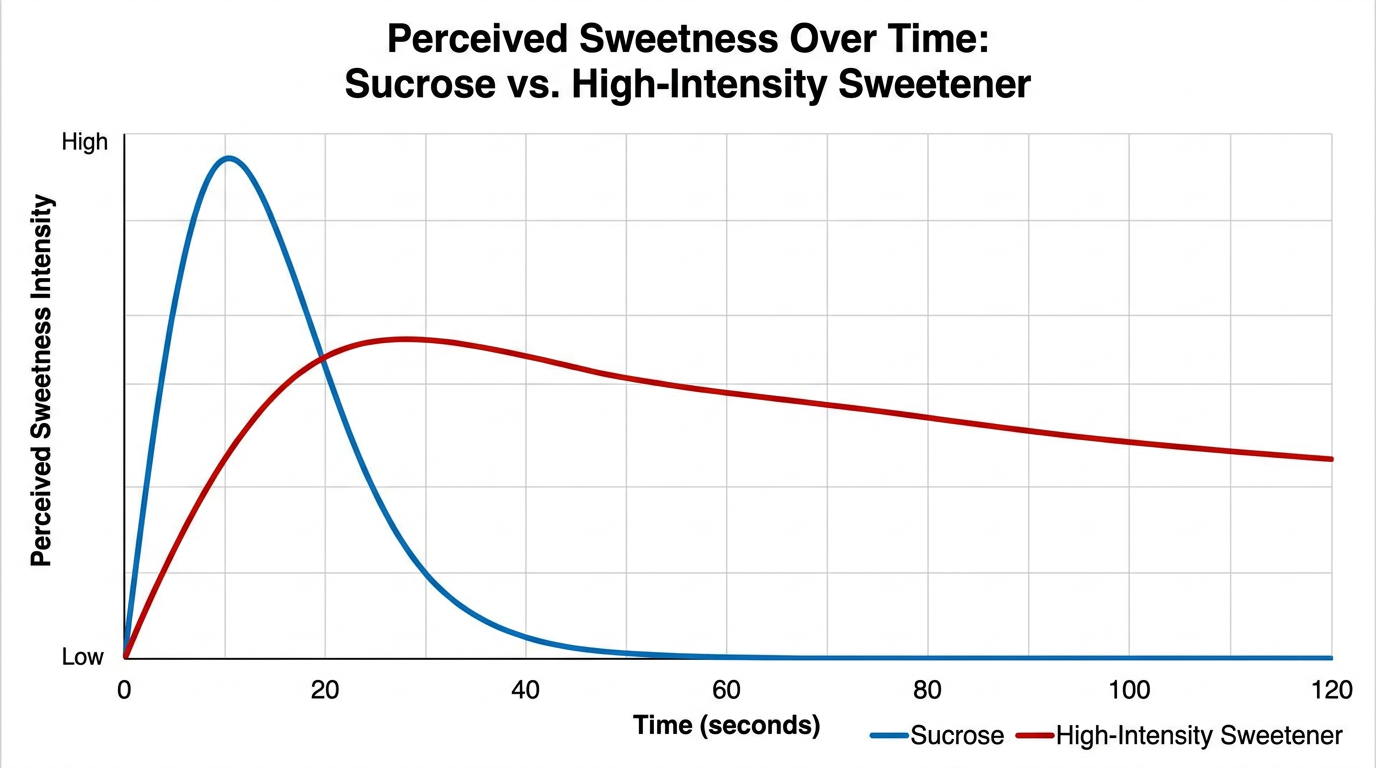
Matching the shape of the curve matters as much as matching its height.
Timing explains why the sweetness reads wrong. The thinness, the sharpness, and the missing middle come from somewhere else, and fixing those is where reformulations are genuinely won or lost.
The same temporal thinking applies to the bitterness that section one identified. Bitter notes frequently arrive late and persist long, which means a low-sugar beverage with botanical or functional actives has two late-arriving, long-staying sensations stacking on top of each other in the finish. The sweetener tail and the bitter tail compound. Solve them as a single timing problem rather than two ingredient problems and the fix comes faster.
Measuring this requires the right method. Time-intensity evaluation is a specific sensory technique in which trained panelists record perceived intensity continuously across the duration of a tasting rather than reporting a single score at the end. A standard difference test, where panelists simply identify whether two samples differ, will not surface a curve mismatch in any useful way. It will tell you the samples are different. It will not tell you that the difference is a two-second delay in onset and a nine-second tail. If you are not measuring across time, you are not measuring the thing that is actually wrong.
Blending addresses this directly, and understanding why turns blending from guesswork into a deliberate technique. Pair a fast-onset sweetener with one that carries the mid-palate. Keep the lingering contributor low enough that its tail stays under the threshold of perception. You are not just adding sweetness from two sources, you are assembling a time course out of components with complementary timing. That is why blends outperform single sweeteners even when total sweetness is identical. The total is the same. The shape is not.
Rebuilding Body, Mouthfeel, and the Flavor System
This is the section of the project where reformulations succeed or fail, and it is consistently under-resourced because it is less obvious than sweetener selection. A drink with slightly imperfect sweetness and correct body will pass. A drink with perfect sweetness and no body will fail, every time, and the panel will struggle to explain why.
Sweetness gets all the attention. Body decides the outcome.
Rebuilding mouthfeel
Soluble fibers. Inulin and soluble corn fiber restore dissolved solids and body while carrying a nutritional benefit onto the label. They are among the most efficient tools available because they solve a structural problem and contribute a marketing asset simultaneously. The honest constraints: gastrointestinal tolerance limits inclusion at higher levels, and fiber inclusion carries declaration implications on the Nutrition Facts panel that need to be worked out with your regulatory reviewer before the formulation locks, not after.
Pectin and hydrocolloid gums. Hydrocolloids are long-chain molecules that bind water and build viscosity. Gellan and xanthan are the standard choices, used at low inclusion, typically fractions of a percent. The risk here is specific and worth stating plainly: too much and you cross the line from body into slimy, and consumers detect that boundary faster and more harshly than any other texture fault in beverages. There is very little forgiveness on the far side of that line. Gellan is also the standard tool for suspension in products carrying particulates or insoluble actives, where it holds material evenly through shelf life instead of letting it settle into a layer at the bottom of the can.
Allulose. It returns here, because this is its most important role. Allulose contributes actual dissolved solids rather than mimicking their effect. It is the closest thing to a structural like-for-like replacement available to a formulator, and in products where thin body is the primary complaint it does more work than any hydrocolloid.
Glycerin. Contributes viscosity along with a perception of sweetness and a warmth on the palate. Dose and labeling considerations constrain its use, but in the right format it fills the mid-palate gap efficiently.
Protein and juice solids. Where the product format allows, these rebuild body while contributing to both the flavor and the label story. A dairy or plant-protein beverage has options here that a clear sparkling beverage simply does not.
One practical discipline governs all of it: track Brix and viscosity against the original benchmark, not against zero. You are aiming at a target, and the target is the original product. This is the same principle behind . A reformulation without a fixed reference is not a reformulation, it is a new product development project wearing a reformulation brief.
how we define the Gold Standard product and build production-ready formulations

Rebuilding the flavor system
Flavor dosing has to be re-evaluated, not carried over. This is the most commonly skipped step in the entire process. When the sugar matrix changes, aroma release changes, which means the same flavor at the same dose lands differently in the new base. Carrying the existing flavor dose forward on the assumption that flavor is flavor produces a product where the top notes are too loud and the middle is hollow. Re-dose from scratch against the benchmark. Treat the flavor as an open variable, because it is one.
Sweetness enhancers and modulators. These amplify perceived sweetness without adding sweetener load. Their practical value is that they let you reduce total sweetener concentration and stay under the thresholds where off-notes become perceptible. They buy you headroom, and headroom is exactly what a constrained sweetener system needs.
Bitterness blockers. These address the bitterness that sugar was previously masking, plus whatever the new sweetener system contributes on its own account. Deploy them against a specific identified bitterness, not as a general-purpose corrective.
Rebalancing the acid system. This is the fix most teams skip entirely, and it is frequently the one that unlocks the whole project. With the sweetness counterweight reduced, the acid load almost always needs to come down, and often the acid itself needs to change. The acids available are not interchangeable:
- Citric is bright, fast, and sharp, with a quick decay. It hits immediately and clears.
- Malic is rounder, with a slower build and longer persistence. It pairs particularly well with stevia because its timing partially fills the onset gap that stevia leaves at the front of the palate.
- Phosphoric is flat and sharp, and it is characteristic of colas. It reads as clean rather than fruity.
- Tartaric is firm and crisp, associated with grape and wine profiles.
Each has a different profile and a different time course, which means acid selection is another temporal decision, not just a pH target. A formulator who selects acid by pH alone is treating a four-dimensional decision as a one-dimensional one.
Salt at trace levels. Small additions round the profile, suppress bitterness, and add perceived body. This is frequently the smallest change with the largest effect on a thin-tasting reformulation, and it costs essentially nothing. It belongs in the toolkit long before more expensive interventions.
Everything in this section interacts. Change the acid and the flavor dose shifts. Add fiber and the sweetness perception shifts. Adjust the sweetener blend and the bitterness balance moves again. This is iterative bench work against a fixed reference, not a checklist executed once in sequence. Format constrains the options too, since packaging, process, and fill conditions determine what is available to you, which is why Getting the formula right on the bench is one problem. Getting it past a loyal consumer base without losing them is an entirely different one.
RTD formats and the formulation calls that decide which launches survive
are worth settling early rather than discovering late.
Staged Reduction or Line Extension: The Commercial Decision
For an established product with a loyal base, the real risk is not that the new formula tastes bad. It is that it tastes different, and different is exactly what loyal consumers punish. The history of the food and beverage industry is littered with beloved products that were reformulated competently and then met with genuine public anger. The formulation was not the failure. The rollout was.
There are two credible paths, and they suit different situations.
Option one: gradual reduction across successive production runs. Reduce sugar in increments small enough to fall below the just-noticeable-difference threshold, the point at which a change becomes perceptible to a typical consumer. Then repeat across multiple production cycles until you reach the target. The advantages are real. The consumer base never experiences a step change, and each increment gets validated before the next one is committed. The trade-offs are equally real. It is slow. It requires sustained organizational commitment across multiple production cycles and frequently across multiple brand managers, which is an organizational endurance problem more than a technical one. And it delivers no marketing moment at any point along the way. You cannot announce it, because announcing it defeats the entire mechanism.
Option two: a separate low-sugar line extension. Leave the original product untouched and launch the reduced-sugar version alongside it. The loyal base is protected completely. The new product gets its own marketing moment, its own positioning, and its own claims. Consumer response is directly measurable rather than inferred. The trade-offs: added SKU complexity, shelf space competition against your own product, split production runs with the cost and scheduling consequences that follow, and the genuine risk that the extension cannibalizes the original rather than growing the franchise.
How to choose. Frame the decision around concrete questions rather than preference:
- How loyal and how vocal is the existing base? A base that posts about formula changes is a different risk profile than one that does not notice.
- How large is the required reduction? A 15 percent reduction and a 50 percent reduction are not the same project and should not use the same strategy. Small reductions suit staging. Large ones usually do not.
- Is there a retailer mandate, a regulatory requirement, or a claim-driven deadline forcing the timeline? A deadline removes staging from the menu if the runway is too short.
- Is the reformulation driven by consumer demand or by an internal label goal? Demand-driven changes support a launch. Label-driven changes often suit quiet staging.
Experienced teams frequently take a hybrid path: launch the extension first, learn from real consumer response and real sales data, then apply what they learned to a staged reduction of the core product with far less guesswork. The extension becomes a live experiment that de-risks the bigger move. That approach costs more up front and saves considerably more later.
The formula has to work on the bench. The rollout has to work in the market. Those are two different projects, and the second one is where most sugar reductions actually fail.
Concrete proof matters more than strategy decks here. Our Whichever rollout path a team chooses, the label sets a hard boundary on what can be claimed, and one federal deadline is now close enough to shape the entire project timeline.
case study on formulating an award-winning RTD cold brew coffee shandy
shows what it looks like to hit a specific commercial standard with a product built to survive contact with a real market.
What You Can Legally Claim: Added Sugars, Nutrient Content Claims, and the April 2028 Deadline
Start with the correction that surprises almost everyone in the room: "low sugar" is not a defined nutrient content claim under FDA rules. The phrase everyone uses in marketing meetings has no legal definition on-pack. There is no "low" category for sugars the way there is for fat or sodium. If it goes on the label, it has to be one of the claims that is actually defined in the regulation.
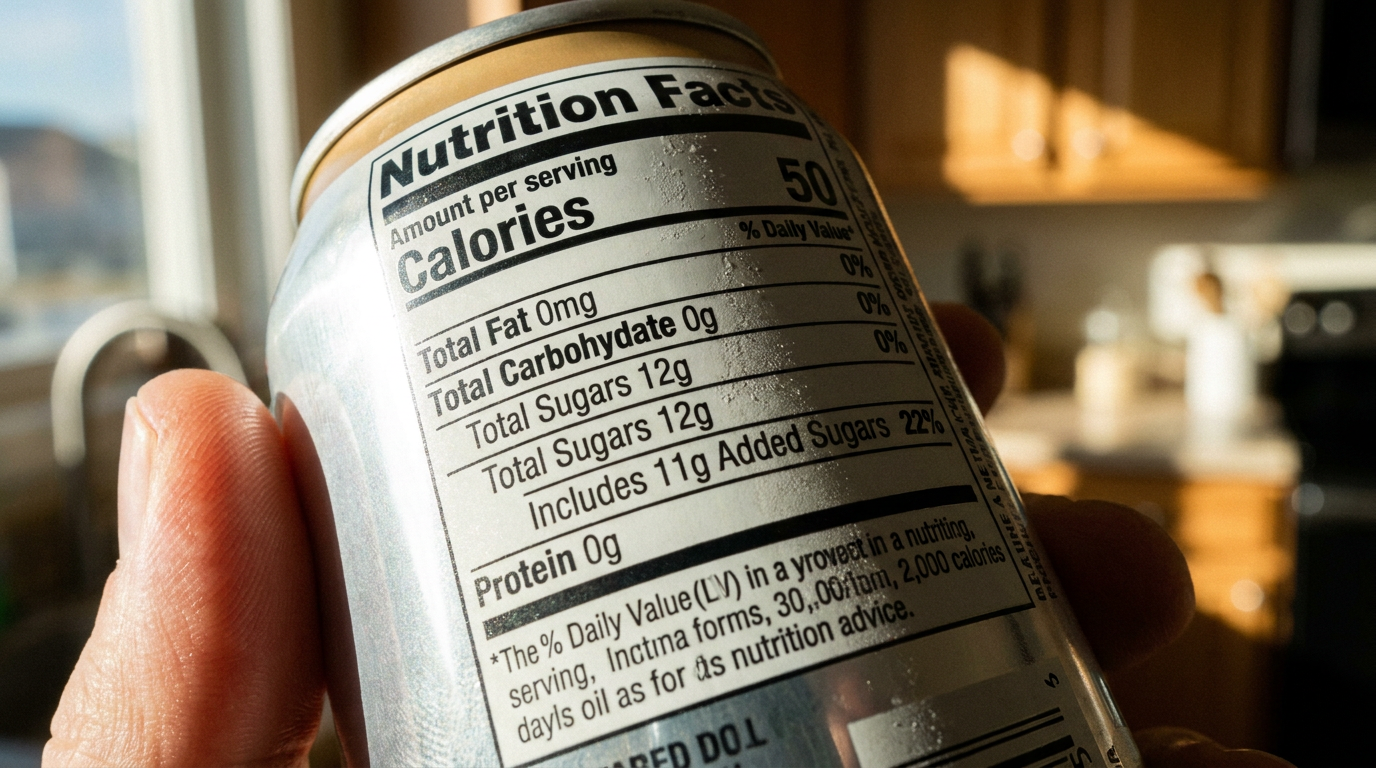
Three sugar content claims are defined under , and each carries a specific formulation implication:
21 CFR 101.60
- Sugar free, no sugar, zero sugar. Requires less than 0.5 g of sugars per RACC and per labeled serving. RACC stands for Reference Amount Customarily Consumed, the standardized serving benchmark FDA uses so that claims across competing products are comparable. The product must contain no sugar-containing ingredients unless properly disclosed with a statement beneath the ingredient list. Where the product is not also low or reduced calorie, the claim requires an accompanying statement such as "not a reduced calorie food." Formulation implication: this is a near-total sugar removal, and every one of the seven functions has to be rebuilt from other sources.
- Reduced sugar, less sugar, lower sugar. A relative claim requiring at least 25 percent less total sugars per RACC than an appropriate reference food, with the reference food identified and the percent difference stated in proximity to the claim. Formulation implication: this is the claim most reformulations are actually targeting, and the 25 percent threshold should drive the formulation target from day one. Teams that set an arbitrary internal target and then discover at the end that they landed at 22 percent have to reopen the whole project.
- No added sugar, no sugar added. Requires that no sugars or ingredients functionally substituting for added sugars are added during processing, that no ingredient contains added sugars, and that the product resembles a food that normally contains added sugars. Formulation implication: the constraint is on ingredient selection rather than on the final number, which makes it a sourcing discipline as much as a formulation one.
The added sugars declaration. Under , added sugars appear indented beneath Total Sugars as "Includes Xg Added Sugars." Declaration is not required when a product contains less than 1 g of added sugars per serving and makes no claims about sweeteners, sugars, added sugars, or sugar alcohols, in which case the label carries "Not a significant source of added sugars." Note the trap carefully: making a sweetener claim removes that exemption. A brand that adds a front-of-pack sweetener callout has just obligated itself to a declaration it previously did not need.
21 CFR 101.9
The allulose advantage. This is the single most useful piece of label math in this article. Under , allulose is excluded from both the Total Sugars and Added Sugars declarations, with calories calculated at 0.4 kcal per gram rather than the 4 kcal per gram applied to conventional sugars. Allulose still appears in Total Carbohydrate and still appears in the ingredient statement. Put that alongside what section four established about its structural behavior and the commercial logic becomes obvious: allulose rebuilds body like a sugar and does not count against the added sugars line. That combination is rare, and it explains why allulose keeps appearing in low-sugar launches across every category.
FDA guidance issued in October 2020
The updated "healthy" claim rule and the deadline that matters. FDA finalized its updated definition of the "healthy" nutrient content claim in December 2024. The rule took effect April 28, 2025, and the mandatory compliance date is April 28, 2028. documents the rule and its timing.
FDA's announcement of the final rule
The rule sets added sugars limits alongside saturated fat and sodium limits, scaled by product category, and requires that a product contain a qualifying amount from a recommended food group. sets out the limits in full. For beverage developers the number that matters most is the individual food limit: no more than 2.5 g of added sugars per RACC. Mixed products sit at 5 g, and meal products at 10 g. For most beverages, 2.5 g is the target, and that is a demanding number for any product that currently sits at conventional sweetness levels.
FDA's guidance on use of the "healthy" claim
Make the timeline argument explicitly, because most teams have not done the arithmetic. If "healthy" is part of the brand's positioning or anywhere on the roadmap, reformulation stops being a taste project and becomes a dated project. Everything has to land before April 28, 2028: the reformulation itself, stability validation, sensory confirmation at end of shelf life, packaging artwork, regulatory review, and production changeover. Work backward from that date through a real development calendar and the runway is considerably shorter than it looks from here. A twelve-month shelf life alone consumes a year of the remaining window if you intend to validate the product at the end of its stated life, which you should.
This section is a summary for planning purposes. Regulatory positions should be confirmed against current FDA guidance and qualified regulatory review before any claim goes to print.Knowing what the label can say means nothing until the product has been tested properly, and tested at the point where most reformulations quietly fall apart.
Testing It Properly: Panels, Benchmarks, and End of Shelf Life
Descriptive sensory panels and consumer preference testing answer different questions, and they are not interchangeable. A trained descriptive panel tells you what is different and by how much, scored on specific attributes: sweetness onset, body, sourness, bitterness, lingering sweetness, aroma intensity. Consumer preference testing tells you whether people like it, and essentially nothing about why.
Teams that run only consumer testing get a verdict with no diagnosis. They know the sample failed. They do not know which lever to pull. Teams that run only descriptive panels get a diagnosis with no verdict. They know the body is 15 percent below the reference. They do not know whether anyone cares. Reformulation needs both, in that order: descriptive testing to steer the bench work, consumer testing to confirm the outcome.
Benchmark against the original as the Gold Standard reference. The original full-sugar product is the target, and it belongs in every panel session as a blind reference rather than as a remembered ideal. Memory drifts across a six-month project. A team that tasted the original in March and is working from recollection in September is calibrating against a fiction. The benchmark stops being a benchmark the moment it stops being tasted. This discipline is central to .
how we build formulations that balance taste, stability, shelf life, and scalability
Test at end of shelf life, not just at fill. This is the most important point in this section and the one most often compressed out of a timeline under pressure. Sweetener and flavor profiles drift over time. Certain high-intensity sweeteners lose intensity under low pH and elevated temperature, which describes the actual storage conditions of a great many beverages in real distribution. Flavor top notes fade. Color shifts. Acid perception changes as the system equilibrates. A reformulation that tastes correct at fill tastes wrong at month six, and month six is when a large share of consumers will actually drink it. Validate at the end of the stated shelf life, using accelerated conditions to move fast and real-time confirmation to be certain. The argument for proving aroma stability across time applies with equal force in other categories where a structural ingredient has been removed, which is why belongs in the plan from the beginning.
shelf-life testing to prove the aroma holds
Test in the finished package. Sweetener and flavor interactions with can liners, PET, and closures are real and measurable. A bench sample in a glass beaker is a useful development tool and it is not the product. Scalping of flavor compounds into packaging materials changes the profile in ways that only show up in the actual container over actual time.
Do not skip the mid-project consumer check.Every discipline described so far belongs to a single process, and that process is how a reformulation runs from the first conversation.
One practical closing note: build the testing protocol at the start of the project, not at the end. The protocol determines the timeline, and the timeline determines whether April 28, 2028 is a comfortable date or an uncomfortable one.
On a staged reduction, each increment requires validation before the next one is committed. Skip that and the team discovers at increment four that increment two was the one that broke it, with two production runs already in market and no clean way back.
How Menu Collective Approaches a Reformulation: Design, Develop, Deliver
We are collaborators, not consultants. We build alongside your team rather than delivering a report and leaving. On a reformulation that distinction carries more weight than usual, because nobody understands the original product and the consumer who loves it better than the brand team does. That knowledge is the starting input for the work, not something we replace. Our full position on explains what that means in practice.
why we are collaborators rather than consultants
Design. Define the Gold Standard product, which on a reformulation is the existing product itself. Establish precisely what must be preserved and what is allowed to change, because those two lists are the boundaries of the entire project. Set the sugar reduction target against the claim the brand intends to make, so the formulation target and the label target are the same number from day one rather than two numbers that meet awkwardly at the end. Assemble the right beverage experts for the specific project, whether that calls for sweetener systems, dairy, botanicals, or carbonated formats.
Develop. Iterative bench work across the sweetener blend, the mouthfeel system, the flavor dose, and the acid balance, validated against the blind benchmark at every round. Scalable formulation, regulatory compliance, and manufacturing quality built into the work rather than bolted on afterward. Stability and end-of-shelf-life validation planned from the first week, because the testing calendar sets the project calendar.
Deliver. Production changeover support, claim substantiation, and the sales, marketing, and distribution strategy that brings the reformulated product to market. On a staged reduction that includes sequencing the increments across production runs. On a line extension it includes positioning the new product so it grows the franchise instead of eating it.
Menu Collective was founded in 2016 by Stuart McCarroll, and the team carries 45+ years of combined experience across the global food and beverage industry. We work from Chicago with global names and bold independent start-ups alike, across any base and any format, from canned cocktails to dairy-based beverages. The work runs from concept to commercialization, and the standard we hold is a product that transcends the industry norm rather than one that merely clears it. Being creative and commercially astute at the same time is the whole discipline: a formula that tastes extraordinary and cannot be manufactured at scale is not a success, and neither is one that scales beautifully and nobody wants to drink twice. Our show what that produces.
beverage development case studies

Low Sugar Does Not Mean Low Flavor
The premise this article opened with resolves cleanly. Low sugar does not mean low flavor. It means more formulation work, done in the right order, against the right benchmark. The teams that accept that produce reduced-sugar products their customers cannot distinguish from the original. The teams that treat it as a swap produce the thin, sharp, slightly wrong sample that started this piece.
April 28, 2028 is closer than a full reformulation and validation cycle makes it look. Teams that start the arithmetic from that date backward tend to move sooner than teams that start from today forward.
The arc holds together as a sequence. Understand what the sugar was actually doing before you remove it. Build a blend rather than making a swap, because no single sweetener replicates sucrose and the ones that claim to are being sold rather than formulated. Match the shape of the sweetness curve, not just its peak. Rebuild the body with real solids and rebalance the acid system that lost its counterweight. Choose the rollout strategy deliberately, because the market risk and the bench risk are different problems. Design to the exact claim you intend to make, from day one. Validate at the end of shelf life, in the finished package, against a benchmark you are still tasting.
Cutting sugar is easy. Keeping the taste is the hard part, and by now the reason is clear. Sugar was doing seven jobs, and a reformulation that succeeds replaces all seven.
Let's Talk
If there is a sugar reduction on the roadmap, or a "healthy" claim the brand wants to be eligible for, the right moment to define the Gold Standard and set the reduction target is before the bench work starts, not after. We build alongside your team, from concept to commercialization, and the first conversation costs nothing.
Reach us at or through our . You will find us at 1210 W Lake St, Chicago, IL 60607, or on (630) 642-0721.
contact pageMenu Collective